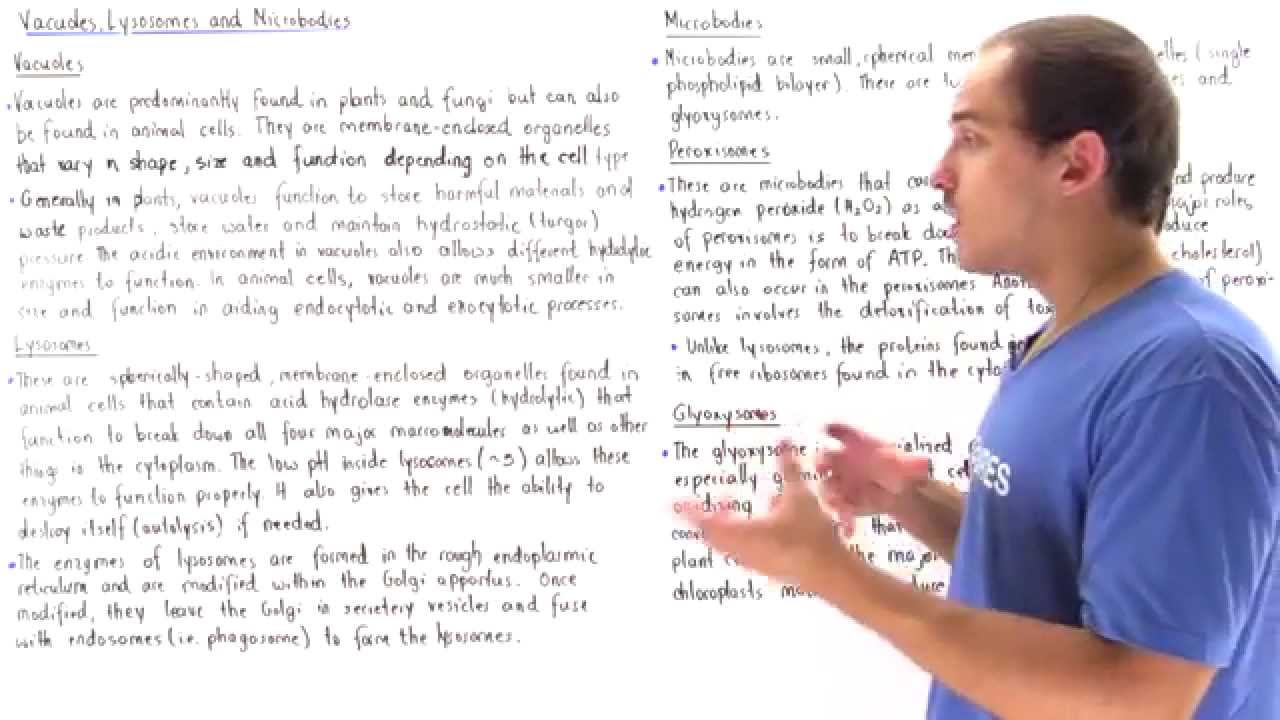
Vacuoles, Lysosomes and Microbodies
Keywords
Summary
178 words
Critical Evaluation
Value of the Information & Strength of the Argument
The video provides a solid introduction to these organelles, explaining their functions clearly and using straightforward language. The argumentation is logical, moving from vacuoles to lysosomes to microbodies, and contrasts their roles and locations. However, the presentation is largely descriptive and lacks critical analysis or discussion of experimental evidence. The value lies in its educational clarity for beginners, but it does not delve into molecular mechanisms or recent research findings.
Scientific Rigor, Source Quality, Title Accuracy
The scientific rigor is moderate: the content aligns with established cell biology knowledge, but no specific sources are cited within the video. The description provides links to the creator’s website and donation page, but these do not contain references to primary literature. The title accurately reflects the content, and the video stays on topic throughout. No comments were provided for analysis.
146 words
Title / Content Match
The title accurately reflects the content, which covers vacuoles, lysosomes, and microbodies in detail.
Quality & Reliability
7/10
The content is a clear and accurate overview of vacuoles, lysosomes, and microbodies, consistent with standard cell biology knowledge. However, it lacks citations to primary literature and contains minor simplifications.
Key Moments
Markers derived by PSI from the transcript: the creator did not define chapters.
- Introduction to vacuoles, lysosomes, and microbodies.
- Definition and general characteristics of vacuoles.
- Functions of vacuoles in plant cells: water storage, turgor pressure, and acidic environment.
- Vacuoles in animal cells and their role in endocytosis and exocytosis.
- Introduction to lysosomes: structure and acidic environment.
- Function of lysosomes in breaking down macromolecules and cellular waste.
- Lysosome formation and role in autolysis and phagocytosis.
- Introduction to microbodies and peroxisomes.
- Functions of peroxisomes: fatty acid breakdown, lipid synthesis, detoxification.
- Difference between lysosomes and peroxisomes in protein synthesis.
- Glyoxysomes in plant cells and their role in sugar production.
Cited Sources
- AK Lectures - Vacuoles, Lysosomes and Microbodies — The video's dedicated lecture page on the creator's website.
- AK Lectures — General website of the creator, containing additional educational content.
Concurring Sources
- Molecular Biology of the Cell (Alberts et al.) — Standard cell biology textbook that corroborates the functions of these organelles.
External References
Contribution & Novelties
The video offers a clear and concise overview of these organelles, making it a useful educational resource for students. It highlights the differences between lysosomes and peroxisomes, and explains the role of glyoxysomes in plant germination. However, it does not present novel research or unique insights.
Pour aller plus loin :
- Lysosome - Wikipedia — Detailed article on lysosome structure and function.
- Peroxisome - Wikipedia — Comprehensive overview of peroxisomes and their metabolic roles.
- Vacuole - Wikipedia — Information on vacuole functions in plant and animal cells.
87 words
Radar Profile
The radar profile shows balanced scores across information quantity, quality, technical level, and reliability, indicating a well-rounded educational video. The technical level is moderate, making it accessible to a broad audience while still providing accurate information.