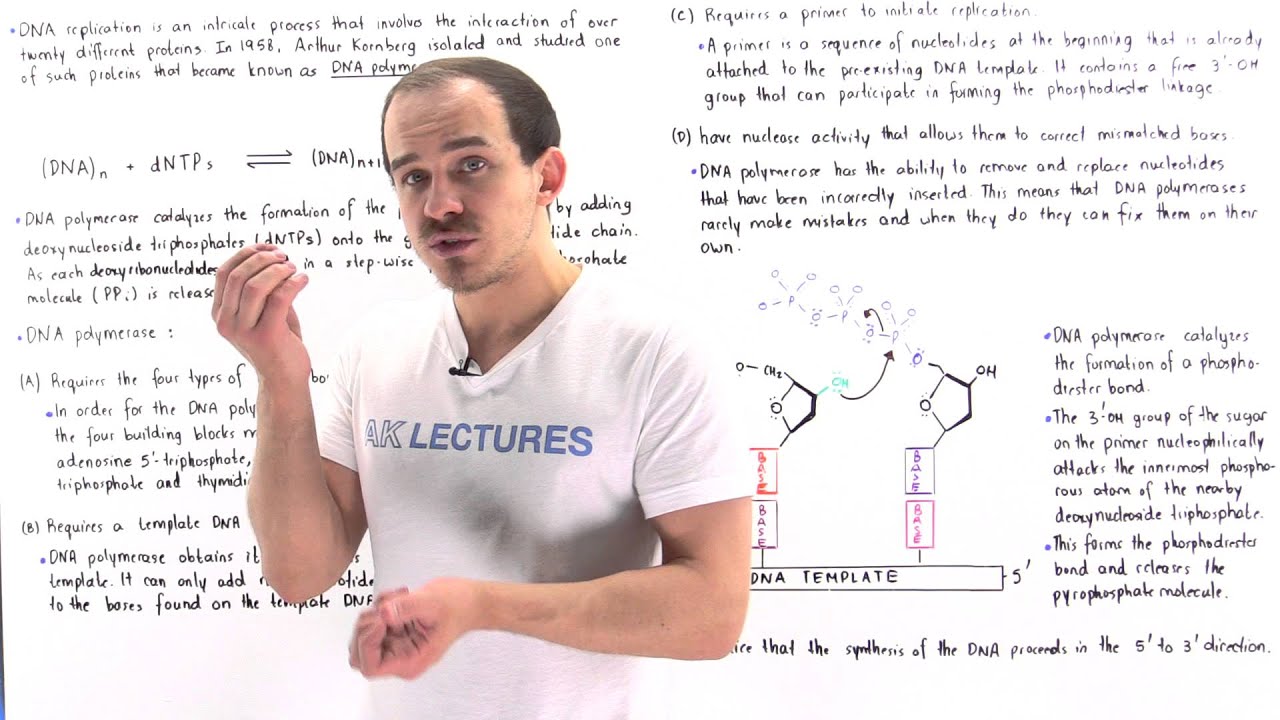
DNA Polymerase
Keywords
Summary
184 words
Critical Evaluation
Value of the Information & Strength of the Argument
The video provides a solid introduction to DNA polymerase, clearly explaining its function and the key components required for DNA synthesis. The argumentation is logical and builds from the general reaction to specific requirements and mechanism. The use of analogies (building construction) helps make the concepts accessible. However, the video lacks depth in discussing the various types of DNA polymerases and their specific roles, and it does not address the complexity of the replication fork or the involvement of other proteins. The explanation of the proofreading mechanism is brief and does not detail the exonuclease activity. Overall, the information is accurate and well-presented for an introductory audience, but it does not offer novel insights or advanced details.
Scientific Rigor, Source Quality, Title Accuracy
The video demonstrates scientific rigor by accurately describing the fundamental aspects of DNA polymerase function, consistent with established molecular biology textbooks. However, it does not cite specific scientific sources or references, which limits its scholarly value. The title ‘DNA Polymerase’ is appropriate and matches the content. The video is part of a lecture series by Andrey K, who appears to be an educator, but no credentials are provided. The description includes links to the lecturer’s website and the specific lecture page, which may contain additional resources. The content is reliable for basic understanding but not for advanced or nuanced topics.
232 words
Title / Content Match
The title 'DNA Polymerase' accurately reflects the content, which focuses on the enzyme's role and mechanism in DNA replication.
Quality & Reliability
7/10
The video provides a clear and accurate explanation of DNA polymerase function, covering the basic requirements (dNTPs, template, primer, Mg2+) and the mechanism of phosphodiester bond formation. The content is consistent with established molecular biology knowledge, though it lacks depth and does not cite specific sources. The presentation is didactic and uses analogies to aid understanding.
Key Moments
Markers derived by PSI from the transcript: the creator did not define chapters.
- Introduction to DNA polymerase and its discovery by Arthur Kornberg.
- General equation for DNA polymerase reaction: adding dNTP to growing chain, forming phosphodiester bond, releasing pyrophosphate.
- Requirement A: Four dNTP building blocks (dATP, dGTP, dCTP, dTTP).
- Requirement B: Template DNA strand as blueprint for complementary base pairing.
- Requirement C: Primer with free 3' hydroxyl group to initiate synthesis.
- Additional requirement: Magnesium ions for efficiency.
- Fact D: DNA polymerase proofreading ability and high accuracy.
- Diagram of phosphodiester bond formation: nucleophilic attack by 3' hydroxyl on alpha phosphate.
- Release of pyrophosphate and direction of synthesis (5' to 3').
- Conclusion: pyrophosphate hydrolysis drives replication forward.
Cited Sources
- AK Lectures - DNA Polymerase and Catalysis of Phosphodiester Bond — Video lecture page with additional resources and diagrams.
- AK Lectures Website — General website of the lecturer, containing other biology lectures.
Concurring Sources
- Molecular Biology of the Cell (Alberts et al.) — Standard textbook reference for DNA replication and polymerase function.
External References
Contribution & Novelties
The video provides a clear and concise explanation of DNA polymerase function, emphasizing the key requirements and the mechanism of phosphodiester bond formation. It is particularly useful for students new to molecular biology. The use of analogies and step-by-step diagrams enhances understanding. However, it does not offer novel insights beyond standard textbook content.
Pour aller plus loin :
- DNA polymerase - Wikipedia — Comprehensive overview of DNA polymerase types and functions.
- DNA replication - Wikipedia — Detailed description of the replication process and the role of various enzymes.
- Arthur Kornberg - Wikipedia — Biography of the scientist who discovered DNA polymerase.
- Phosphodiester bond - Wikipedia — Explanation of the chemical bond formed during DNA synthesis.
- Proofreading (biology) - Wikipedia — Mechanism of error correction by DNA polymerase.
127 words
Radar Profile
The radar profile shows moderate scores across all dimensions, with slightly higher values for quality and reliability. This indicates a balanced but not exceptional educational video. The content is accurate but lacks depth and advanced details, making it suitable for introductory learning rather than expert audiences.