Blood Flow in the Heart
Keywords
Summary
149 words
Critical Evaluation
Value of the Information & Strength of the Argument
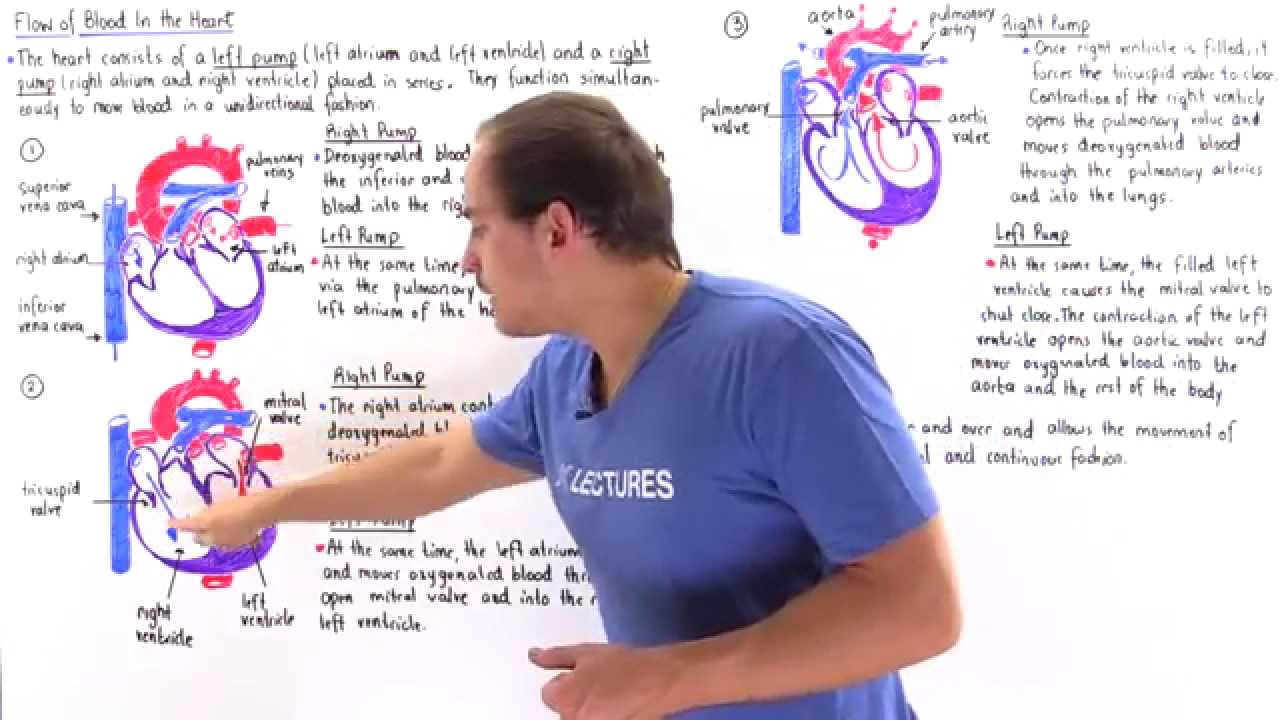
The video provides a clear and structured explanation of cardiac blood flow, breaking down the process into three stages. It effectively uses diagrams to illustrate the anatomy and the sequence of events. The argumentation is logical and follows the physiological sequence, emphasizing the coordination between the atria and ventricles. The explanation of valve function and pressure changes is accurate and helps the viewer understand the mechanics of unidirectional flow. However, the video lacks depth in discussing the electrical conduction system or the cardiac cycle in terms of pressure-volume changes, which could enhance the understanding for advanced learners.
Scientific Rigor, Source Quality, Title Accuracy
The scientific content is accurate and aligns with standard medical knowledge. The video does not cite specific sources, but the information is consistent with established physiology. The title ‘Blood Flow in the Heart’ accurately describes the content. The video is a tutorial, and the lack of citations is typical for such educational content. The description provides links to the creator’s website and lecture page, which may contain additional resources. The adequacy between title and content is high, as the video focuses precisely on the pathway of blood through the heart.
202 words
Title / Content Match
The title accurately reflects the content, which focuses on the pathway of blood through the heart's chambers and valves.
Quality & Reliability
7/10
The video provides a clear and accurate explanation of cardiac blood flow, based on established physiological knowledge. The content is consistent with standard medical textbooks, though it lacks citations and references to specific sources.
Key Moments
Markers derived by PSI from the transcript: the creator did not define chapters.
- Introduction to the heart as two pumps and overview of chambers.
- Explanation of the right and left pumps and their chambers.
- Description of the four valves: tricuspid, mitral, pulmonary, and aortic.
- Stage 1: Atrial relaxation and filling with blood from vena cavae and pulmonary veins.
- Stage 2: Atrial contraction, opening of AV valves, and ventricular filling.
- Stage 3: Ventricular contraction, closure of AV valves, and ejection into pulmonary arteries and aorta.
- Summary of the three stages and the continuous unidirectional flow.
Cited Sources
- AK Lectures - Blood Flow in the Heart — The video is hosted on this page, which may contain additional notes and diagrams.
- AK Lectures Website — General website of the creator, offering various lectures.
- Donation Page — Page for supporting the creator, not directly related to content.
Concurring Sources
- Cardiac cycle - Wikipedia — Confirms the sequence of atrial and ventricular events described in the video.
- Heart valves - Wikipedia — Details the structure and function of the valves mentioned.
Contribution & Novelties
The video offers a clear, step-by-step visual explanation of cardiac blood flow, which is valuable for beginners. It simplifies the complex process into three stages, making it easy to understand. The use of diagrams enhances comprehension. However, it does not introduce new scientific concepts but rather presents established knowledge in an accessible manner.
Pour aller plus loin :
- Cardiac cycle - Wikipedia — Provides a more detailed overview of the cardiac cycle, including pressure changes and electrical activity.
- Heart - Wikipedia — Comprehensive article on heart anatomy and function.
- Circulatory system - Wikipedia — Explains the systemic and pulmonary circulation in context.
102 words
Radar Profile
The radar profile shows high scores in quality of information and fiabilite, indicating accurate and reliable content. The quantity of information is moderate, and the technical level is suitable for a general audience. The overall balance suggests a solid educational resource.