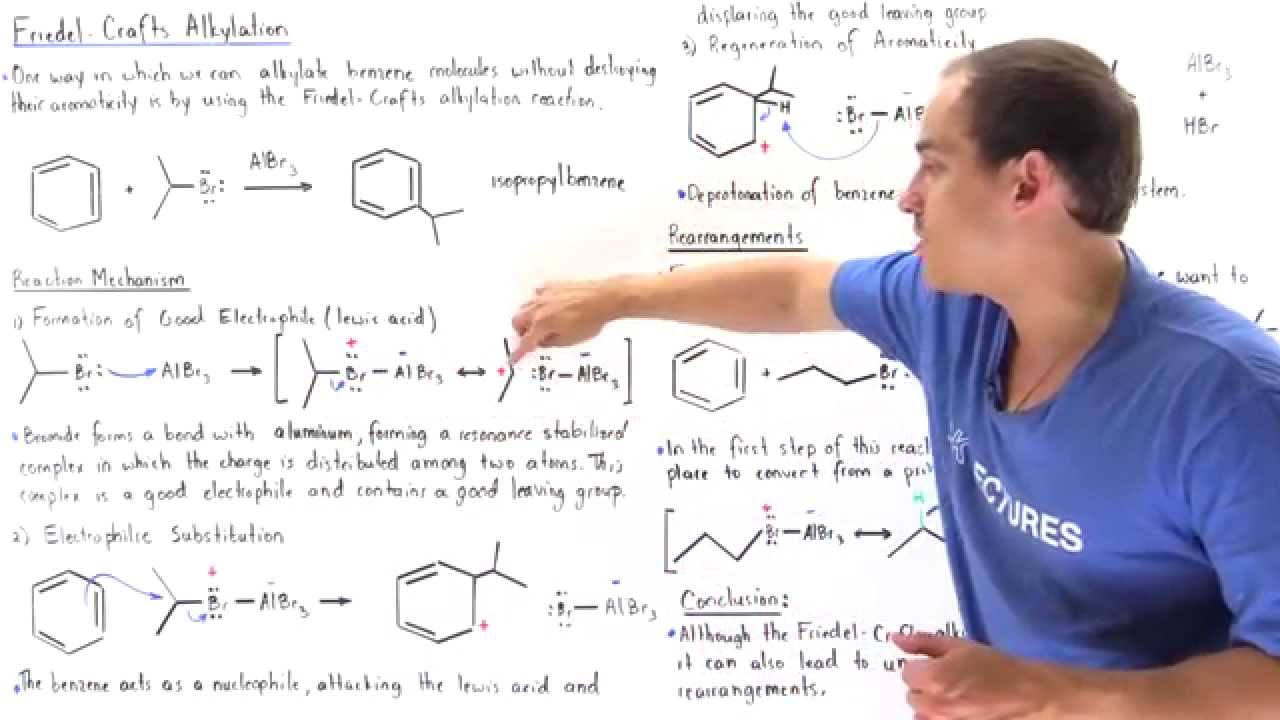
Friedel-Crafts Alkylation
Keywords
Summary
134 words
Critical Evaluation
Value of the Information & Strength of the Argument
The video provides a solid foundational explanation of the Friedel-Crafts alkylation mechanism, breaking it down into clear steps and highlighting key concepts such as electrophile formation, resonance stabilization, and carbocation stability. The argumentation is logical and well-supported by the step-by-step mechanism. However, it does not address potential side reactions like polyalkylation or the use of other catalysts, which limits its comprehensiveness. The discussion of rearrangements is valuable and correctly explains the preference for more stable carbocations.
Scientific Rigor, Source Quality, Title Accuracy
The scientific rigor is adequate for an introductory tutorial, with accurate mechanistic details consistent with standard textbooks. However, no external sources are cited, and the video relies solely on the instructor’s explanation. The title accurately reflects the content, and the video stays focused on the topic. The description includes links to the instructor’s website and donation page, but no specific references to literature or further reading.
157 words
Title / Content Match
The title accurately reflects the content, which focuses exclusively on the Friedel-Crafts alkylation reaction.
Quality & Reliability
7/10
The video provides a clear and accurate explanation of the Friedel-Crafts alkylation mechanism, consistent with standard organic chemistry textbooks. However, it lacks citations to primary literature and does not discuss alternative mechanisms or recent advances.
Key Moments
Markers derived by PSI from the transcript: the creator did not define chapters.
- Introduction to Friedel-Crafts alkylation and its purpose.
- General reaction example with isopropyl bromide and aluminum bromide.
- Step 1: Formation of the electrophile via catalyst coordination.
- Step 2: Electrophilic attack on benzene ring.
- Step 3: Deprotonation and restoration of aromaticity.
- Discussion of limitations and carbocation rearrangements.
Cited Sources
- AK Lectures - Friedel-Crafts Alkylation — Video lecture page on the same topic.
- AK Lectures — General website of the instructor.
- Donate to AK Lectures — Donation page for the channel.
Concurring Sources
- Organic Chemistry by Clayden et al. — Standard textbook covering Friedel-Crafts alkylation mechanism and limitations.
Contribution & Novelties
The video offers a clear, step-by-step mechanism of the Friedel-Crafts alkylation, emphasizing the role of the Lewis acid catalyst and resonance stabilization. It also highlights the limitation of carbocation rearrangements, which is a key point for understanding reaction outcomes. The presentation is accessible for beginners.
Pour aller plus loin :
- Friedel-Crafts reaction - Wikipedia — Overview of both alkylation and acylation, including limitations and variations.
- Carbocation - Wikipedia — Detailed explanation of carbocation stability and rearrangements.
- Electrophilic aromatic substitution - Wikipedia — General mechanism context for aromatic substitution reactions.
89 words
Radar Profile
The radar profile shows high scores in quality of information and technical level, indicating a solid educational resource. The quantity of information is moderate, and the global reliability is good but not exceptional due to lack of citations.