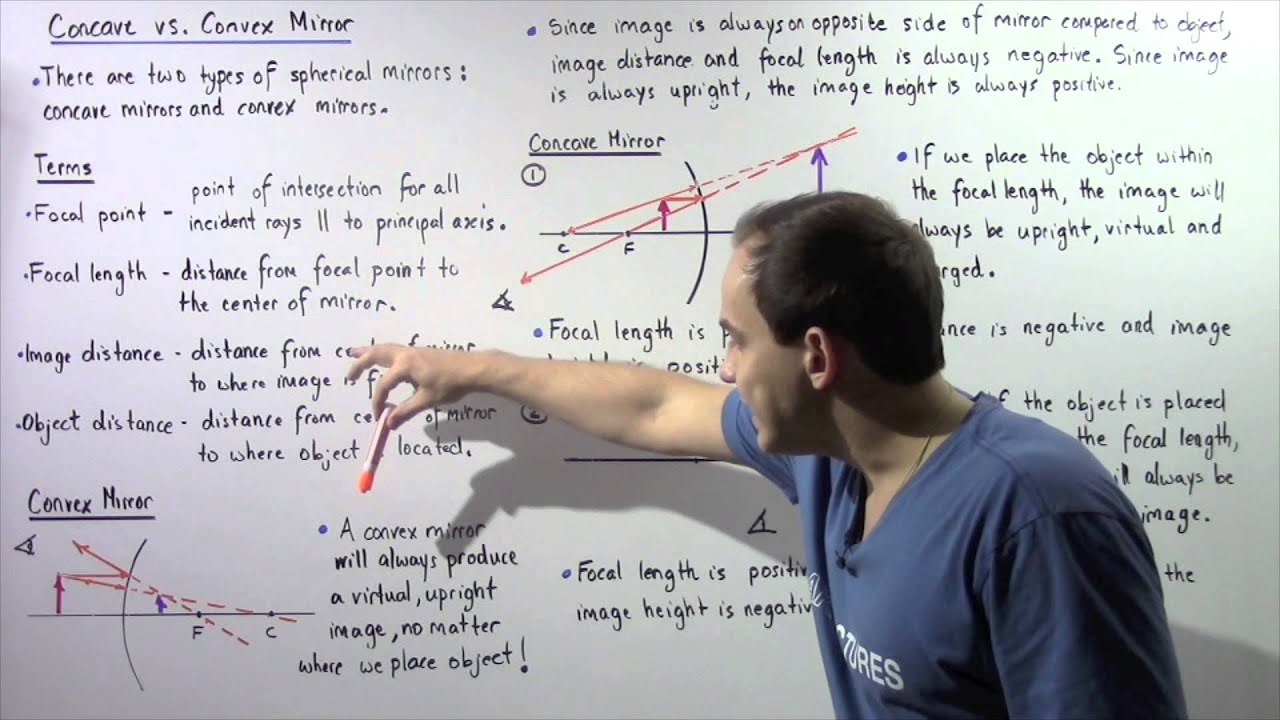
Summary of Concave and Convex Mirrors
Keywords
Summary
146 words
Critical Evaluation
Value of the Information & Strength of the Argument
The video provides a clear and systematic overview of concave and convex mirrors, effectively summarizing key concepts such as focal point, focal length, and image formation. The argumentation is logical, building from definitions to specific cases, and uses ray diagrams to illustrate image location. However, the video lacks depth in explaining the underlying physics, such as the mirror equation and magnification, and does not provide derivations or quantitative examples. The value lies in its clarity for beginners, but it may not satisfy viewers seeking a more rigorous treatment.
Scientific Rigor, Source Quality, Title Accuracy
The video is scientifically accurate in its descriptions of image formation and sign conventions, but it does not cite any external sources or references. The content is based on standard optics principles, but the lack of citations reduces its scholarly rigor. The title accurately reflects the content, which is a summary of concave and convex mirrors. No comments were provided for analysis.
165 words
Title / Content Match
The title accurately reflects the content, which is a summary of concave and convex mirrors.
Quality & Reliability
7/10
Clear and systematic explanation of mirror types, sign conventions, and image formation, but lacks references and depth on derivations.
Key Moments
Markers derived by PSI from the transcript: the creator did not define chapters.
- Introduction to concave and convex mirrors and summary of topics.
- Definition of focal point, principal axis, focal length, and sign conventions for image distance.
- Explanation of convex mirrors: always produce virtual, upright images with negative image distance and focal length.
- Introduction to concave mirrors and case 1: object within focal length produces virtual, upright, enlarged image.
- Case 2: object beyond focal length produces real, inverted image with positive image distance.
- Summary of sign conventions for convex and concave mirrors.
- Conclusion and recap of key points.
Cited Sources
- AK Lectures Website — Main website of the lecturer, providing additional resources.
- Donation Page — Page for supporting the channel.
- Lecture Page for Summary of Concave and Convex Mirrors — Direct link to the lecture on the website.
Concurring Sources
- HyperPhysics - Mirror Equation — Provides the mirror equation and sign conventions, consistent with the video's content.
Contribution & Novelties
The video offers a clear and concise summary of concave and convex mirrors, emphasizing sign conventions and image characteristics. It is particularly useful for students who need a quick review. However, it does not introduce novel concepts or advanced applications.
Pour aller plus loin :
- Mirror equation — Provides the mathematical relationship between object distance, image distance, and focal length.
- Ray tracing (physics) — Explains the method used to determine image location.
- Sign convention — Discusses conventions used in optics, including the Cartesian sign convention.
85 words
Radar Profile
The radar profile shows balanced scores across all dimensions, with slightly lower technical depth, indicating a solid introductory tutorial that is clear and reliable but not highly advanced.