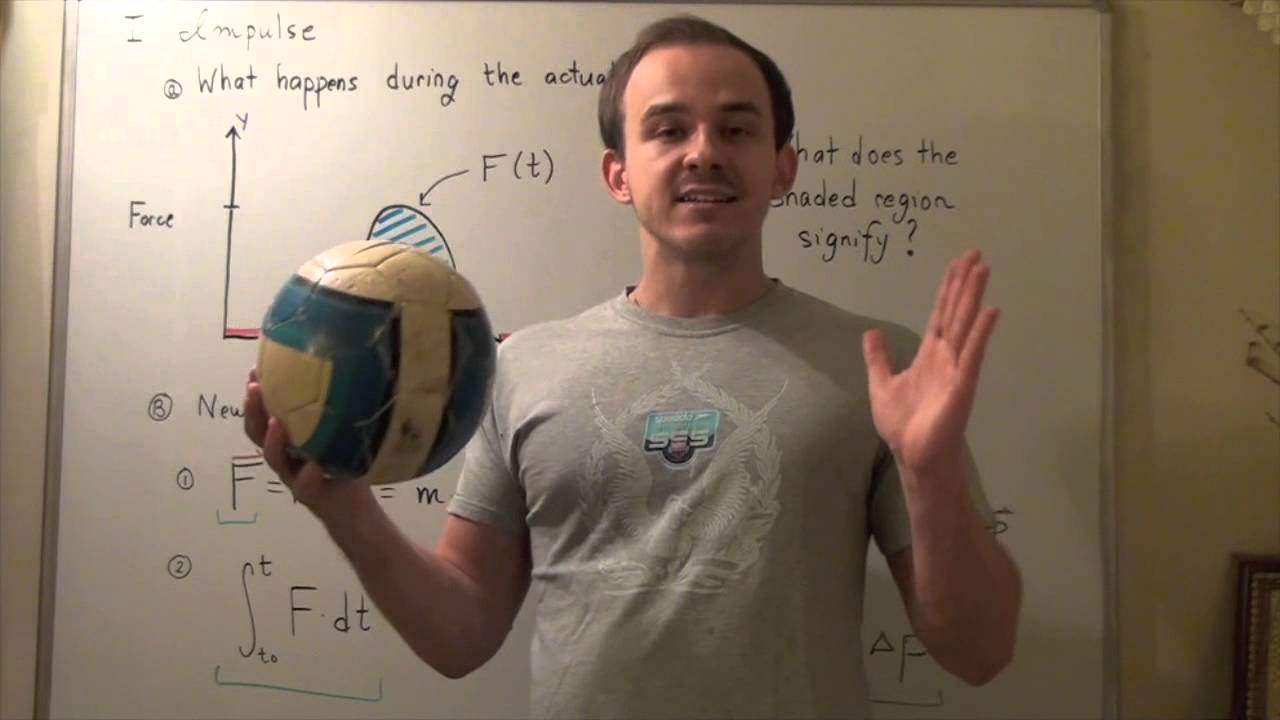
Impulse
Keywords
Summary
211 words
Critical Evaluation
Value of the Information & Strength of the Argument
The video provides a clear and logical derivation of impulse from Newton’s second law, using calculus to show that the integral of force over time equals the change in momentum. The argumentation is solid, building step by step from fundamental principles. The explanation of average force as a constant force producing the same impulse is intuitive and well-illustrated graphically. However, the video does not discuss real-world applications or limitations, and it assumes prior knowledge of calculus and momentum, which may limit its accessibility. The value lies in its pedagogical clarity for students already familiar with basic physics.
Scientific Rigor, Source Quality, Title Accuracy
The video is scientifically rigorous in its derivation, correctly applying Newton’s second law and integral calculus. However, it does not cite any external sources or references, relying solely on the instructor’s explanation. The title ‘Impulse’ accurately reflects the content, which focuses on defining and deriving impulse. The video does not include any citations or links to further reading, which could enhance its credibility. The description provides links to the lecturer’s website and donation page, but these are not academic sources. Overall, the content is accurate but lacks external validation.
201 words
Title / Content Match
The title 'Impulse' accurately reflects the content, which focuses on defining and deriving the concept of impulse in the context of collisions.
Quality & Reliability
7/10
The video provides a clear, step-by-step derivation of impulse as the change in momentum, correctly applying Newton's second law and integral calculus. The explanation is accurate and pedagogically sound, though it lacks citations to external sources and does not address potential misconceptions or alternative formulations.
Key Moments
Markers derived by PSI from the transcript: the creator did not define chapters.
- Introduction to collisions and focus on what happens during contact.
- Graphical representation of force vs. time during a collision, with force zero before and after contact.
- Posing the question: what does the area under the force-time curve represent?
- Review of Newton's second law and definition of acceleration.
- Derivation of force as the rate of change of momentum.
- Manipulating the equation and introducing the integral of force over time.
- Solving the integral to show that impulse equals change in momentum.
- Definition of impulse and its vector nature.
- Introduction of average force and its graphical representation.
- Derivation of average force formula and conclusion.
Cited Sources
- AK Lectures - Impulse — The lecture page on the instructor's website, likely containing additional notes and resources.
- AK Lectures — The main website of the instructor, providing access to other lectures and materials.
- AK Lectures Donate — Donation page for supporting the channel, not a scientific source.
Concurring Sources
- Impulse (physics) - Wikipedia — Confirms that impulse equals the change in momentum and is the integral of force over time.
- Momentum - Wikipedia — Provides background on momentum and its conservation, aligning with the video's content.
Contribution & Novelties
The video offers a clear, step-by-step derivation of impulse from Newton’s second law, emphasizing the graphical interpretation of impulse as the area under the force-time curve. It introduces the concept of average force as a constant force that produces the same impulse, which is a useful simplification for problem-solving. The presentation is pedagogically effective for students learning about momentum and collisions.
Pour aller plus loin :
- Impulse (physics) - Wikipedia — Provides a comprehensive overview of impulse, including its definition, relation to momentum, and applications.
- Momentum - Wikipedia — Background on momentum, a key concept in the video.
- Newton’s laws of motion - Wikipedia — The foundational laws used in the derivation.
- Integral - Wikipedia — For understanding the mathematical operation used in the derivation.
125 words
Radar Profile
The radar profile shows strong scores in quality of information and reliability, with moderate scores in quantity and technical level. This indicates a focused, accurate tutorial that may not cover extensive breadth but provides solid foundational knowledge.