Compliance of Blood Vessels
Keywords
Summary
115 words
Critical Evaluation
Value of the Information & Strength of the Argument
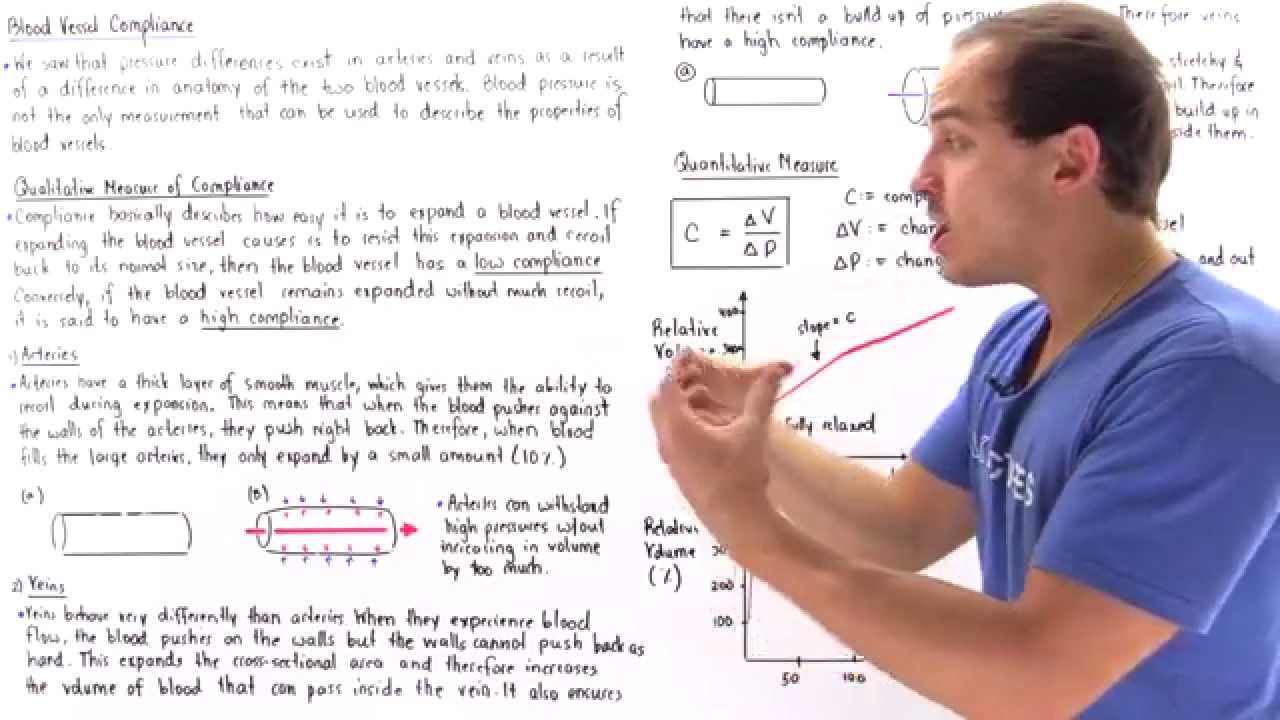
The video provides a clear and logical explanation of vascular compliance, using qualitative descriptions and quantitative graphs to illustrate the differences between arteries and veins. The argumentation is sound, building from the structural basis (smooth muscle thickness) to functional outcomes (pressure and volume changes). However, the content is introductory and lacks depth, such as discussing clinical relevance or pathological conditions affecting compliance.
Scientific Rigor, Source Quality, Title Accuracy
The video is scientifically accurate but does not cite any external sources, relying on established physiological knowledge. The title accurately reflects the content. No comments were provided for analysis.
106 words
Title / Content Match
The title accurately reflects the content, which focuses on the concept of compliance in blood vessels.
Quality & Reliability
7/10
Clear and accurate explanation of vascular compliance, consistent with standard physiology. However, no sources are cited, and the content is basic, lacking depth on clinical implications or quantitative details.
Key Moments
Markers derived by PSI from the transcript: the creator did not define chapters.
- Introduction to compliance and its definition
- Explanation of low compliance in arteries due to thick smooth muscle
- Explanation of high compliance in veins due to thin smooth muscle
- Introduction of the compliance equation C = ΔV/ΔP
- Graphical comparison of artery and vein compliance
- Summary of differences and functional implications
Cited Sources
- AK Lectures - Compliance of Blood Vessels — Video lecture page with additional resources
- AK Lectures — General website for educational content
Concurring Sources
- Vascular compliance - Wikipedia — Confirms the definition and formula for compliance.
External References
Contribution & Novelties
The video provides a clear, accessible introduction to vascular compliance, using simple analogies and graphs. It effectively contrasts arterial and venous compliance, linking structure to function. While not novel, it serves as a solid educational resource.
Pour aller plus loin :
- Vascular compliance - Wikipedia — Overview of compliance in blood vessels.
- Arterial stiffness - Wikipedia — Related concept of arterial stiffness and its clinical importance.
- Windkessel effect - Wikipedia — Explains how arterial compliance affects blood flow dynamics.
79 words
Radar Profile
The radar profile shows moderate scores across all dimensions, with slightly higher quality and reliability compared to quantity and technical depth. This indicates a solid but basic educational video, suitable for beginners but not for advanced learners.