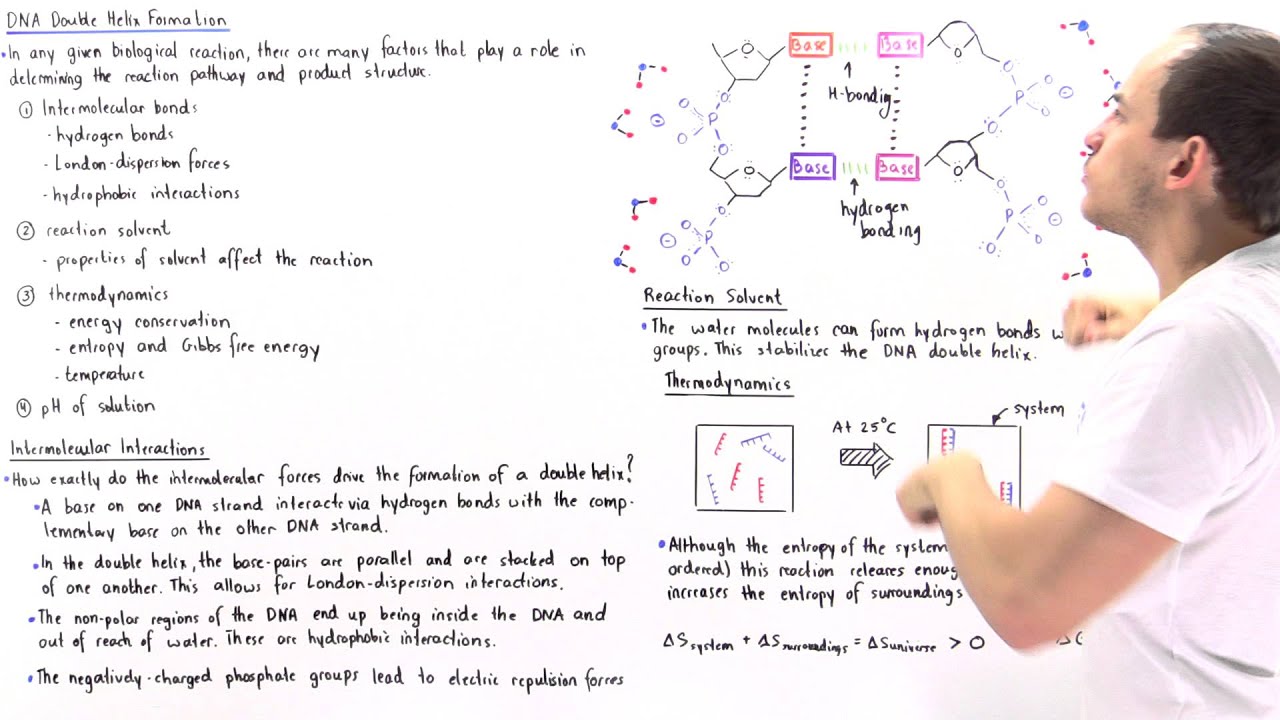
Formation of DNA Double Helix
Keywords
Summary
171 words
Critical Evaluation
Value of the Information & Strength of the Argument
The video provides a clear and logical explanation of the molecular basis of DNA double helix formation. It systematically covers the key intermolecular forces (hydrogen bonds, London dispersion forces, hydrophobic effect) and their roles, as well as the thermodynamic principles (entropy, Gibbs free energy) that make the process spontaneous. The argumentation is sound and well-structured, building from basic concepts to a comprehensive understanding. The use of diagrams aids comprehension, though the lack of quantitative data or references limits its depth for advanced learners.
Scientific Rigor, Source Quality, Title Accuracy
The scientific content is accurate and aligns with established biochemistry knowledge. However, the video does not cite specific sources or references, relying instead on general principles. The title accurately reflects the content, which focuses on the formation of the DNA double helix. The video is a tutorial-style lecture, and while it is informative, it does not engage with primary literature or provide citations, which affects its rigor for research purposes.
168 words
Title / Content Match
The title accurately reflects the content, which focuses on the formation of the DNA double helix and the factors influencing it.
Quality & Reliability
7/10
The video provides a clear and accurate explanation of the molecular interactions and thermodynamics driving DNA double helix formation, consistent with established biochemistry. It is educational and well-structured, though it lacks citations and depth for advanced audiences.
Key Moments
Markers derived by PSI from the transcript: the creator did not define chapters.
- Introduction to factors influencing biological reactions: intermolecular bonds, solvent, thermodynamics.
- Overview of DNA double helix structure: antiparallel strands, phosphate backbone, base pairing.
- Explanation of hydrogen bonds between complementary bases.
- Discussion of London dispersion forces between stacked bases.
- Role of hydrophobic effect in burying nonpolar bases inside the helix.
- Repulsive forces between negatively charged phosphate groups.
- Interaction of water solvent with phosphate groups via hydrogen bonds.
- Thermodynamic analysis: entropy decrease of system, entropy increase of surroundings, spontaneity.
- Conclusion and mention of future topic: pH influence.
Cited Sources
- AK Lectures - Formation of DNA Double Helix — The video is hosted on this page, which may contain additional resources.
- AK Lectures Website — General website of the instructor, providing access to other lectures.
Concurring Sources
- Lehninger Principles of Biochemistry — Standard biochemistry textbook that covers DNA structure and thermodynamics.
External References
Contribution & Novelties
The video provides a clear and accessible explanation of the molecular interactions and thermodynamics that drive DNA double helix formation. It synthesizes concepts from intermolecular forces, solvent effects, and thermodynamics in a coherent framework. While not novel in content, it serves as an effective educational resource for students.
Pour aller plus loin :
- DNA structure — Overview of DNA structure and function.
- Hydrogen bond — Detailed explanation of hydrogen bonding.
- Hydrophobic effect — The role of hydrophobic interactions in molecular assembly.
- Gibbs free energy — Thermodynamic concept underlying spontaneity.
89 words
Radar Profile
The radar profile shows a balanced performance across all dimensions, with slightly higher scores in quality of information and reliability, reflecting the accurate and well-structured content. The lower score in technical level indicates that the video is accessible to a general audience but may lack depth for advanced learners.