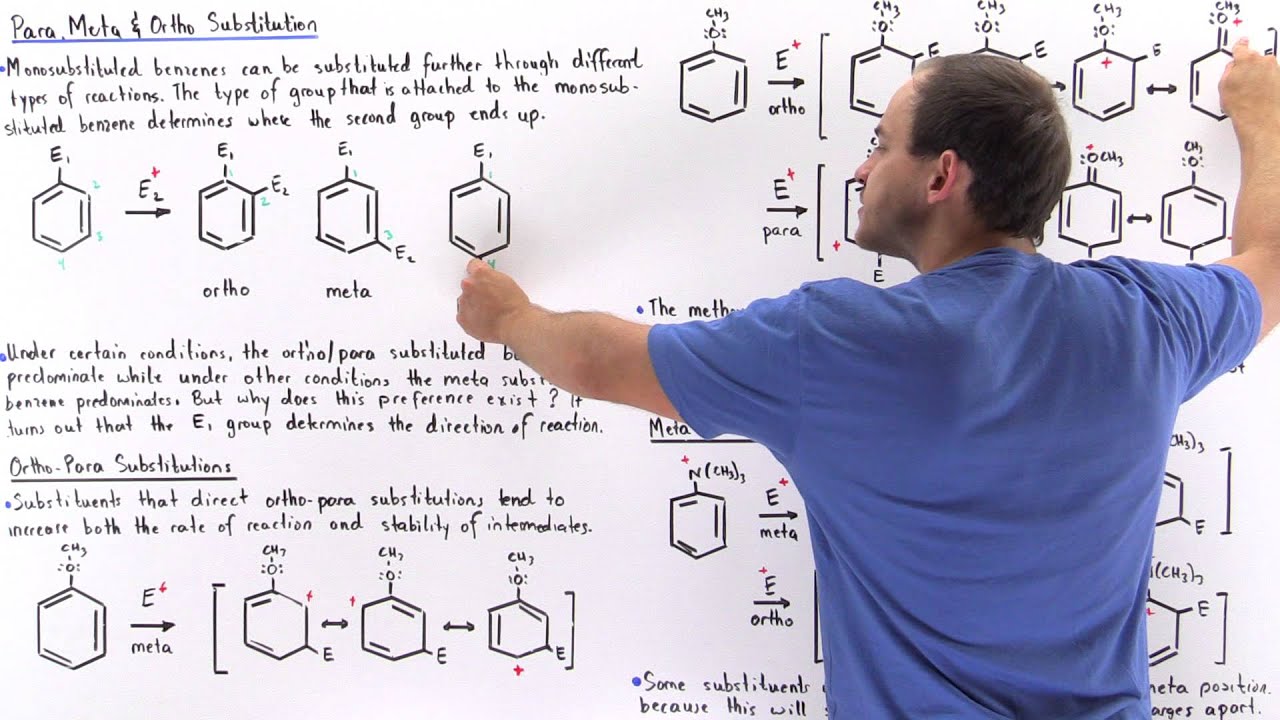
Ortho, Meta and Para Substitution
Keywords
Summary
148 words
Critical Evaluation
Value of the Information & Strength of the Argument
The video provides a solid explanation of the electronic effects governing ortho/meta/para selectivity in electrophilic aromatic substitution. It uses resonance structures to demonstrate how electron-donating groups stabilize the intermediate carbocation, lowering activation energy and favoring ortho/para products. Conversely, it shows how electron-withdrawing groups with positive charges create electrostatic repulsion in ortho/para intermediates, making meta substitution more favorable. The argumentation is logical and well-structured, building from basic definitions to mechanistic reasoning. However, it does not address exceptions or the influence of steric hindrance, which is a limitation.
Scientific Rigor, Source Quality, Title Accuracy
The video is scientifically accurate and follows standard organic chemistry principles. It does not cite specific sources, but the content aligns with established textbooks. The title accurately reflects the content. The description provides links to the instructor’s website and donation page, but no external references. The video is a tutorial, not a research presentation, so the lack of citations is acceptable. The explanation is rigorous and consistent with known mechanisms.
171 words
Title / Content Match
The title accurately reflects the content, which focuses on the positional isomerism in electrophilic substitution of monosubstituted benzenes.
Quality & Reliability
7/10
The video provides a clear and accurate explanation of ortho/meta/para substitution in electrophilic aromatic substitution, using resonance structures and inductive effects. However, it lacks citations to primary literature and does not discuss exceptions or advanced topics.
Key Moments
Markers derived by PSI from the transcript: the creator did not define chapters.
- Introduction to monosubstituted benzene and electrophilic substitution
- Definition of ortho, meta, and para positions
- Explanation of how substituents determine product distribution
- Example with methoxy group: resonance stabilization leads to ortho/para
- Example with trimethylammonium group: electrostatic repulsion favors meta
- Summary of directing effects based on lone pairs vs. positive charges
Cited Sources
- AK Lectures - Ortho, Meta and Para Substitution — Lecture page on the instructor's website
- AK Lectures — General website for the video series
Concurring Sources
- Organic Chemistry by Clayden et al. — Standard textbook covering electrophilic aromatic substitution and directing effects.
External References
Contribution & Novelties
The video offers a clear pedagogical explanation of ortho/meta/para directing effects, using resonance structures to illustrate the stability of intermediates. It effectively contrasts electron-donating groups (with lone pairs) and electron-withdrawing groups (with positive charges) to explain selectivity. The presentation is accessible and reinforces fundamental concepts.
Pour aller plus loin :
- Electrophilic aromatic substitution — Overview of the reaction mechanism.
- Arenium ion — The intermediate discussed in the video.
- Inductive effect — Electronic effects influencing reactivity.
75 words
Radar Profile
The radar profile shows balanced scores across information quantity, quality, technical level, and reliability, indicating a well-rounded educational video. The technical level is appropriate for the target audience, and the content is reliable despite lacking citations.