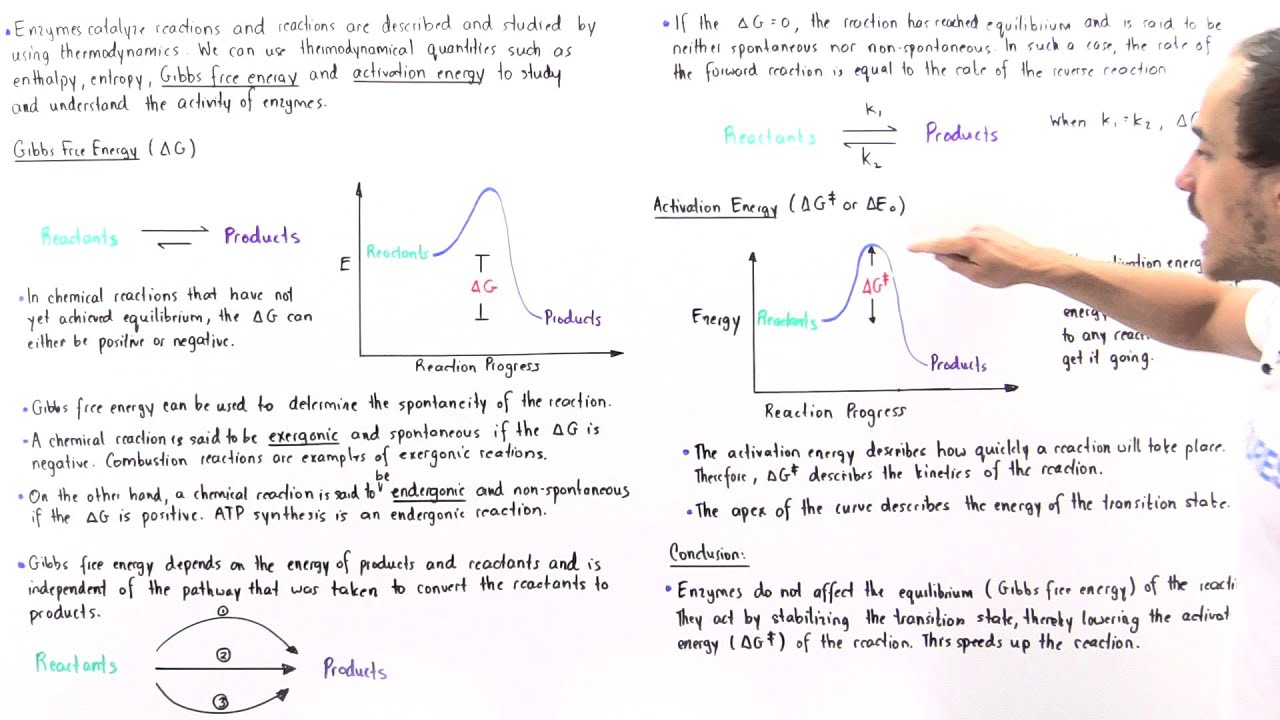
Enzymes' Effect on Activation Energy and Free Energy
Keywords
Summary
143 words
Critical Evaluation
Value of the Information & Strength of the Argument
The video provides a solid conceptual foundation for understanding enzyme catalysis, clearly distinguishing between thermodynamics (ΔG) and kinetics (activation energy). The argumentation is logical and builds stepwise, using diagrams to illustrate energy profiles. It correctly states that enzymes do not change ΔG but lower activation energy, which is a fundamental principle. However, it lacks quantitative examples or experimental data, and the explanation of transition state stabilization is brief. The value lies in its clarity for beginners, but it does not delve into mechanistic details or alternative catalytic strategies.
Scientific Rigor, Source Quality, Title Accuracy
The video is scientifically accurate but does not cite specific sources or references. The description provides links to the creator’s website and donation page, but no external scientific references. The title accurately reflects the content. The presentation is consistent with standard biochemistry textbooks, but the lack of citations reduces its scientific rigor. No comments were provided for analysis.
161 words
Title / Content Match
The title accurately reflects the content, which focuses on how enzymes affect activation energy and free energy.
Quality & Reliability
7/10
The video provides a clear and accurate explanation of fundamental biochemical concepts (Gibbs free energy, activation energy, enzyme catalysis) with correct scientific principles. However, it lacks citations to primary literature and does not discuss experimental evidence or nuances, limiting its depth.
Key Moments
Markers derived by PSI from the transcript: the creator did not define chapters.
- Introduction to thermodynamics and kinetics of reactions.
- Definition of Gibbs free energy and its role in spontaneity.
- Explanation of exergonic and endergonic reactions with examples.
- Discussion on how ΔG is independent of pathway and unaffected by enzymes.
- Introduction to activation energy and transition state.
- Explanation of how enzymes lower activation energy by stabilizing transition state.
- Summary: enzymes speed up reactions without changing ΔG.
Cited Sources
- AK Lectures Website — General educational resource by the video creator.
- Lecture Page: Enzymes' Effect on Activation Energy and Free Energy — Direct link to the lecture page for this video.
Concurring Sources
- Enzyme catalysis - Wikipedia — Confirms that enzymes lower activation energy without altering ΔG.
- Gibbs free energy - Wikipedia — Supports the definition and properties of ΔG.
External References
Contribution & Novelties
The video offers a clear pedagogical explanation of the distinction between Gibbs free energy and activation energy, emphasizing that enzymes affect only the latter. It effectively uses energy diagrams to illustrate concepts. While not novel, it serves as a useful educational resource.
Pour aller plus loin :
- Enzyme catalysis - Wikipedia — Overview of enzyme mechanisms and transition state stabilization.
- Gibbs free energy - Wikipedia — Detailed thermodynamic background.
- Transition state theory - Wikipedia — Theoretical basis for activation energy.
80 words
Radar Profile
The radar profile shows high scores in information quality and technical level, with moderate scores in quantity and reliability. This indicates a focused, accurate tutorial that could benefit from more depth and citations.