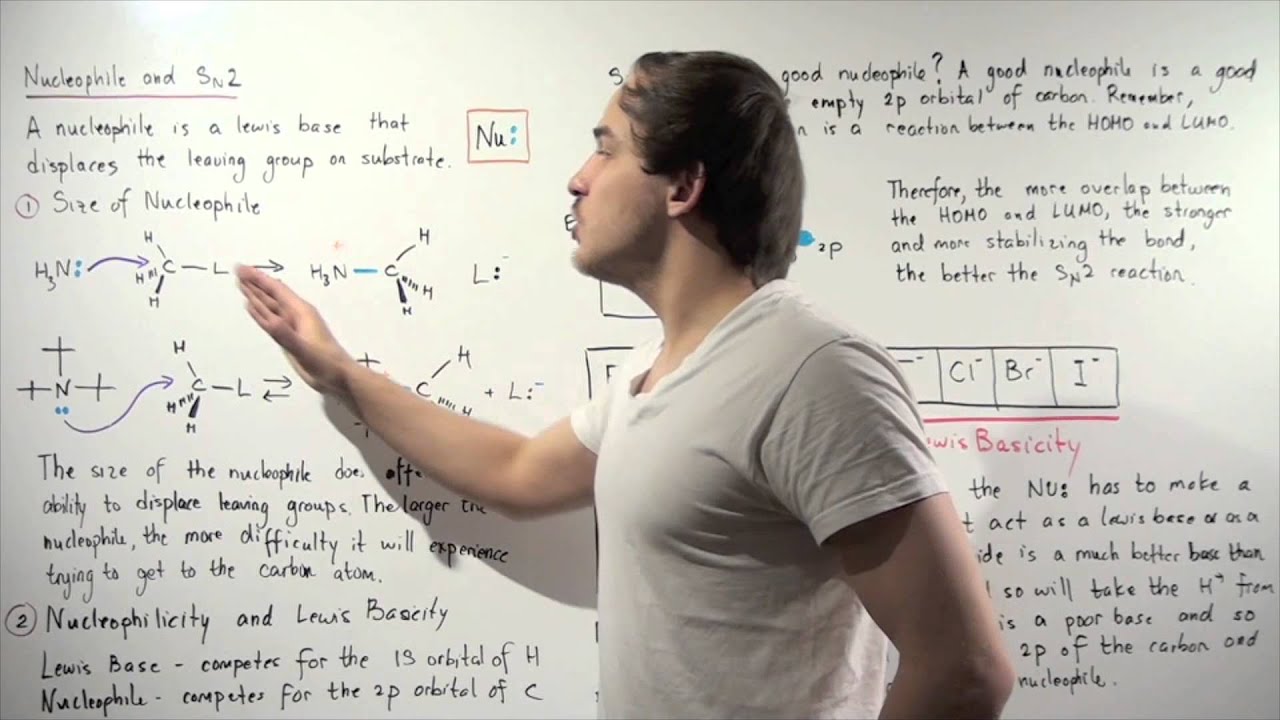
Effect of Nucleophile Size on Reaction Rate (Sn2)
Keywords
Summary
175 words
Critical Evaluation
Value of the Information & Strength of the Argument
The video provides a clear and logical explanation of how nucleophile size impacts SN2 reaction rates, using steric hindrance and electrostatic repulsion as key concepts. The argumentation is sound and builds on previous lectures, effectively contrasting small and bulky nucleophiles. The distinction between Lewis basicity and nucleophilicity is well-articulated, with a compelling example using halogens and the role of polar protic solvents. The explanation of orbital overlap (HOMO-LUMO) adds depth, though it may be slightly advanced for beginners. Overall, the content is valuable for understanding fundamental principles in organic chemistry.
Scientific Rigor, Source Quality, Title Accuracy
The video is scientifically accurate and aligns with standard organic chemistry textbooks. However, it does not cite specific sources or references, relying on established knowledge. The title accurately reflects the content, and the video stays on topic throughout. No external sources are provided beyond the creator’s website, which limits the ability to verify claims independently. The explanation is consistent with current understanding, but the lack of citations reduces the overall rigor.
176 words
Title / Content Match
The title accurately reflects the content, focusing on the effect of nucleophile size on SN2 reaction rates.
Quality & Reliability
7/10
The video provides a clear and accurate explanation of the effect of nucleophile size on SN2 reaction rates, grounded in fundamental organic chemistry principles. The content is consistent with established knowledge, though it lacks citations to primary literature and does not address potential exceptions or nuances in detail.
Key Moments
Markers derived by PSI from the transcript: the creator did not define chapters.
- Introduction to nucleophile definition and recap of substrate size effect.
- Comparison of two reactions with small vs. bulky nucleophiles.
- Explanation of electrostatic repulsion and its effect on reaction rate.
- Distinction between Lewis base and nucleophile based on orbital competition.
- Discussion of nucleophilicity trends among halogens and the role of solvent.
- Explanation of how polar protic solvents affect nucleophilicity.
- Conclusion summarizing the effect of nucleophile size and solvent on SN2 reactions.
Cited Sources
- AK Lectures - Effect of Nucleophile Size on SN2 Reactions — The video's dedicated lecture page, providing additional context and resources.
- AK Lectures Website — The creator's website hosting the video and related lectures.
Concurring Sources
- Organic Chemistry Textbook (e.g., Clayden) — Standard textbooks confirm the steric effect of bulky nucleophiles and the solvent-dependent nucleophilicity trends.
External References
Contribution & Novelties
The video provides a clear pedagogical explanation of how nucleophile size affects SN2 reaction rates, emphasizing steric hindrance and electrostatic repulsion. It also clarifies the often-confused distinction between Lewis basicity and nucleophilicity, using orbital competition and solvent effects to explain observed trends. The content is valuable for students learning organic chemistry, offering a conceptual framework that complements textbook treatments.
Pour aller plus loin :
- SN2 reaction — Overview of SN2 mechanism and factors affecting rate.
- Nucleophile — Definition and factors influencing nucleophilicity.
- Lewis acids and bases — Background on Lewis acid-base theory.
- Polar protic solvents — Explanation of solvent effects on nucleophilicity.
102 words
Radar Profile
The radar profile shows high scores in information quality and reliability, with moderate scores in quantity and technical level. This indicates a focused, accurate tutorial that may lack depth for advanced learners but is solid for introductory understanding.