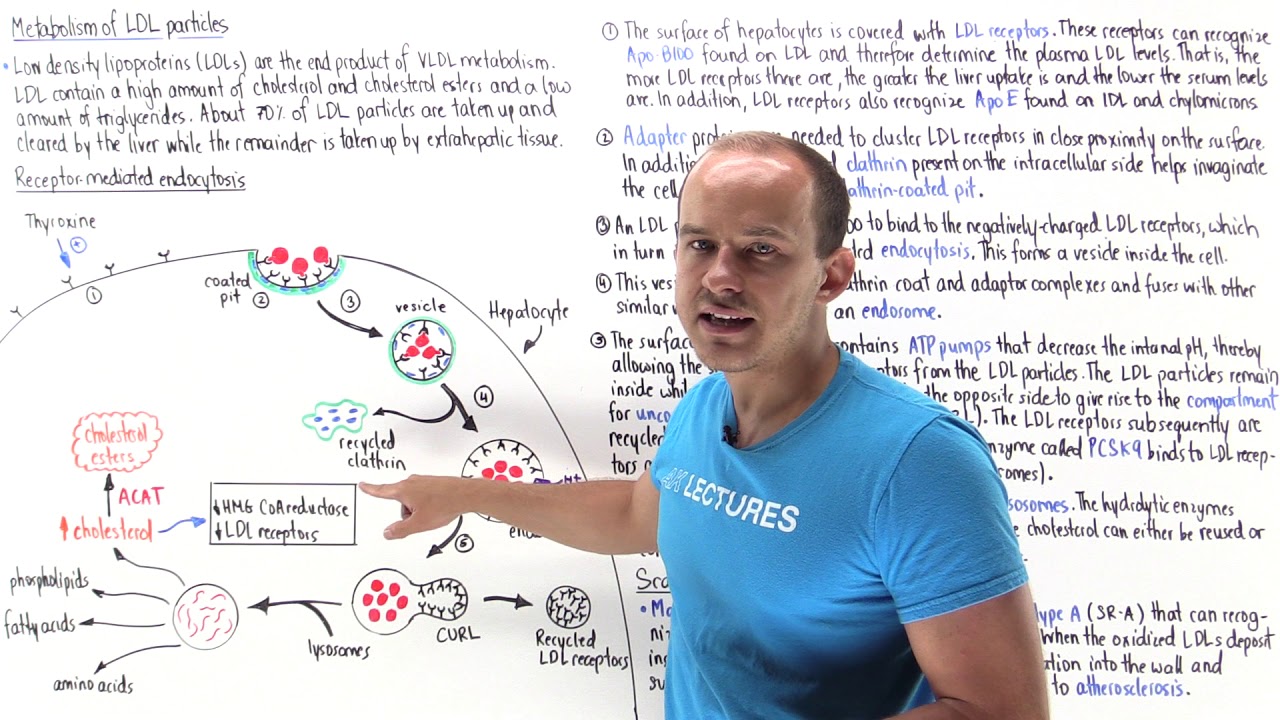
Metabolism of low-density lipoproteins (LDLs)
Keywords
Summary
114 words
Critical Evaluation
Value of the Information & Strength of the Argument
The video provides a solid foundation in LDL metabolism, explaining the biochemical pathways and regulatory mechanisms in a logical sequence. The argumentation is coherent, building from VLDL production to LDL uptake and its implications for atherosclerosis. The explanation of receptor-mediated endocytosis is detailed, including the roles of clathrin, adapter proteins, and the acidification of endosomes. The discussion of PCSK9 and its effect on LDL receptor degradation is particularly valuable, as it connects to current therapeutic targets. However, the video does not delve into experimental evidence or clinical studies, limiting its depth for advanced learners.
Scientific Rigor, Source Quality, Title Accuracy
The video is scientifically accurate and aligns with standard biochemistry textbooks. However, it does not cite specific sources or references, relying on established knowledge. The title accurately reflects the content, and the video stays on topic throughout. The description provides links to the creator’s website and donation page, but no direct references to scientific literature. The content is presented in a tutorial style, suitable for educational purposes, but lacks citations to primary research.
182 words
Title / Content Match
The title accurately reflects the content, which focuses on the metabolism of LDL particles, including their synthesis, uptake, and regulation.
Quality & Reliability
7/10
The video provides a clear and accurate overview of LDL metabolism, receptor-mediated endocytosis, and related regulatory mechanisms. The content aligns with established biochemistry and cell biology knowledge. However, it lacks citations to primary literature and does not discuss recent advances or controversies in detail.
Key Moments
Markers derived by PSI from the transcript: the creator did not define chapters.
- Introduction to LDL metabolism and overview of VLDL production in the liver.
- Explanation of VLDL to IDL conversion via lipoprotein lipase and the formation of LDL.
- Discussion of LDL receptor-mediated endocytosis, including the role of clathrin and adapter proteins.
- Description of endosome acidification and the dissociation of LDL from receptors.
- Role of PCSK9 in LDL receptor degradation and its regulation.
- Fate of LDL particles: lysosomal degradation and cholesterol storage.
- Scavenger receptors on macrophages and their role in atherosclerosis.
Cited Sources
- AK Lectures Website — The creator's website, which hosts additional lectures and resources.
- Donation Page — A page for supporting the channel, mentioned in the video description.
Concurring Sources
- LDL receptor — Confirms the role of LDL receptors in endocytosis and their regulation.
- PCSK9 — Supports the description of PCSK9's function in LDL receptor degradation.
Contribution & Novelties
The video offers a clear and concise explanation of LDL metabolism, focusing on the molecular mechanisms of receptor-mediated endocytosis and its regulation. It effectively connects the biochemical pathway to clinical implications, such as atherosclerosis. The inclusion of PCSK9 and its role in LDL receptor degradation is a notable addition, as it is a key target for cholesterol-lowering drugs.
Pour aller plus loin :
- LDL receptor — Provides detailed information on the structure and function of LDL receptors.
- PCSK9 — Overview of PCSK9 and its role in cholesterol metabolism.
- Atherosclerosis — Comprehensive article on the disease process mentioned in the video.
100 words
Radar Profile
The radar profile shows balanced scores across all dimensions, with slightly higher quality and reliability compared to quantity and technical depth. This indicates a well-structured educational video that is accurate but not overly detailed or comprehensive.