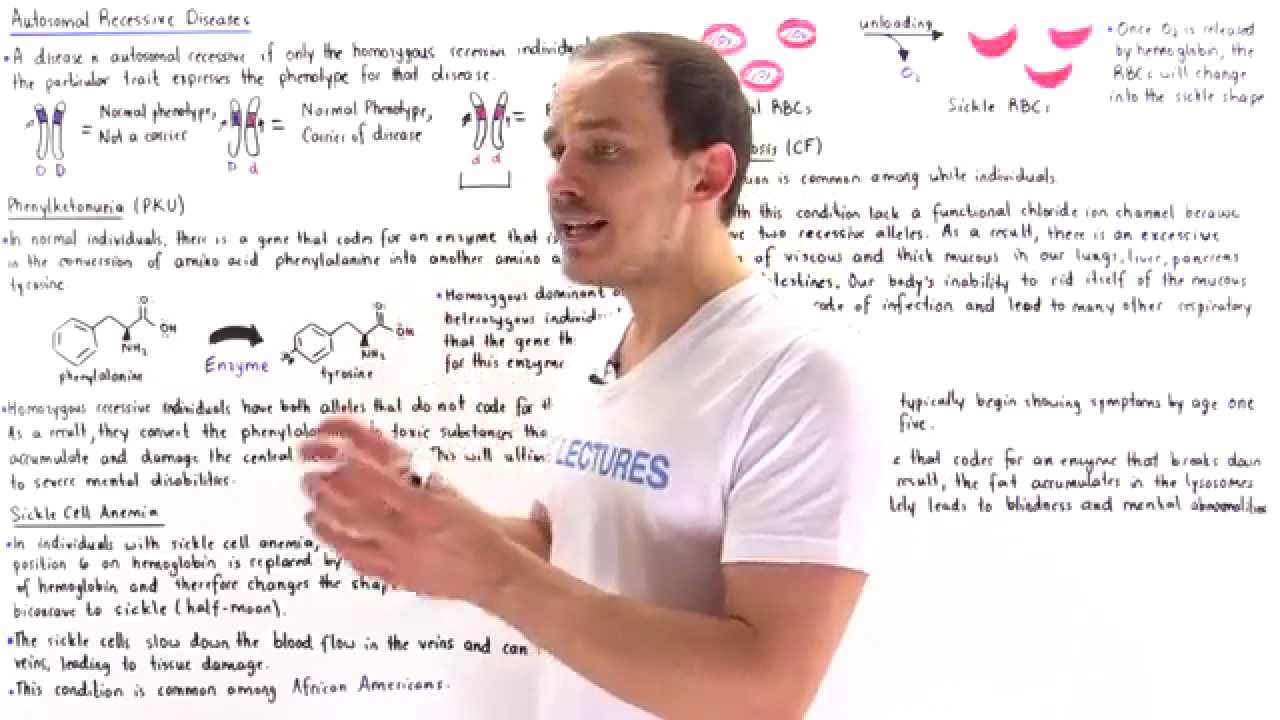
Autosomal Recessive Diseases
Keywords
Summary
164 words
Critical Evaluation
Value of the Information & Strength of the Argument
The video provides a solid foundation for understanding autosomal recessive inheritance. It clearly explains the genetic basis and uses diagrams to illustrate the concepts. The examples are well-chosen and cover a range of severities, from manageable (PKU) to fatal (Tay-Sachs). The argumentation is logical, moving from definitions to specific cases, and the molecular explanations (e.g., enzyme deficiency in PKU, hemoglobin mutation in sickle cell) are accurate. However, the video does not delve into population genetics, carrier screening, or treatment options, which would enhance its value. The presentation is didactic and accessible, but lacks critical analysis of the diseases’ broader implications.
Scientific Rigor, Source Quality, Title Accuracy
The video is scientifically accurate and aligns with established knowledge in genetics. The presenter does not cite specific sources, but the information is consistent with standard textbooks. The title accurately reflects the content. The description provides links to the creator’s website and lecture page, which may contain additional resources, but no direct references to primary literature are given. The video is suitable for educational purposes, though viewers seeking in-depth citations would need to consult other sources.
191 words
Title / Content Match
The title accurately reflects the content, which focuses on autosomal recessive diseases.
Quality & Reliability
7/10
The video provides a clear and accurate introduction to autosomal recessive diseases, with correct definitions and examples. It covers four classic diseases (PKU, sickle cell anemia, cystic fibrosis, Tay-Sachs) and explains the molecular basis of each. However, it lacks citations to primary literature and does not discuss prevalence or genetic counseling in depth.
Key Moments
Markers derived by PSI from the transcript: the creator did not define chapters.
- Introduction to chromosomes, genes, and proteins
- Definition of autosomal recessive disease
- Explanation of genotypes: homozygous dominant, heterozygous, homozygous recessive
- Introduction to Phenylketonuria (PKU)
- Explanation of sickle cell anemia and hemoglobin mutation
- Discussion of cystic fibrosis and chloride channel defect
- Overview of Tay-Sachs disease and lipid accumulation
- Summary and conclusion
Cited Sources
- AK Lectures Website — General resource for lectures
- Lecture Page for Autosomal Recessive Diseases — Direct link to the video's lecture page
Concurring Sources
- Genetics Home Reference - Autosomal Recessive — Explains autosomal recessive inheritance patterns
External References
Contribution & Novelties
The video offers a clear and concise introduction to autosomal recessive diseases, suitable for students. It effectively uses diagrams to explain genetic concepts and provides four classic examples. The novelty lies in its pedagogical approach, breaking down complex genetic principles into digestible segments.
Pour aller plus loin :
- Phenylketonuria - Wikipedia — Detailed overview of PKU, including genetics and management.
- Sickle cell disease - Wikipedia — Comprehensive information on sickle cell anemia, including molecular basis and clinical aspects.
- Cystic fibrosis - Wikipedia — Overview of CF, including genetics and treatment.
- Tay–Sachs disease - Wikipedia — Information on Tay-Sachs, including genetic basis and prognosis.
103 words
Radar Profile
The radar profile shows balanced scores across information quantity, quality, technical level, and reliability, indicating a well-rounded educational video. The high quality and reliability scores reflect accurate content, while the moderate technical level suggests accessibility for a broad audience.