Introduction to DNA
Keywords
Summary
192 words
Critical Evaluation
Value of the Information & Strength of the Argument
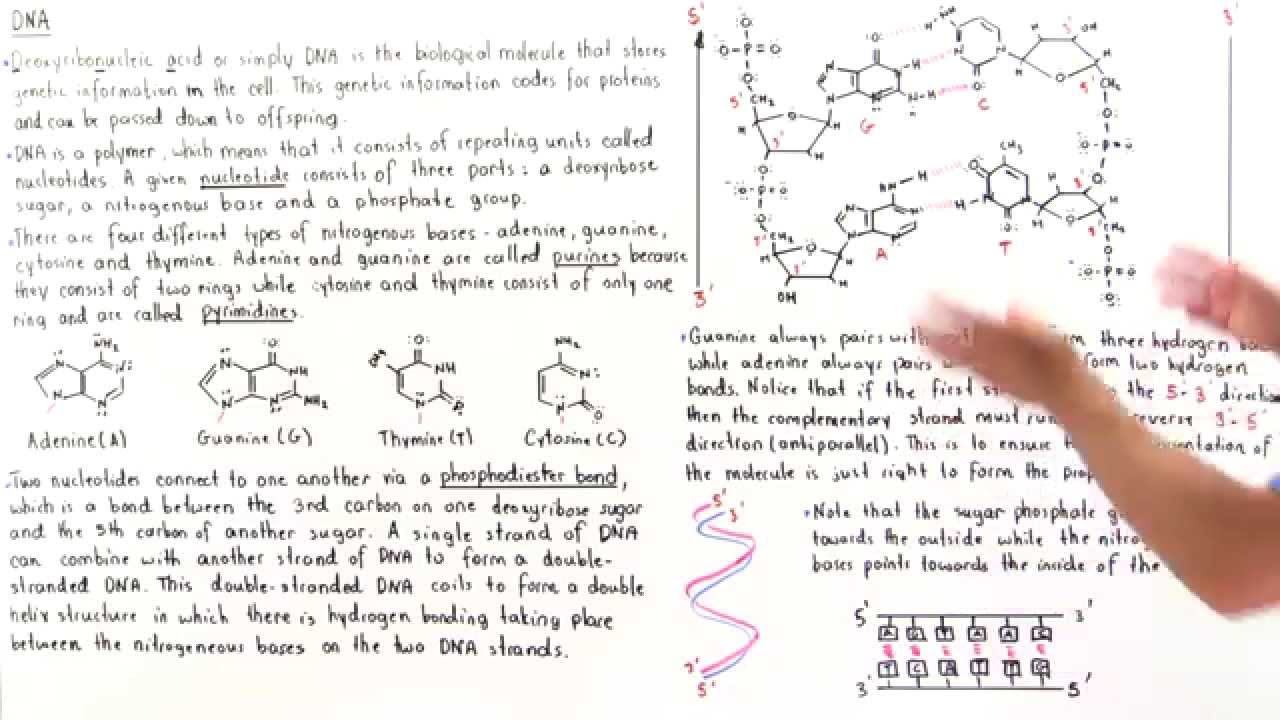
The video offers high educational value for beginners in molecular biology, presenting fundamental concepts in a logical sequence. The argumentation is solid, building from basic definitions to more complex structural details. The use of clear diagrams and step-by-step explanations enhances understanding. The presenter effectively uses analogies (e.g., comparing DNA to proteins) to aid comprehension. The explanation of base pairing and antiparallel orientation is particularly well done, providing a strong foundation for understanding DNA replication and function.
Scientific Rigor, Source Quality, Title Accuracy
The scientific content is accurate and aligns with standard molecular biology textbooks. The video does not cite specific external sources, but the information presented is well-established and uncontroversial. The title accurately reflects the content, which is a basic introduction to DNA. The presentation is clear and methodical, with no apparent biases or unsupported claims. The video’s educational purpose is fulfilled without overcomplicating the material.
155 words
Title / Content Match
The title accurately reflects the content, which is a basic introduction to DNA structure and composition.
Quality & Reliability
8/10
Clear, accurate, and well-structured explanation of DNA structure and composition, consistent with established molecular biology. Minor simplifications for introductory level, but no factual errors.
Key Moments
Markers derived by PSI from the transcript: the creator did not define chapters.
- Introduction to DNA and its function
- Explanation of nucleotides and their components
- Description of the four nitrogenous bases and classification into purines and pyrimidines
- Formation of phosphodiester bonds between nucleotides
- Introduction to the double helix and hydrogen bonding between complementary bases
- Explanation of antiparallel orientation of DNA strands
- Summary of DNA structure and key points
Cited Sources
- AK Lectures Website — Main website for the video and additional lectures
- Donation Page — Support page for the channel
- Introduction to DNA Lecture Page — Direct link to the lecture on the AK Lectures website
Concurring Sources
- DNA Structure on Wikipedia — Confirms the basic structure of DNA as described in the video.
- Nucleic Acid Structure on Wikipedia — Provides detailed information on nucleotide composition and bonding.
Contribution & Novelties
This video provides a clear and accessible introduction to DNA structure, making complex concepts understandable for beginners. Its strength lies in the step-by-step visual explanations and the emphasis on key concepts like base pairing and antiparallel orientation. While it does not present new scientific findings, it serves as an excellent educational resource.
Pour aller plus loin :
- DNA structure on Wikipedia — Comprehensive overview of DNA structure and function.
- Nucleic acid structure on Wikipedia — Detailed explanation of nucleotide and nucleic acid structure.
- Base pair on Wikipedia — Information on hydrogen bonding and base pairing rules.
96 words
Radar Profile
The radar profile shows high scores in quality of information and reliability, with moderate scores in quantity and technical level. This indicates a well-structured and accurate introductory video, suitable for beginners but not delving into advanced topics.
💬 Très positif. Sur les 30 commentaires analysés, tous expriment une gratitude et une admiration extrêmes pour la clarté et l'efficacité de l'explication, certains allant jusqu'à dire que l'enseignant est le meilleur qu'ils aient jamais vu.