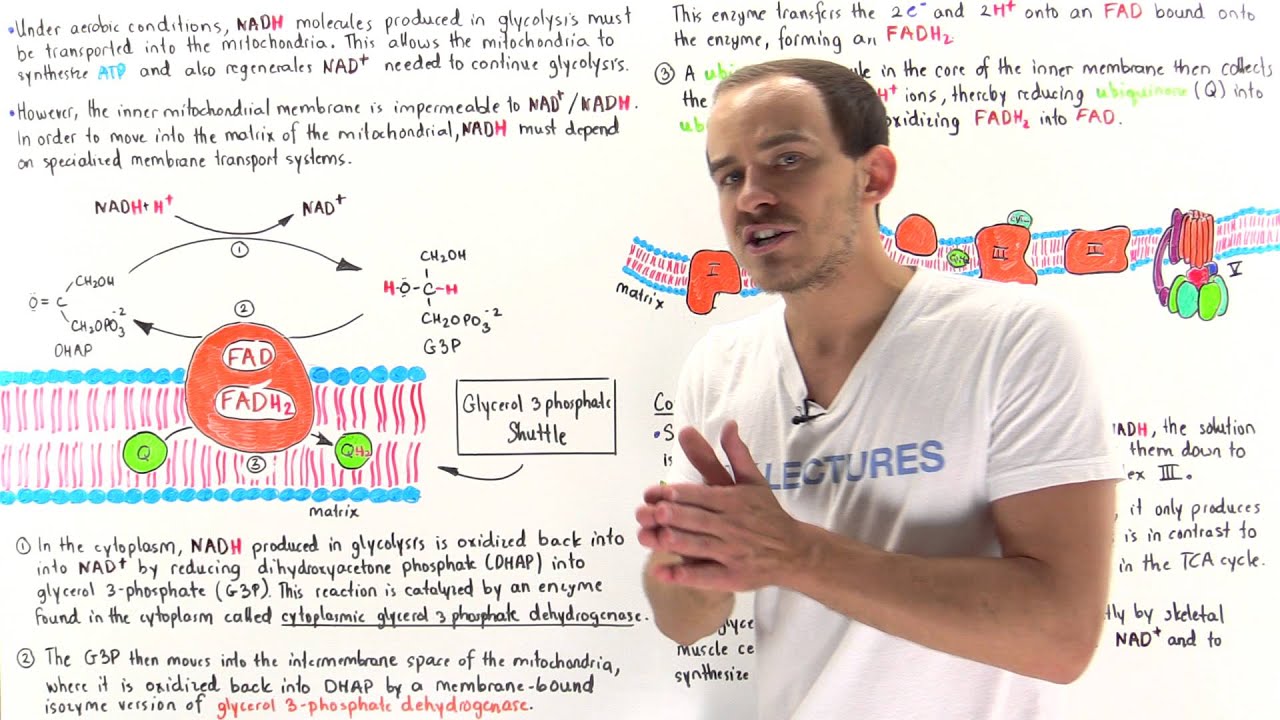
Glycerol 3-Phosphate Shuttle
Keywords
Summary
151 words
Critical Evaluation
Value of the Information & Strength of the Argument
The video provides a thorough and clear explanation of the glycerol 3-phosphate shuttle, breaking down each step and emphasizing the logic behind the process. The argumentation is solid, with a step-by-step progression from the problem (NADH transport) to the solution (shuttle mechanism) and its consequences (ATP yield). The use of diagrams and repetition reinforces understanding. However, the video does not discuss alternative shuttles in detail, which could provide a more comprehensive view.
Scientific Rigor, Source Quality, Title Accuracy
The scientific content is accurate overall, but there are minor errors in the number of protons pumped by Complex III and IV (stated as 2 and 4, respectively, instead of 4 and 2), as pointed out by several viewers. The video does not cite specific sources, but the explanation aligns with standard biochemistry textbooks. The title accurately reflects the content, which is focused solely on the glycerol 3-phosphate shuttle.
156 words
Title / Content Match
The title accurately reflects the content, which focuses exclusively on the glycerol 3-phosphate shuttle.
Quality & Reliability
8/10
Clear and accurate explanation of the glycerol 3-phosphate shuttle, with minor errors in proton pumping numbers (complex III and IV) noted by viewers. The content is well-structured and aligns with standard biochemistry knowledge.
Key Moments
Markers derived by PSI from the transcript: the creator did not define chapters.
- Introduction to the problem of NADH transport into mitochondria.
- Explanation of the cytoplasmic glycerol 3-phosphate dehydrogenase reaction.
- Description of the mitochondrial glycerol 3-phosphate dehydrogenase and FAD reduction.
- Transfer of electrons to ubiquinone and bypass of Complex I.
- Calculation of ATP yield for NADH from citric acid cycle (2.5 ATP).
- Calculation of ATP yield for NADH from glycolysis via shuttle (1.5 ATP).
- Conclusion and mention of tissue-specific shuttle usage.
Cited Sources
- AK Lectures - Glycerol 3-Phosphate Shuttle — The video's dedicated lecture page on the creator's website.
- AK Lectures — The creator's educational website with additional biochemistry lectures.
Concurring Sources
- Biochemistry Textbook (e.g., Lehninger) — Standard biochemistry textbooks describe the glycerol 3-phosphate shuttle similarly.
External References
Contribution & Novelties
The video offers a clear and detailed walkthrough of the glycerol 3-phosphate shuttle, emphasizing the biochemical logic and ATP yield calculations. It is particularly useful for students struggling with the concept. For further exploration, consider the malate-aspartate shuttle, which is used in liver and cardiac cells and yields more ATP. Additionally, the role of FAD in the electron transport chain and the structure of Complex III are relevant topics.
Pour aller plus loin :
- Malate-aspartate shuttle — Comparison with the glycerol 3-phosphate shuttle.
- Flavin adenine dinucleotide — Role of FAD in redox reactions.
- Electron transport chain — Overview of the complexes and proton pumping.
104 words
Radar Profile
The radar profile shows high scores in information quantity and quality, with a slightly lower technical level, indicating a well-balanced educational video. The fiability is high, though minor errors slightly reduce the overall score.
💬 Très positif. Sur les 30 commentaires analysés, la grande majorité exprime une gratitude et une admiration pour la clarté des explications, avec quelques corrections factuelles sur le nombre de protons pompés.