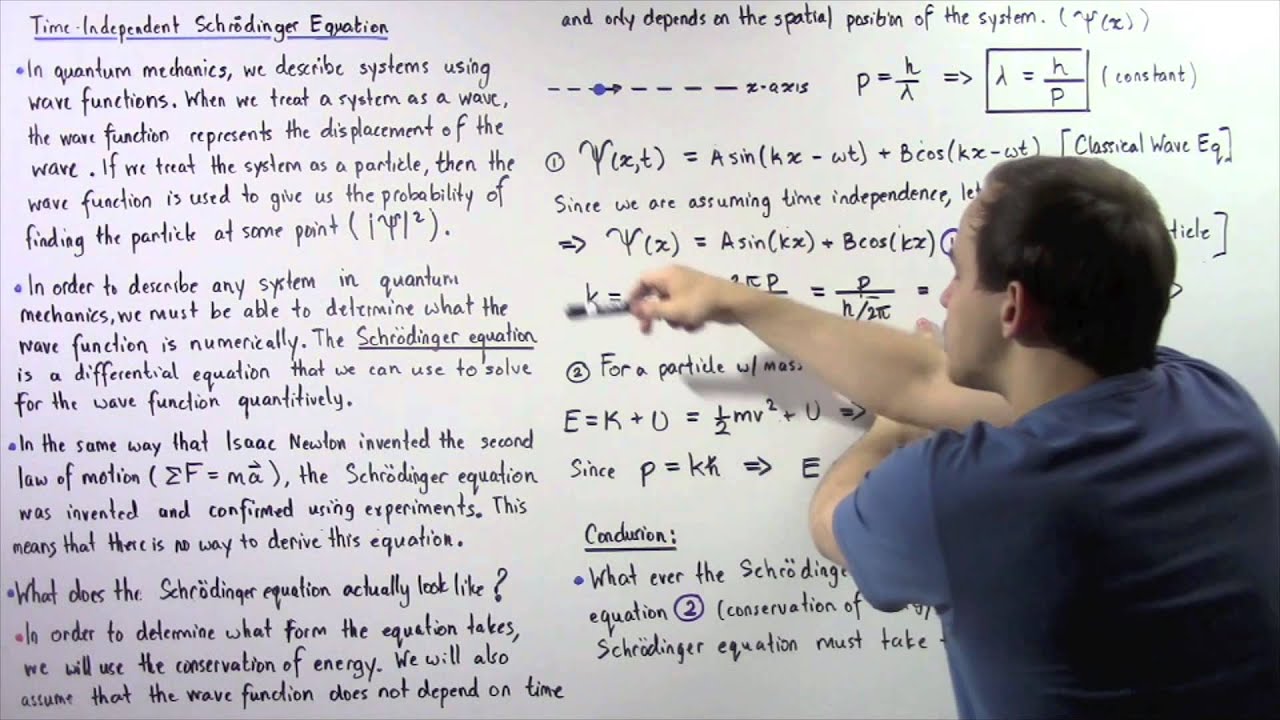
Time-Independent Schrodinger Equation
Keywords
Summary
173 words
Critical Evaluation
Value of the Information & Strength of the Argument
The video provides a clear and logical step-by-step derivation of the time-independent Schrödinger equation, making it accessible to students. The argumentation is sound, starting from the classical wave equation and energy conservation, and systematically building up to the final equation. The presenter emphasizes that the equation is not derived but determined and confirmed experimentally, which is an important epistemological point. However, the derivation lacks some mathematical rigor, such as justifying the form of the wave function and the treatment of potential energy. The explanation is intuitive and helpful for beginners, but it does not delve into the physical interpretation or applications of the equation.
Scientific Rigor, Source Quality, Title Accuracy
The video is a tutorial that does not cite external sources, but it is based on standard quantum mechanics principles. The presenter mentions that the Schrödinger equation is experimentally confirmed, but no specific experiments or references are provided. The title accurately reflects the content, which is focused solely on the time-independent Schrödinger equation. The lack of citations and references to original work reduces the scientific rigor, but the content itself is accurate and aligns with established physics. The video does not include any public comments, so no analysis of viewer feedback is possible.
212 words
Title / Content Match
The title accurately reflects the content, which focuses exclusively on deriving and explaining the time-independent Schrödinger equation.
Quality & Reliability
7/10
The video provides a clear pedagogical derivation of the time-independent Schrödinger equation from classical wave equation and energy conservation, but lacks rigorous mathematical justification and references to original sources.
Key Moments
Markers derived by PSI from the transcript: the creator did not define chapters.
- Introduction to the Schrödinger equation and its importance in quantum mechanics.
- Explanation of wave-particle duality and the wave function.
- Discussion on the origin of the Schrödinger equation and its experimental confirmation.
- Setting up the problem: free particle moving along x-axis.
- Derivation of the classical wave equation and its time-independent form.
- Application of conservation of energy and non-relativistic kinetic energy.
- Taking the second derivative of the wave function to obtain a differential equation.
- Combining the differential equation with the energy expression to derive the time-independent Schrödinger equation.
- Final form of the equation and concluding remarks.
Cited Sources
- AK Lectures — Website of the lecturer, providing additional resources.
- Donation page — Support page for the channel.
- Lecture page — Direct link to the lecture on the website.
Concurring Sources
- Schrödinger equation - Wikipedia — Standard reference for the Schrödinger equation.
Contribution & Novelties
The video provides a clear and accessible derivation of the time-independent Schrödinger equation, which is a fundamental concept in quantum mechanics. It emphasizes that the equation is not derived from first principles but is a postulate confirmed by experiments. The step-by-step approach helps students understand the logical progression from classical wave mechanics to quantum mechanics.
Pour aller plus loin :
- Schrödinger equation - Wikipedia — Overview and historical context.
- Wave function - Wikipedia — Detailed explanation of the wave function and its interpretation.
- Quantum mechanics - Wikipedia — General introduction to quantum mechanics.
93 words
Radar Profile
The radar profile shows high scores in information quantity and quality, with a moderate level of technical depth. The reliability is also high, indicating a trustworthy educational resource. The overall balance suggests a well-structured tutorial suitable for beginners.