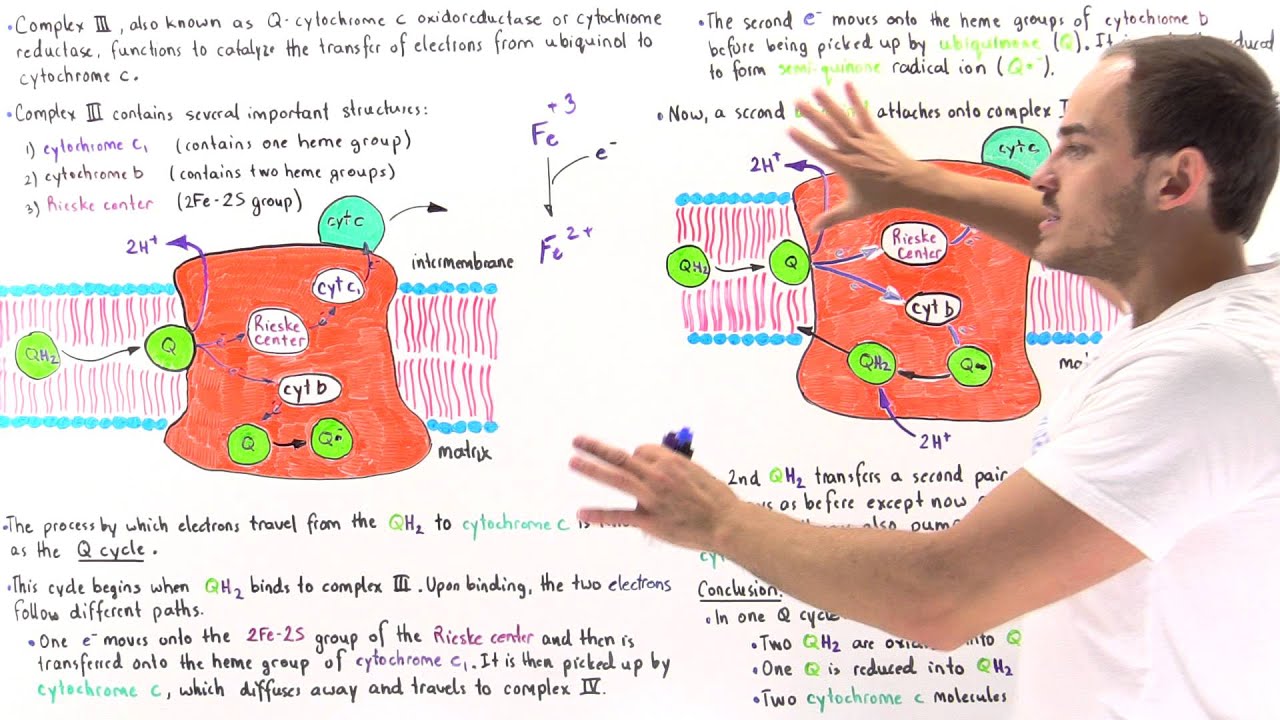
Q-Cycle and Complex III of Electron Transport Chain
Keywords
Summary
208 words
Critical Evaluation
Value of the Information & Strength of the Argument
The video delivers high educational value by breaking down a complex biochemical process into manageable steps. The argumentation is logical and systematic, following the flow of electrons and protons through each half-cycle. The presenter uses clear diagrams and verbal repetition to reinforce understanding, making the content accessible without oversimplifying. The explanation of why the Q-cycle is necessary (due to the difference in electron-carrying capacity between ubiquinone and cytochrome c) is particularly insightful and well-argued.
Scientific Rigor, Source Quality, Title Accuracy
The scientific rigor is high; the content aligns with standard biochemistry textbooks. However, the video does not cite specific sources, relying instead on established knowledge. The title accurately reflects the content, and the video stays focused on the topic without digressions. The presenter’s teaching method is effective, but the lack of citations may be a minor limitation for viewers seeking primary references.
151 words
Title / Content Match
The title accurately reflects the content, which focuses exclusively on the Q-cycle and Complex III of the electron transport chain.
Quality & Reliability
8/10
The video provides a detailed and accurate explanation of the Q-cycle mechanism, consistent with established biochemistry knowledge. The presenter uses clear diagrams and step-by-step reasoning, though no external sources are cited. The content is pedagogically sound and aligns with standard textbook descriptions.
Key Moments
Markers derived by PSI from the transcript: the creator did not define chapters.
- Introduction to Complex III and its role in the electron transport chain.
- Overview of the three major components of Complex III: cytochrome c1, cytochrome b, and Rieske center.
- Explanation of the first half-cycle of the Q-cycle, including electron pathways and proton pumping.
- Detailed description of the second half-cycle, including the formation of ubiquinol from semiquinone.
- Summary of the four key points: electron carrier capacities, proton release, ubiquinol recycling, and cytochrome c reduction.
- Conclusion emphasizing the importance of the proton gradient for ATP synthesis.
Cited Sources
- AK Lectures Website — The video is part of the AK Lectures series, and the website provides additional resources and lectures.
- Lecture Page for Q-Cycle and Complex III — The specific lecture page on the AK Lectures website, which may contain supplementary notes or diagrams.
Concurring Sources
- Biochemistry Textbook (e.g., Lehninger Principles of Biochemistry) — Standard biochemistry textbooks describe the Q-cycle in a similar manner, confirming the accuracy of the video's content.
External References
Contribution & Novelties
The video provides a clear and detailed explanation of the Q-cycle, a topic often found confusing by students. Its originality lies in the step-by-step breakdown of the two half-cycles, with emphasis on the electron pathways and the recycling mechanism. The presenter’s use of repetition and visual aids enhances comprehension.
Pour aller plus loin :
- Mitochondrial electron transport chain — Provides an overview of the entire electron transport chain, contextualizing Complex III.
- Coenzyme Q – cytochrome c reductase — Detailed article on Complex III, including its structure and function.
- Q cycle — Specific article on the Q-cycle mechanism, offering additional insights and references.
102 words
Radar Profile
The radar profile shows high scores in information quantity, quality, and technical level, with a slightly lower but still strong score in reliability. This indicates a well-structured, informative, and technically sound educational video, though it could benefit from citing external sources to enhance its reliability.
💬 Très positif. Sur les 30 commentaires analysés, tous expriment une gratitude et une admiration extrêmes pour la clarté de l'explication, beaucoup mentionnant que le Q-cycle leur est enfin devenu compréhensible.