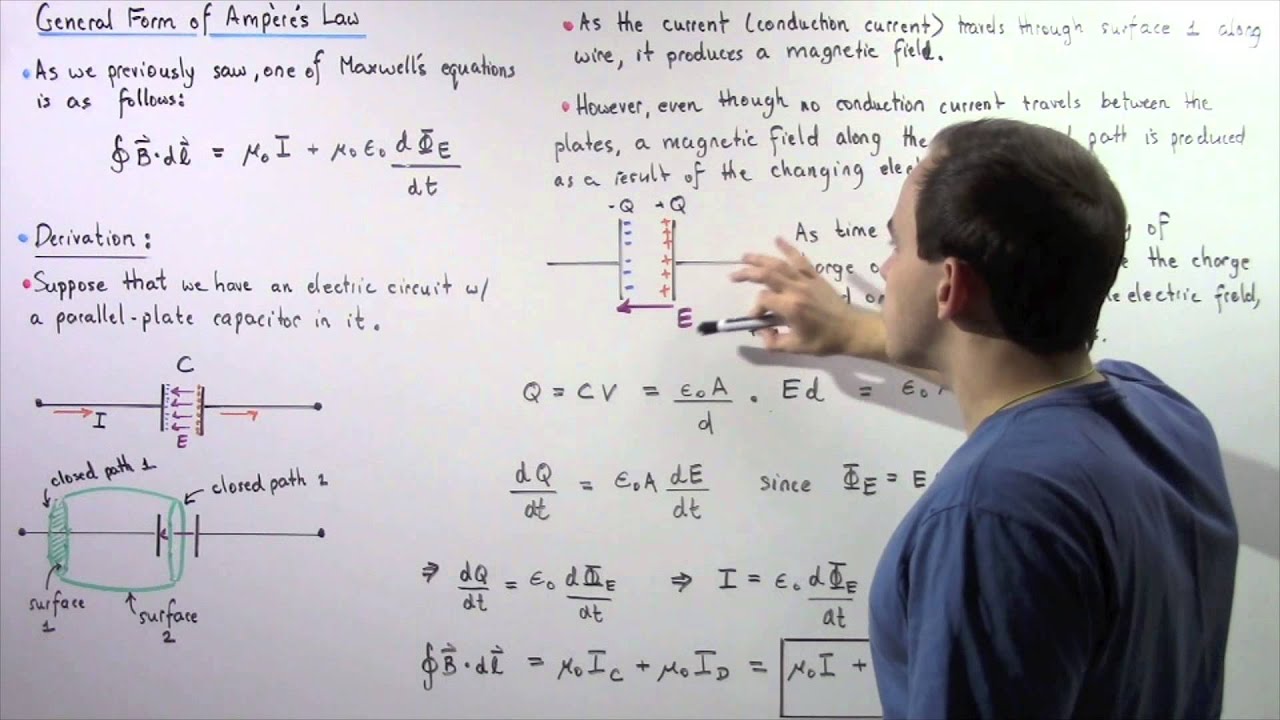
General Form of Ampere's Law Derivation
Keywords
Summary
157 words
Critical Evaluation
Value of the Information & Strength of the Argument
The video provides a clear and logical derivation of the general form of Ampere’s law, which is a fundamental equation in electromagnetism. The argumentation is solid, as it builds upon previously established concepts such as the basic form of Ampere’s law and the definition of electric flux. The presenter carefully explains each step, making the derivation accessible. The value lies in its pedagogical clarity, as it bridges the gap between the static and dynamic cases, emphasizing the role of displacement current. The reasoning is consistent and mathematically correct, though it does not delve into experimental verification or broader implications, which limits its depth.
Scientific Rigor, Source Quality, Title Accuracy
The video is scientifically rigorous in its derivation, following standard textbook methods. However, it does not cite external sources or references, relying solely on the presenter’s explanation. The title accurately reflects the content, which is a derivation of the general form of Ampere’s law. The description provides links to the presenter’s website and donation page, but no specific references to textbooks or papers. The lack of citations reduces the verifiability of the content, but the derivation itself is standard and can be found in many physics textbooks. The video does not contain any advertising or sponsored content.
215 words
Title / Content Match
The title accurately describes the content, which is a derivation of the general form of Ampere's law.
Quality & Reliability
7/10
The derivation is mathematically sound and follows standard textbook methodology. The presentation is clear and step-by-step, but lacks explicit references to external sources or experimental validation. The video is a tutorial, not a peer-reviewed study, so the score reflects its educational value and internal consistency.
Key Moments
Markers derived by PSI from the transcript: the creator did not define chapters.
- Introduction and statement of the general form of Ampere's law.
- Setup of the parallel plate capacitor circuit and definition of surfaces.
- Explanation of the conduction current term and its magnetic field.
- Introduction of the displacement current concept and its derivation.
- Derivation of the displacement current using capacitance and electric flux.
- Combining terms to obtain the final general form of Ampere's law.
- Conclusion and summary of the derivation.
Cited Sources
- AK Lectures Website — The lecturer's website where additional resources and lectures are available.
- Donation Page — Support page for the channel.
- Lecture Page — Direct link to the lecture on the website.
Concurring Sources
- Maxwell's equations — The general form of Ampere's law is one of Maxwell's equations, and this source provides a comprehensive overview.
- Displacement current — The concept of displacement current is central to the derivation, and this source explains it in detail.
Contribution & Novelties
The video provides a clear and systematic derivation of the general form of Ampere’s law, emphasizing the physical significance of the displacement current. It is a valuable educational resource for students, as it breaks down the derivation into manageable steps. The novelty lies in its pedagogical approach, which uses a parallel plate capacitor to intuitively explain the concept of displacement current.
Pour aller plus loin :
- Maxwell’s equations — Overview of the four equations and their significance.
- Displacement current — Detailed explanation of the concept and its role in electromagnetism.
- Ampere’s circuital law — Historical context and original formulation.
99 words
Radar Profile
The radar profile shows high scores in quality of information and technical level, indicating a well-structured and accurate tutorial. The quantity of information is moderate, as the video focuses on a single derivation. The overall reliability is good, though the lack of external references slightly reduces the score.
💬 Sur les 0 commentaires analysés, aucune tendance n'est disponible.