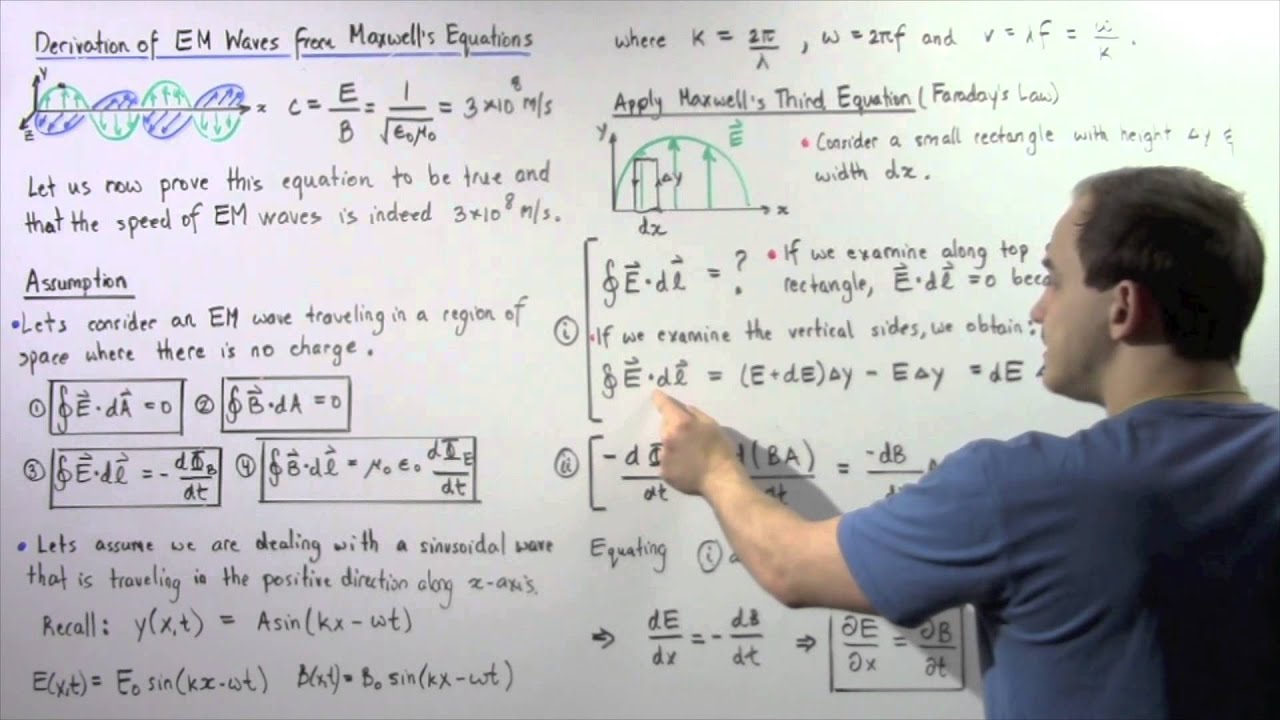
Derivation of Electromagnetic Waves from Maxwell's Equations
Keywords
Summary
141 words
Critical Evaluation
Value of the Information & Strength of the Argument
The video provides a clear and rigorous derivation of electromagnetic waves from Maxwell’s equations. The argumentation is logical and step-by-step, building from fundamental assumptions to the final result. The presenter carefully explains each step, including the application of Faraday’s law and Ampère-Maxwell law to rectangular loops, and correctly handles partial derivatives. The derivation is mathematically sound and aligns with standard textbook treatments. The value lies in its pedagogical clarity, making a complex derivation accessible to students. The presenter also connects the derived speed to the known speed of light, reinforcing the significance of Maxwell’s equations.
Scientific Rigor, Source Quality, Title Accuracy
The video demonstrates scientific rigor by deriving the wave equation from Maxwell’s equations without skipping steps. The presenter uses standard notation and correctly applies vector calculus. The sources are not explicitly cited within the video, but the content is based on well-established physics. The title accurately reflects the content, as the video indeed derives electromagnetic waves from Maxwell’s equations. The description provides links to the presenter’s website and donation page, but no external references are given. Overall, the scientific quality is high, though the lack of explicit citations is a minor drawback.
202 words
Title / Content Match
The title accurately describes the content: the video derives electromagnetic waves from Maxwell's equations, including the speed of light.
Quality & Reliability
8/10
The derivation is mathematically rigorous and follows standard textbook methodology. The presenter correctly applies Maxwell's equations under the assumptions of no charges/currents and sinusoidal waves, leading to the wave equation and the speed of light. The explanation is clear and step-by-step, with proper use of partial derivatives. Minor limitations: no discussion of boundary conditions or vector calculus nuances, but the core physics is accurate.
Key Moments
Markers derived by PSI from the transcript: the creator did not define chapters.
- Introduction to electromagnetic waves and the goal of deriving their speed from Maxwell's equations.
- Statement of assumptions: no charges/currents and sinusoidal wave traveling in x-direction.
- Application of Faraday's law to a rectangular loop in the electric field.
- Application of Ampère-Maxwell law to a rectangular loop in the magnetic field.
- Derivation of the wave equation and the relation v = E/B.
- Calculation of the speed of light using ε₀ and μ₀.
Cited Sources
- AK Lectures — Website of the presenter, providing additional lectures and resources.
- Derivation of Electromagnetic Waves from Maxwell's Equations — Direct link to the lecture page for this video.
Concurring Sources
- Maxwell's equations — Standard reference for Maxwell's equations and their derivations.
- Electromagnetic wave equation — Derivation of the wave equation from Maxwell's equations.
External References
Contribution & Novelties
The video provides a clear and systematic derivation of electromagnetic waves from Maxwell’s equations, which is a fundamental topic in physics. Its originality lies in its pedagogical approach, breaking down the derivation into manageable steps and explaining each mathematical manipulation. It reinforces the connection between electricity, magnetism, and light, highlighting the predictive power of Maxwell’s equations.
Pour aller plus loin :
- Maxwell’s equations — Overview of the four equations and their significance.
- Electromagnetic radiation — General properties and spectrum of electromagnetic waves.
- Speed of light — Historical context and precise value.
91 words
Radar Profile
The radar profile shows high scores in quality, quantity, and technical level, indicating a well-structured and informative tutorial. The reliability score is also high, reflecting the accuracy of the physics. The overall shape suggests a balanced and rigorous educational content.