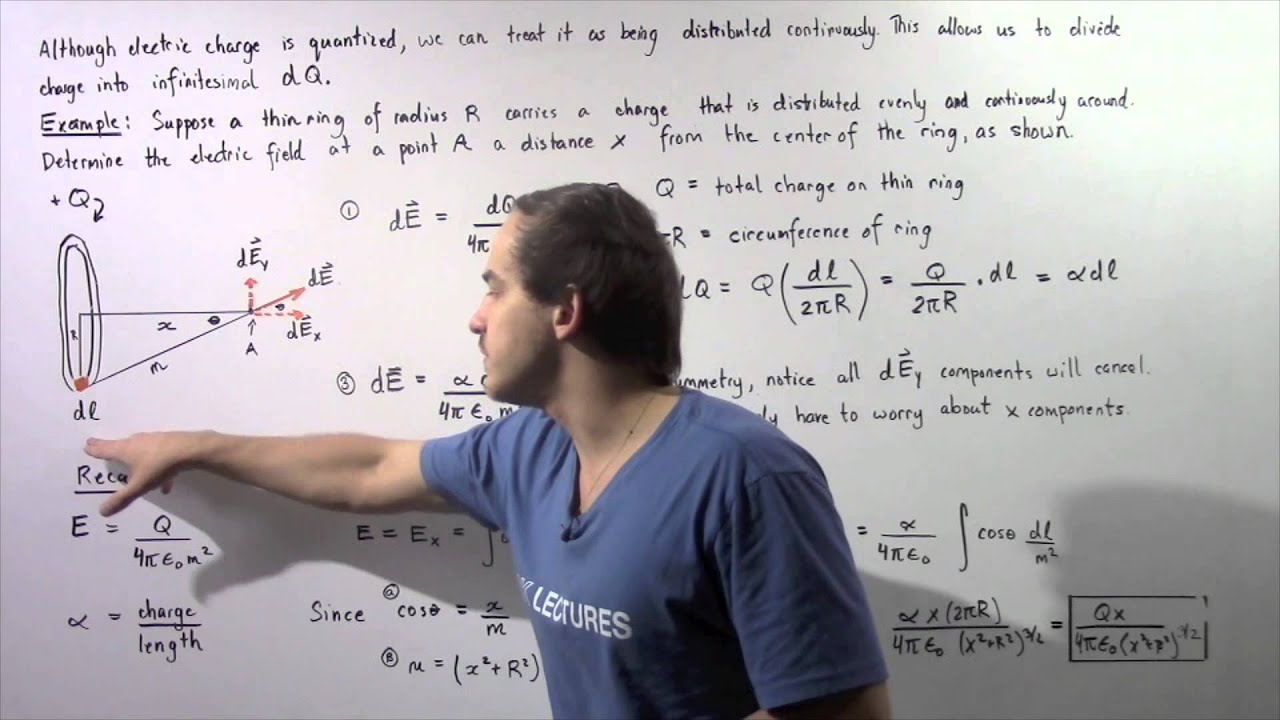
Electric Field due to Ring of Charge
Keywords
Summary
167 words
Critical Evaluation
Value of the Information & Strength of the Argument
The video provides a clear and logical derivation of the electric field due to a ring of charge. It breaks down the problem into five steps, making it easy to follow. The argumentation is solid: it uses Coulomb’s law, the principle of superposition, and symmetry arguments to simplify the integration. The explanation of why the perpendicular components cancel is particularly well done. The video also correctly introduces the concept of linear charge density and uses it to express the charge element. Overall, the information is accurate and the reasoning is sound, making it a valuable resource for students learning about continuous charge distributions.
Scientific Rigor, Source Quality, Title Accuracy
The video is scientifically rigorous in its derivation, but it does not cite any external sources. The title accurately reflects the content, which is a focused tutorial on the electric field of a ring of charge. The video does not discuss experimental verification or limitations of the model, but this is typical for an introductory physics tutorial. The lack of citations is not a major issue for a tutorial, but it limits the ability to verify the information independently.
197 words
Title / Content Match
The title accurately describes the content, which is a focused derivation of the electric field for a ring of charge.
Quality & Reliability
8/10
The video provides a clear, step-by-step derivation of the electric field due to a ring of charge, using standard physics principles (Coulomb's law, superposition, symmetry). The explanation is mathematically sound and pedagogically effective. However, it lacks citations to external sources and does not discuss experimental verification or limitations.
Key Moments
Markers derived by PSI from the transcript: the creator did not define chapters.
- Introduction: recall quantization of charge and continuous distribution.
- Setup of the problem: thin ring of radius R with charge Q, point A at distance x.
- Definition of infinitesimal charge element dq and electric field dE.
- Introduction of linear charge density λ and relation dq = λ dl.
- Expression for dE in terms of dl and λ.
- Symmetry argument: cancellation of perpendicular components.
- Integration setup: only x-component contributes.
- Use of cosine and Pythagorean theorem to simplify integrand.
- Integration over the ring circumference.
- Final result: E = Qx / (4πε₀ (x² + R²)^(3/2)).
Cited Sources
- AK Lectures Website — General educational resource for physics lectures.
- Donate page — Support for the channel.
- Related lecture: Electric Field due to Infinite Parallel Plates Example — Related example on electric fields.
Concurring Sources
- HyperPhysics - Electric Field, Ring of Charge — Confirms the derived formula for the electric field on the axis of a ring.
Contribution & Novelties
The video provides a clear and systematic derivation of the electric field due to a ring of charge, which is a classic example in electromagnetism. It emphasizes the method of dividing a continuous charge distribution into infinitesimal elements and integrating, which is a fundamental technique. The video does not present new research but serves as an educational resource. For further exploration, one can study more complex charge distributions, such as disks or spheres, and the use of Gauss’s law for symmetric cases.
Pour aller plus loin :
- Electric field — General concept of electric field.
- Coulomb’s law — Fundamental law used in the derivation.
- Superposition principle — Principle used to sum contributions.
- Linear charge density — Definition of charge density.
- Gauss’s law — Alternative method for symmetric charge distributions.
129 words
Radar Profile
The radar profile shows high scores in quality and reliability, with slightly lower scores in quantity and technical level. This indicates a focused, accurate tutorial that may not cover a wide range of related topics but provides solid foundational knowledge.