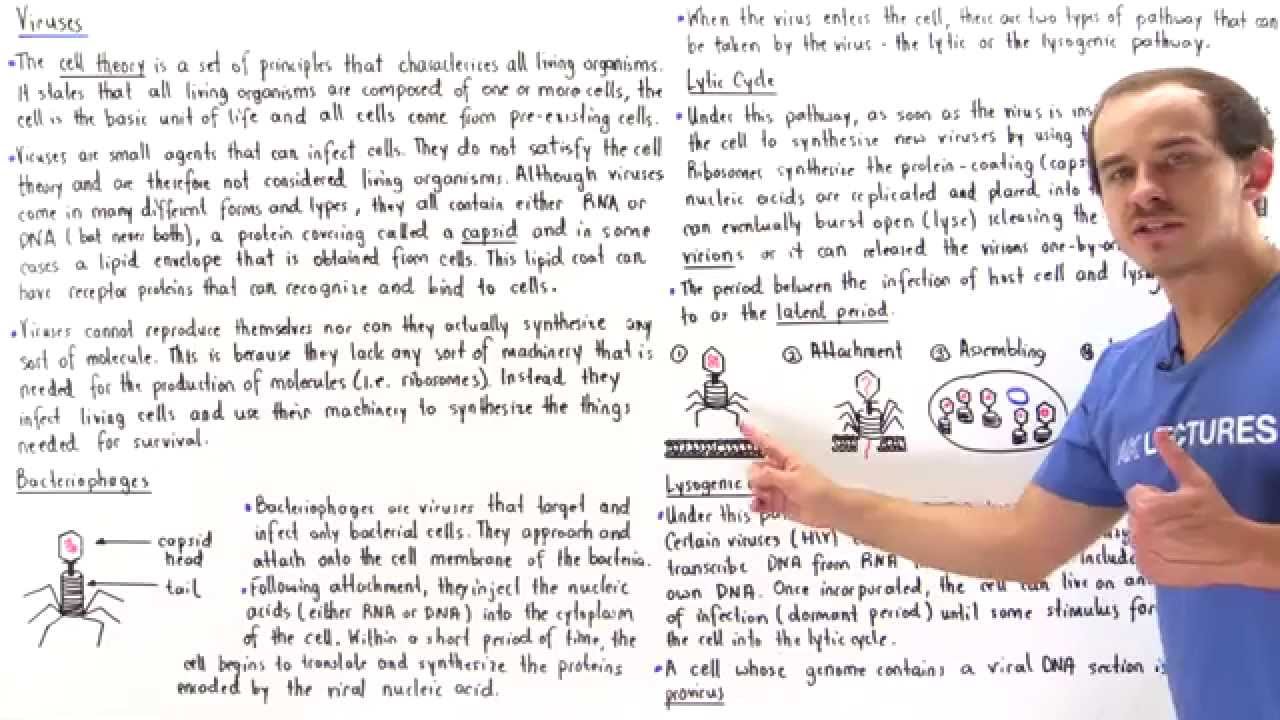
Viruses, Lytic Cycle and Lysogenic Cycle
Keywords
Summary
212 words
Critical Evaluation
Value of the Information & Strength of the Argument
The video provides a clear and structured explanation of viral replication cycles, using simple diagrams and analogies to aid understanding. The argumentation is logical, progressing from viral structure to the two cycles, and effectively contrasts the lytic and lysogenic pathways. However, the presentation is purely descriptive and lacks critical analysis or discussion of exceptions and complexities, such as the diversity of viral strategies or the molecular mechanisms involved. The value lies in its pedagogical clarity for beginners, but it does not offer novel insights or depth for advanced learners.
Scientific Rigor, Source Quality, Title Accuracy
The scientific rigor is moderate: the content is accurate but presented without citations or references to primary literature. The video relies on established textbook knowledge, which is reliable for introductory purposes, but it does not engage with current research or controversies. The title accurately reflects the content, and the video stays on topic. No external sources are cited within the video, and the description only provides links to the creator’s website and donation page, which are not scientific references. The lack of citations limits the video’s utility for verifying claims or exploring further.
197 words
Title / Content Match
The title accurately reflects the content, which focuses on viruses and their two main replication cycles.
Quality & Reliability
7/10
The video provides a clear and accurate overview of viral structure and the lytic and lysogenic cycles, but lacks depth and citations. It is suitable for introductory biology, but does not cover recent research or nuances.
Key Moments
Markers derived by PSI from the transcript: the creator did not define chapters.
- Introduction to cell theory and definition of viruses as non-living.
- Description of viral structure: nucleic acids, capsid, lipid envelope.
- Introduction to bacteriophage and its structure.
- Explanation of the lytic cycle steps: attachment, injection, synthesis, assembly, lysis.
- Explanation of the lysogenic cycle: integration as provirus, dormancy, and induction.
- Comparison of lytic and lysogenic cycles, mentioning HIV as an example.
Cited Sources
- AK Lectures - Viruses, Lytic Cycle and Lysogenic Cycle — The video's dedicated lecture page on the creator's website.
- AK Lectures - Homepage — The creator's educational website.
- AK Lectures - Donate — Donation page for the educational content.
Concurring Sources
- Bacteriophage - Wikipedia — Confirms the structure and lytic cycle of bacteriophages.
- Lysogenic cycle - Wikipedia — Confirms the integration and dormancy aspects of the lysogenic cycle.
Contribution & Novelties
The video offers a clear, didactic explanation of viral replication cycles, which is valuable for students new to virology. It effectively uses the bacteriophage as a model to illustrate the lytic cycle and introduces the lysogenic cycle with the concept of a provirus. The main novelty is the pedagogical approach, not new scientific information.
Pour aller plus loin :
- Bacteriophage - Wikipedia — Provides detailed information on bacteriophage biology and their use in research.
- Lysogenic cycle - Wikipedia — Explores the lysogenic cycle in more depth, including molecular mechanisms and examples.
- HIV - Wikipedia — Discusses HIV’s replication cycle, including its lysogenic-like behavior and integration into the host genome.
109 words
Radar Profile
The radar profile shows a balanced performance across all dimensions, with moderate scores in information quantity, quality, and reliability, and a lower score in technical level, reflecting the introductory nature of the content.