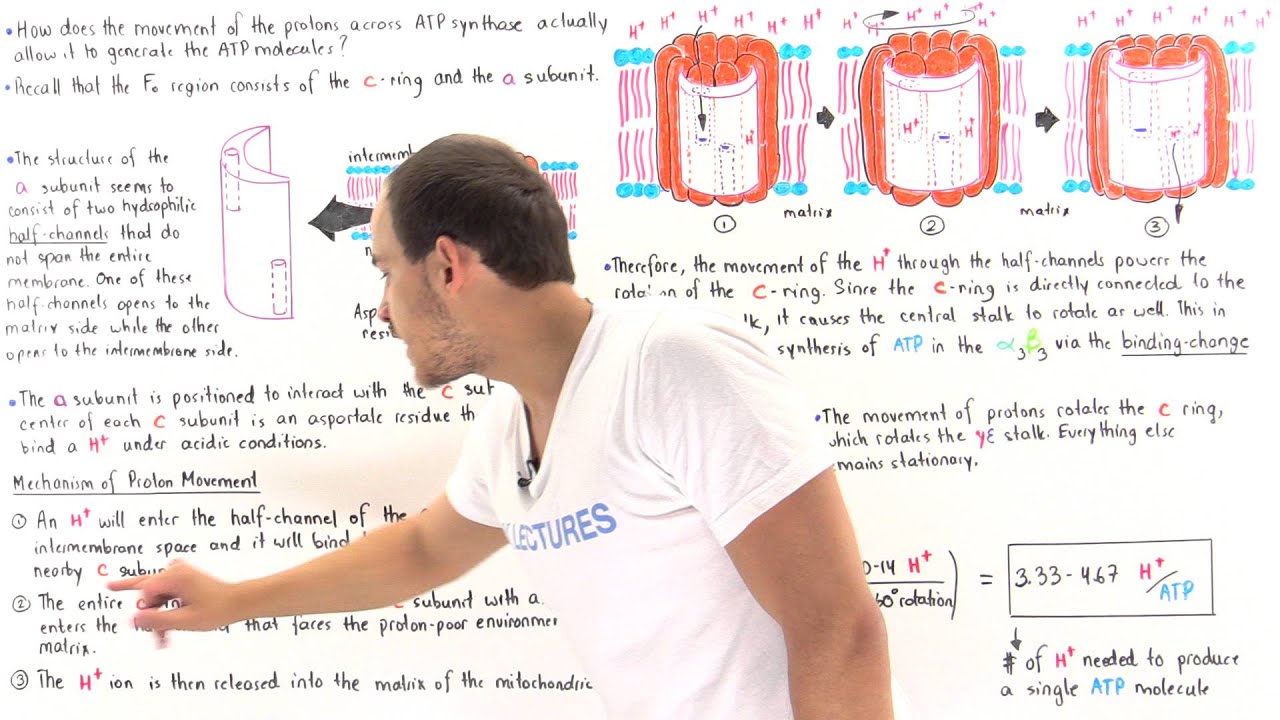
Proton Movement in ATP Synthase
Keywords
Summary
130 words
Critical Evaluation
Value of the Information & Strength of the Argument
The video provides a clear and detailed explanation of the proton movement mechanism in ATP synthase, which is a complex topic. The argumentation is logical and well-structured, building from the structure of the F0 region to the mechanism of proton flow and its coupling to ATP synthesis. The use of diagrams enhances understanding. The video correctly emphasizes the role of the c-ring rotation and the half-channels in the a-subunit. The stoichiometry calculation is presented clearly, though it simplifies the variability in c-ring subunit numbers. Overall, the information is valuable for students and provides a solid foundation for understanding chemiosmotic coupling.
Scientific Rigor, Source Quality, Title Accuracy
The video is scientifically accurate and aligns with established biochemical knowledge. However, it does not cite specific sources or references, which limits the ability to verify the information directly. The title accurately reflects the content. The video is a science communication piece, not a peer-reviewed study, so the lack of citations is not unexpected. The diagrams are helpful and the explanation is consistent with textbook descriptions of ATP synthase function.
185 words
Title / Content Match
The title accurately reflects the content, which focuses on the mechanism of proton movement through ATP synthase.
Quality & Reliability
8/10
Clear and accurate explanation of the mechanism of proton movement in ATP synthase, based on established biochemical knowledge. The video is well-structured and uses helpful diagrams. Minor limitations: no explicit citations to primary literature, and the structure of the a-subunit is presented as a model.
Key Moments
Markers derived by PSI from the transcript: the creator did not define chapters.
- Introduction to the lecture, focusing on two questions: how proton movement powers ATP synthesis and how many protons are needed per ATP.
- Review of ATP synthase structure: F1 and F0 regions, c-ring and a-subunit.
- Detailed description of the F0 region, including the c-ring and a-subunit, and the aspartate residue at position 61.
- Explanation of the proton movement mechanism: protons enter the half-channel, bind to aspartate, and cause c-ring rotation.
- Continuation of the mechanism: rotation of the c-ring drives the central stalk, leading to ATP synthesis.
- Discussion of the stoichiometry: 10-14 protons per 360-degree rotation produce 3 ATP, giving 3.3-4.7 protons per ATP.
- Summary of the key points and conclusion.
Cited Sources
- AK Lectures - Proton Movement in ATP Synthase — The video's dedicated lecture page on the AK Lectures website.
- AK Lectures - Main Website — The main website of the channel, providing access to other lectures.
Concurring Sources
- ATP synthase - Wikipedia — General reference on ATP synthase structure and function, consistent with the video's explanation.
External References
Contribution & Novelties
The video provides a clear and accessible explanation of the proton movement mechanism in ATP synthase, which is often challenging for students. It breaks down the process into logical steps and uses diagrams to illustrate the rotation of the c-ring and the role of the a-subunit. The video also addresses the stoichiometry of protons to ATP, which is a common point of confusion. Overall, it serves as an excellent educational resource for biochemistry students.
Pour aller plus loin :
- ATP synthase - Wikipedia — Provides a comprehensive overview of ATP synthase structure and function.
- Chemiosmosis - Wikipedia — Explains the proton gradient and its role in ATP synthesis.
- Binding change mechanism - Wikipedia — Details the catalytic mechanism of ATP synthesis in the F1 region.
125 words
Radar Profile
The radar profile shows high scores in information quantity, quality, and reliability, with a slightly lower score in technical level, indicating that the video is accessible to a broad audience while maintaining scientific accuracy.
💬 Très positif. Sur les 30 commentaires analysés, tous expriment une gratitude et une admiration extrêmes pour la clarté des explications et l'utilité des vidéos pour les études, avec des termes comme 'héros', 'sauvé ma vie' et 'meilleur professeur'.