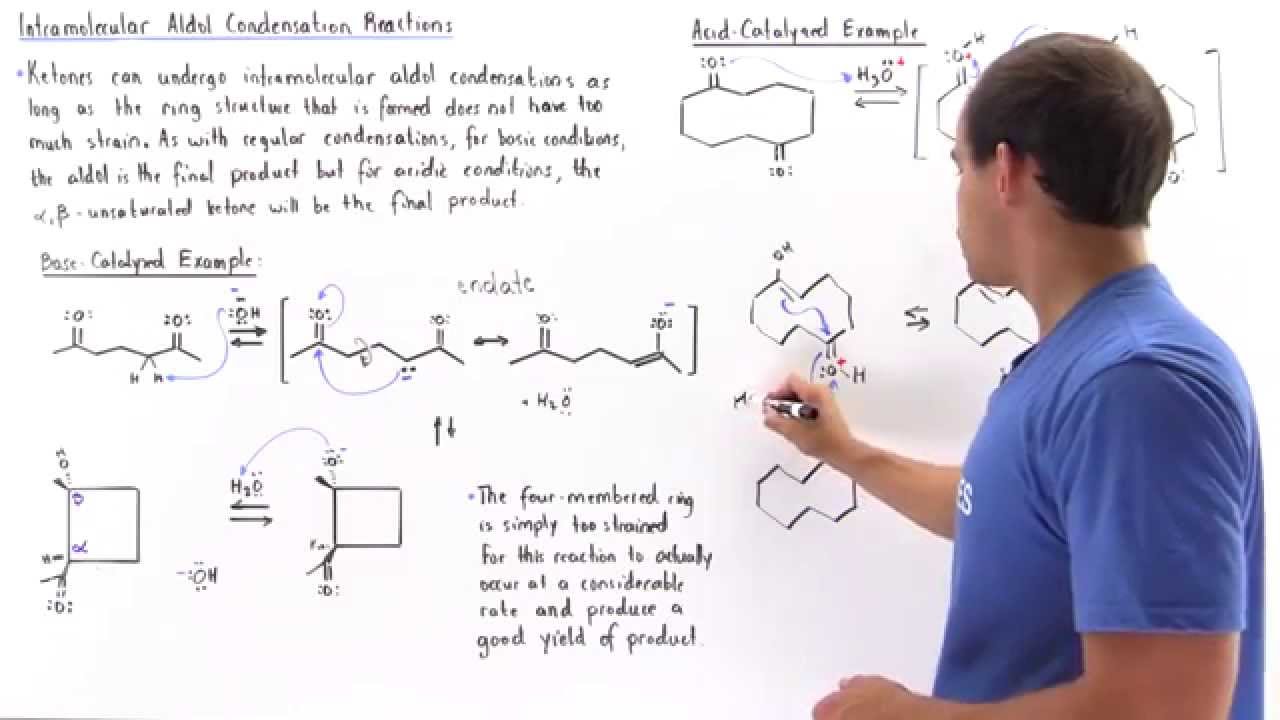
Intramolecular Aldol Condensation
Keywords
Summary
145 words
Critical Evaluation
Value of the Information & Strength of the Argument
The video provides a clear and logical explanation of the intramolecular aldol condensation, breaking down each step of the mechanism. It effectively uses examples to illustrate why certain ring sizes are favored, highlighting the role of ring strain. The argumentation is sound, with careful attention to electron pushing and intermediate stability. However, it does not discuss experimental evidence or real-world applications, limiting its value for advanced learners. The focus is purely on mechanism, without addressing regioselectivity or stereochemistry, which are important in synthetic applications.
Scientific Rigor, Source Quality, Title Accuracy
The video is scientifically accurate in its depiction of the aldol condensation mechanism, but it lacks citations to primary literature or textbooks. The title accurately describes the content, which is a tutorial on intramolecular aldol condensation. No external sources are referenced, and the description only provides links to the creator’s website and donation page. The absence of sources reduces the scientific rigor, though the content itself is consistent with standard organic chemistry knowledge.
172 words
Title / Content Match
The title accurately reflects the content, which focuses exclusively on intramolecular aldol condensation.
Quality & Reliability
7/10
The video provides a clear, step-by-step mechanism for intramolecular aldol condensation under basic and acidic conditions, with accurate chemical reasoning. However, it lacks citations to primary literature and does not address experimental evidence or exceptions, limiting its scientific depth.
Key Moments
Markers derived by PSI from the transcript: the creator did not define chapters.
- Introduction to intramolecular aldol condensation and overview of basic vs acidic conditions.
- Base-catalyzed example: formation of enolate and intramolecular attack leading to a strained four-membered ring.
- Explanation of why four-membered rings are too strained, favoring five- and six-membered rings.
- Start of acid-catalyzed example with a 10-carbon diketone, protonation step.
- Formation of enol and intramolecular attack on the protonated carbonyl.
- Formation of aldol intermediate and subsequent dehydration to yield α,β-unsaturated ketone.
- Final elimination step and product formation, summarizing the difference between basic and acidic conditions.
Cited Sources
- AK Lectures - Intramolecular Aldol Condensation — Video lecture page with additional resources.
- AK Lectures Website — General website for educational content.
Concurring Sources
- Clayden, Organic Chemistry (2nd ed.) — Standard textbook covering aldol reactions in detail.
External References
Contribution & Novelties
The video provides a clear, step-by-step tutorial on intramolecular aldol condensation, emphasizing the mechanistic differences between basic and acidic conditions. It effectively illustrates the importance of ring strain in determining reaction feasibility. While not novel, it serves as a useful educational resource for students.
Pour aller plus loin :
- Aldol condensation — Overview of the aldol reaction and its variants.
- Ring strain — Explanation of how ring size affects stability.
- Enolate chemistry — Detailed discussion of enolate formation and reactivity.
80 words
Radar Profile
The radar profile shows balanced scores across information quantity, quality, technical level, and reliability, with a slight emphasis on quality and reliability. This indicates a solid educational video with accurate content, though it may lack depth in terms of advanced concepts and citations.