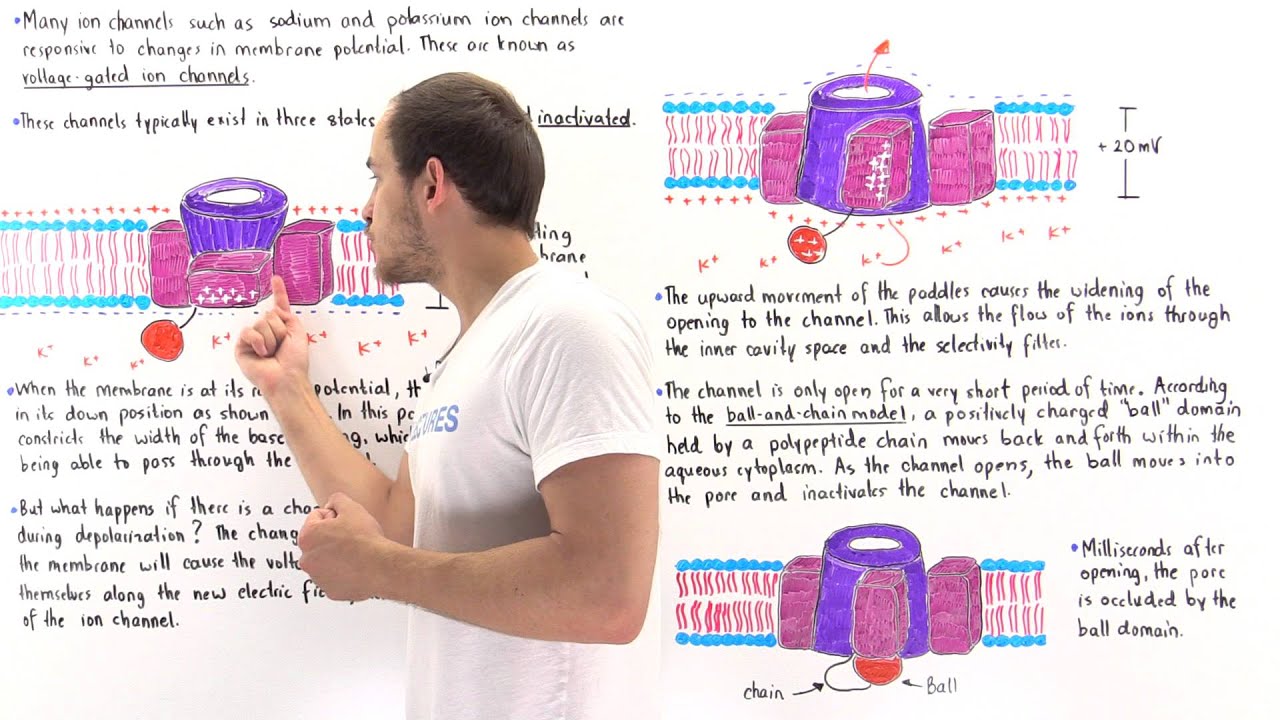
Voltage-Gated Ion Channels
Keywords
Summary
151 words
Critical Evaluation
Value of the Information & Strength of the Argument
The video provides a valuable educational overview of voltage-gated ion channels, clearly explaining the conformational states and the role of the paddle domains in voltage sensing. The argumentation is logically structured, moving from the closed state to the open state and then to inactivation, with each step building on the previous. The use of the ball-and-chain model is well-illustrated, and the explanation of how depolarization alters the electric field and triggers conformational changes is compelling. However, the video does not delve into quantitative aspects or experimental evidence, which limits its depth. The presentation is persuasive for an introductory audience, but it lacks critical evaluation of alternative models or nuances in channel gating.
Scientific Rigor, Source Quality, Title Accuracy
The scientific rigor is moderate: the content is accurate but presented without citations to primary literature. The video relies on established textbook knowledge, and the ball-and-chain model is a well-known hypothesis, though it is presented as fact without mentioning its limitations. The title accurately reflects the content, and the video stays on topic. The description provides links to the creator’s website and donation page, but no direct references to scientific papers. The video does not include any public comments for analysis, so no trends can be inferred.
214 words
Title / Content Match
The title accurately reflects the content, which focuses on the structure and function of voltage-gated ion channels.
Quality & Reliability
7/10
The video provides a clear and accurate explanation of voltage-gated ion channels, covering the three conformational states and the ball-and-chain model of inactivation. The content is consistent with established biophysics and neuroscience knowledge, though it lacks citations to primary literature and simplifies some molecular details.
Key Moments
Markers derived by PSI from the transcript: the creator did not define chapters.
- Introduction to voltage-gated ion channels and their response to membrane potential changes.
- Explanation of the three conformational states: closed, open, and inactivated.
- Description of the closed state with the paddle domains oriented downward, constricting the pore.
- Explanation of depolarization and its effect on the electric field and paddle orientation.
- Transition to the open state, allowing ion flow through the pore.
- Introduction of the ball-and-chain model for inactivation.
- Detailed description of the ball-and-chain mechanism blocking the pore.
- Summary of the three states and their role in regulating ion movement.
Cited Sources
- AK Lectures - Voltage-Gated Ion Channels — Lecture page for this video, providing additional resources.
- AK Lectures — General website of the creator, containing many educational videos.
- Donation Page — Support page for the channel.
Concurring Sources
- Voltage-gated ion channel - Wikipedia — General reference confirming the structural and functional aspects described.
- Ball-and-chain inactivation - Wikipedia — Reference for the inactivation model mentioned in the video.
Contribution & Novelties
The video offers a clear and concise explanation of voltage-gated ion channels, particularly emphasizing the conformational changes and the ball-and-chain model. It is a useful educational resource for students, but it does not present new scientific findings. The originality lies in its pedagogical approach, using simple diagrams and analogies to explain complex biophysical concepts.
Pour aller plus loin :
- Voltage-gated ion channel — Overview of the topic, including structure and function.
- Ball-and-chain inactivation — Detailed description of the model.
- Action potential — Context for the role of voltage-gated channels in neuronal signaling.
92 words
Radar Profile
The radar profile shows balanced scores across information quantity, quality, technical level, and reliability, with a slight emphasis on quality and reliability. This indicates a solid educational resource that is accurate but not highly technical or comprehensive.