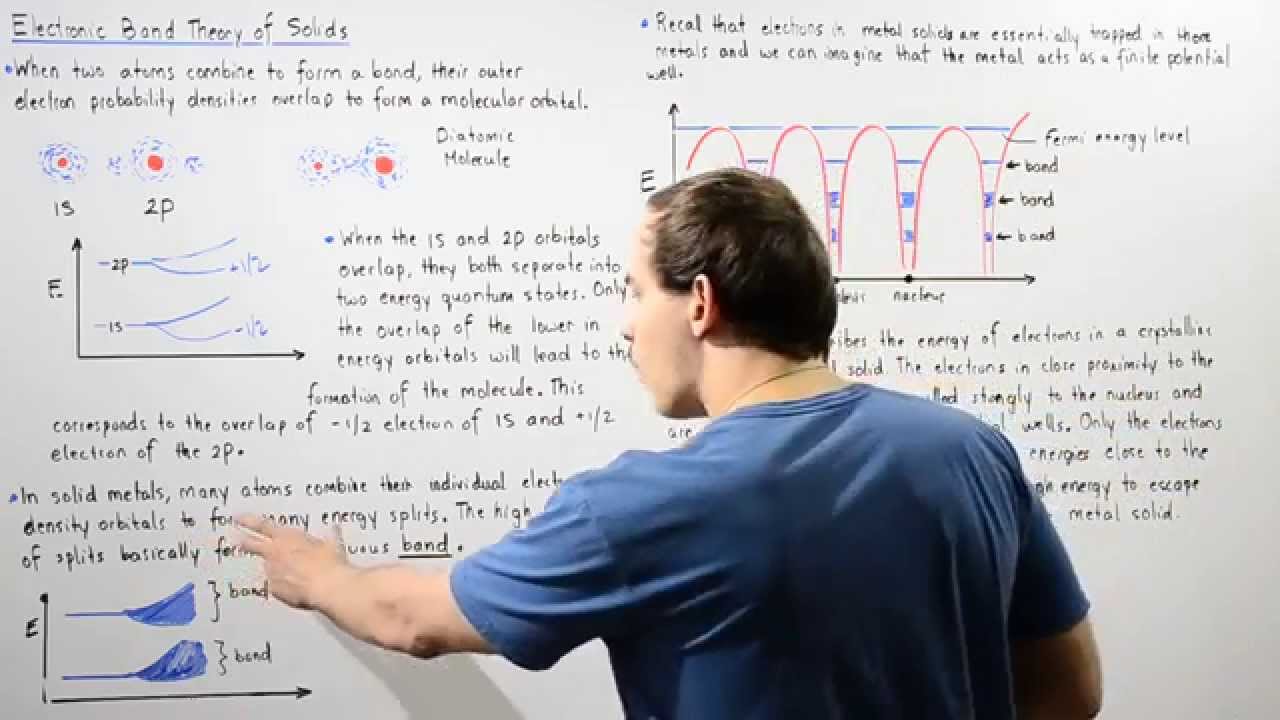
Electron Band Theory of Solids
Keywords
Summary
162 words
Critical Evaluation
Value of the Information & Strength of the Argument
The video provides a clear and logical explanation of band theory, building from molecular orbital theory to the formation of energy bands in solids. The argumentation is sound, using established quantum mechanical principles such as the Heisenberg uncertainty principle and electron spin. The explanation of the Fermi energy and its role in conductivity is particularly valuable. However, the video lacks depth in some areas, such as the derivation of band structures and the distinction between conductors, insulators, and semiconductors, which are not addressed. The presentation is didactic and easy to follow, making it a useful introductory resource.
Scientific Rigor, Source Quality, Title Accuracy
The video is scientifically accurate and aligns with standard solid-state physics textbooks. However, it does not cite any external sources or references, which limits its scholarly rigor. The title accurately reflects the content, and the video stays on topic throughout. The lack of citations is a minor weakness, but the content itself is reliable and consistent with established knowledge.
171 words
Title / Content Match
The title accurately reflects the content, which focuses on the electronic band theory of solids.
Quality & Reliability
7/10
The video provides a clear, accurate introduction to band theory, but lacks citations and depth. It is based on standard physics concepts and is consistent with established knowledge.
Key Moments
Markers derived by PSI from the transcript: the creator did not define chapters.
Cited Sources
- AK Lectures - Electron Band Theory of Solids — Video lecture page with additional resources
- AK Lectures Website — General website for the lecture series
- Donate to AK Lectures — Support page for the channel
Concurring Sources
- Electronic band structure - Wikipedia — General reference for band theory concepts
Contribution & Novelties
The video offers a clear and concise introduction to band theory, making it accessible to students. It effectively connects molecular orbital theory to the formation of energy bands in solids. The explanation of the Fermi energy and its significance is particularly helpful. However, it does not introduce new concepts or original research.
Pour aller plus loin :
- Band theory — Wikipedia article providing a comprehensive overview.
- Fermi energy — Wikipedia article on the Fermi energy.
- Kronig-Penney model — A quantum mechanical model that explains energy bands in periodic potentials.
89 words
Radar Profile
The radar profile shows moderate scores across all dimensions, with slightly higher quality and reliability compared to quantity and technical depth. This indicates a solid introductory video that is accurate but not exhaustive.
💬 Très positif. Sur les 30 commentaires analysés, tous expriment une grande satisfaction, louant la clarté des explications et l'accent du présentateur, sans aucune critique négative.