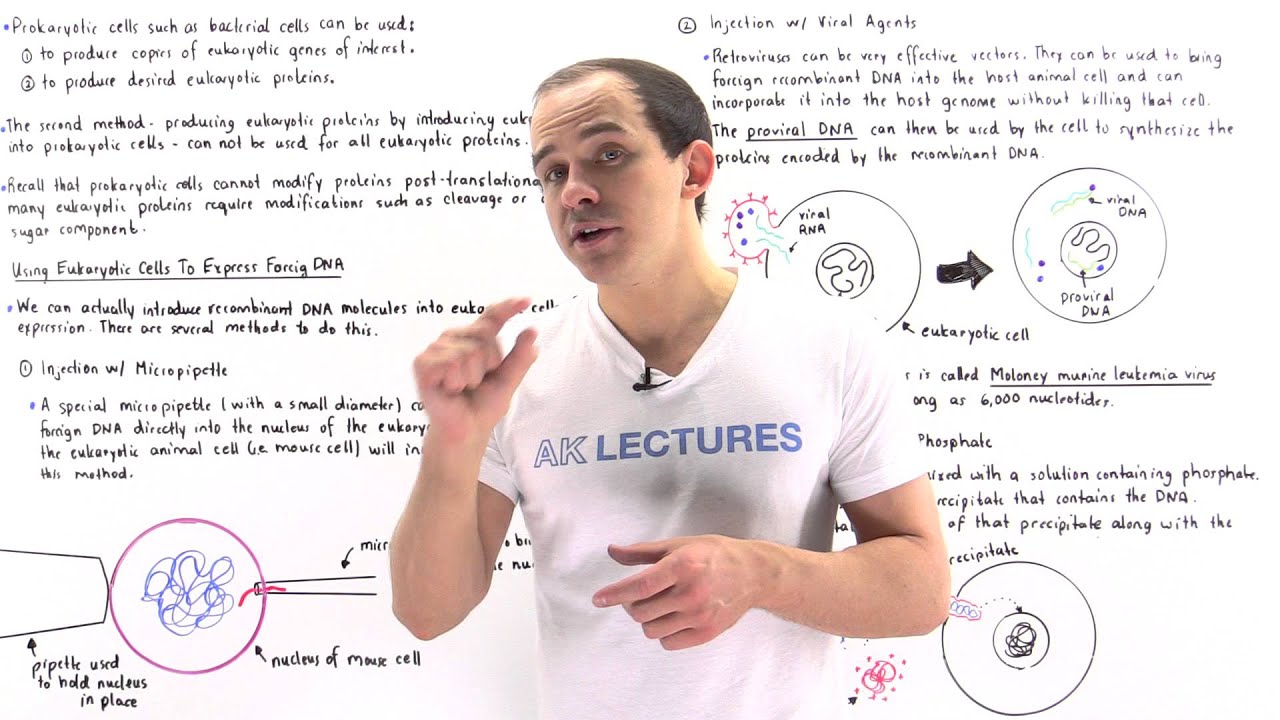
Gene Transfection
Keywords
Summary
138 words
Critical Evaluation
Value of the Information & Strength of the Argument
The video provides a clear and structured explanation of gene transfection methods, highlighting the rationale behind using eukaryotic cells for protein production. It effectively contrasts prokaryotic and eukaryotic systems, explaining why post-translational modifications are important. The argumentation is logical, moving from the problem (prokaryotic cells cannot modify proteins) to the solution (eukaryotic cells can be used) and then detailing three methods. However, the video lacks depth in discussing the efficiency, limitations, and applications of each method, and it does not address alternative methods like electroporation or lipofection. The explanation of the calcium phosphate mechanism is vague, admitting that the exact mechanism is unknown.
Scientific Rigor, Source Quality, Title Accuracy
The video is scientifically accurate in its core content, but it does not cite specific sources or references. The description provides links to the creator’s website and donation page, but no direct references to scientific literature. The title accurately reflects the content, which is focused on gene transfection methods. The video is a basic educational resource, suitable for introductory understanding, but it lacks citations to primary literature and does not discuss recent advances or controversies in the field.
196 words
Title / Content Match
The title accurately reflects the content, which focuses on methods for introducing foreign genes into eukaryotic cells.
Quality & Reliability
7/10
The video provides a clear and accurate overview of gene transfection methods, with correct explanations of key concepts such as retroviruses, reverse transcriptase, and calcium phosphate transfection. However, it lacks citations to primary literature and does not discuss limitations or alternative methods in depth.
Key Moments
Markers derived by PSI from the transcript: the creator did not define chapters.
- Introduction to recombinant DNA technology and applications in prokaryotic cells.
- Explanation of post-translational modifications in eukaryotic cells and limitations of prokaryotic cells.
- Introduction to the three methods for injecting genes into eukaryotic cells.
- Method 1: Injection with a micropipette, including success rate in mouse cells.
- Method 2: Injection with retroviruses, explaining reverse transcriptase and integrase.
- Diagram of retroviral vector and integration into host genome.
- Example of Moloney murine leukemia virus and its capacity for DNA insertion.
- Method 3: Transfection with calcium phosphate, including precipitate formation and endocytosis.
- Diagram of calcium phosphate transfection and DNA uptake.
- Summary of the three methods and conclusion.
Cited Sources
- AK Lectures - Gene Transfection — The video's dedicated lecture page on the creator's website, providing additional resources.
- AK Lectures — The creator's educational website hosting the video and related content.
Concurring Sources
- Transfection - Wikipedia — General overview of transfection methods, consistent with the video's content.
- Retrovirus - Wikipedia — Information on retroviruses and their use as vectors, supporting the video's explanation.
External References
Contribution & Novelties
The video provides a concise and accessible introduction to gene transfection methods, which is valuable for students and beginners. It clearly explains the rationale for using eukaryotic cells for protein production and outlines three common techniques. However, it does not offer novel insights or advanced details beyond standard textbook content.
Pour aller plus loin :
- Transfection - Wikipedia — Overview of transfection methods and applications.
- Retrovirus - Wikipedia — Detailed information on retrovirus biology and use as vectors.
- Calcium phosphate transfection - Wikipedia — Specifics on the calcium phosphate method.
90 words
Radar Profile
The radar profile shows balanced scores across all dimensions, with slightly lower technical depth and source rigor. This indicates a solid introductory resource, but not a comprehensive or highly technical treatment.