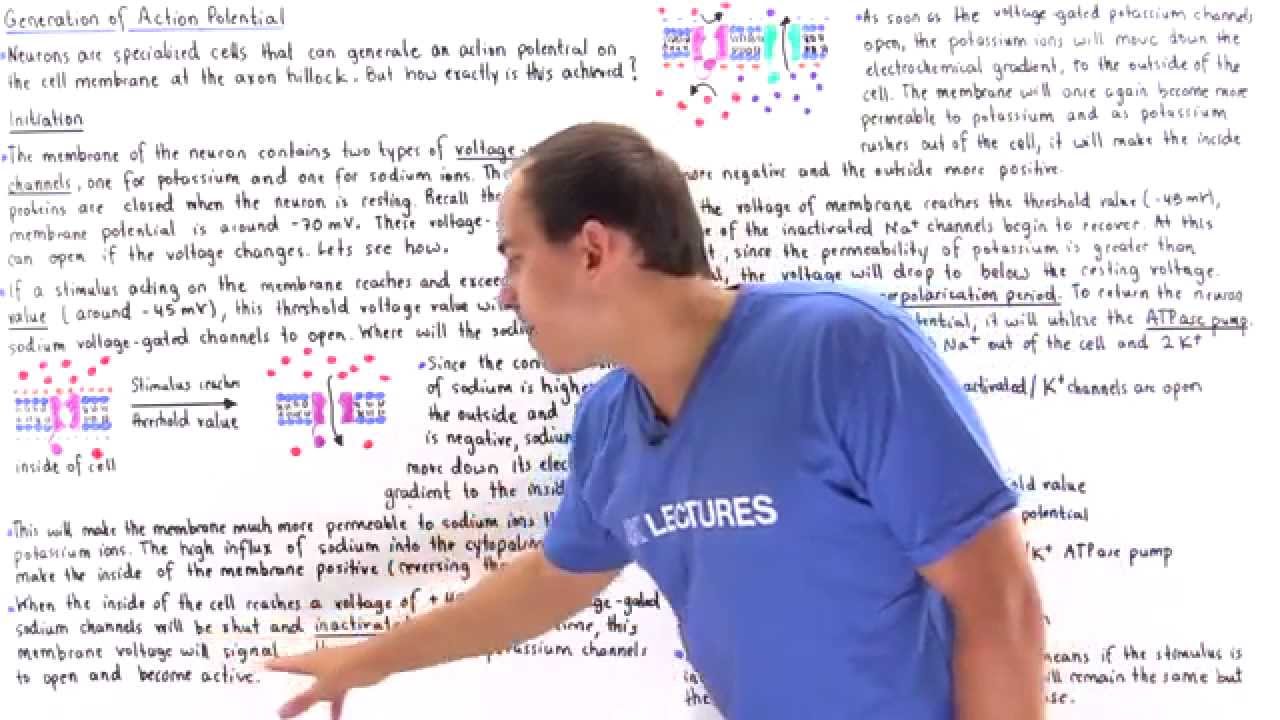
Initiation of Action Potential
Keywords
Summary
148 words
Critical Evaluation
Value of the Information & Strength of the Argument
The video provides a solid, step-by-step explanation of the initiation of action potentials, making complex concepts accessible. The argumentation is logical and well-structured, using diagrams and clear analogies. It effectively explains the roles of voltage-gated channels and the electrochemical gradient. However, it does not delve into experimental evidence or alternative perspectives, limiting its depth for advanced learners.
Scientific Rigor, Source Quality, Title Accuracy
The scientific content is accurate and aligns with standard neuroscience textbooks. However, the video does not cite specific sources or references, relying on general knowledge. The title accurately reflects the content, focusing on the initiation phase. The description provides links to the creator’s website and lecture page, but no external scientific references. The video is a tutorial, so the lack of citations is acceptable but reduces its scholarly rigor.
141 words
Title / Content Match
The title accurately reflects the content, which focuses specifically on the initiation phase of action potentials.
Quality & Reliability
8/10
The video provides a clear and accurate explanation of the initiation of action potentials, covering key concepts such as voltage-gated channels, depolarization, repolarization, hyperpolarization, and the all-or-nothing principle. The content aligns with established neuroscience knowledge, though it lacks citations to primary literature.
Key Moments
Markers derived by PSI from the transcript: the creator did not define chapters.
- Introduction to action potentials and voltage-gated ion channels
- Explanation of resting membrane potential and threshold
- Depolarization: sodium channels open and sodium influx
- Repolarization: potassium channels open and potassium efflux
- Hyperpolarization and role of sodium-potassium pump
- Graph summary of action potential phases
- All-or-nothing principle and frequency coding
- Refractory periods: absolute and relative
Cited Sources
- AK Lectures Website — General educational resource by the author
- Lecture Page: Initiation of Action Potential — Direct link to the lecture content
Concurring Sources
- Neuroscience textbook (e.g., Kandel et al.) — Standard reference for action potential mechanisms
External References
Contribution & Novelties
The video offers a clear and concise tutorial on the initiation of action potentials, suitable for students. It provides a visual and step-by-step explanation of the phases, which is valuable for understanding the process. While it does not present new research, it effectively synthesizes existing knowledge.
Pour aller plus loin :
- Action potential - Wikipedia — Comprehensive overview of action potentials.
- Voltage-gated sodium channel - Wikipedia — Detailed information on sodium channels.
- Hodgkin-Huxley model - Wikipedia — Mathematical model of action potentials.
82 words
Radar Profile
The radar profile shows high scores in quality and reliability, with moderate quantity and technical level, indicating a focused and accurate tutorial that may not cover all advanced aspects.