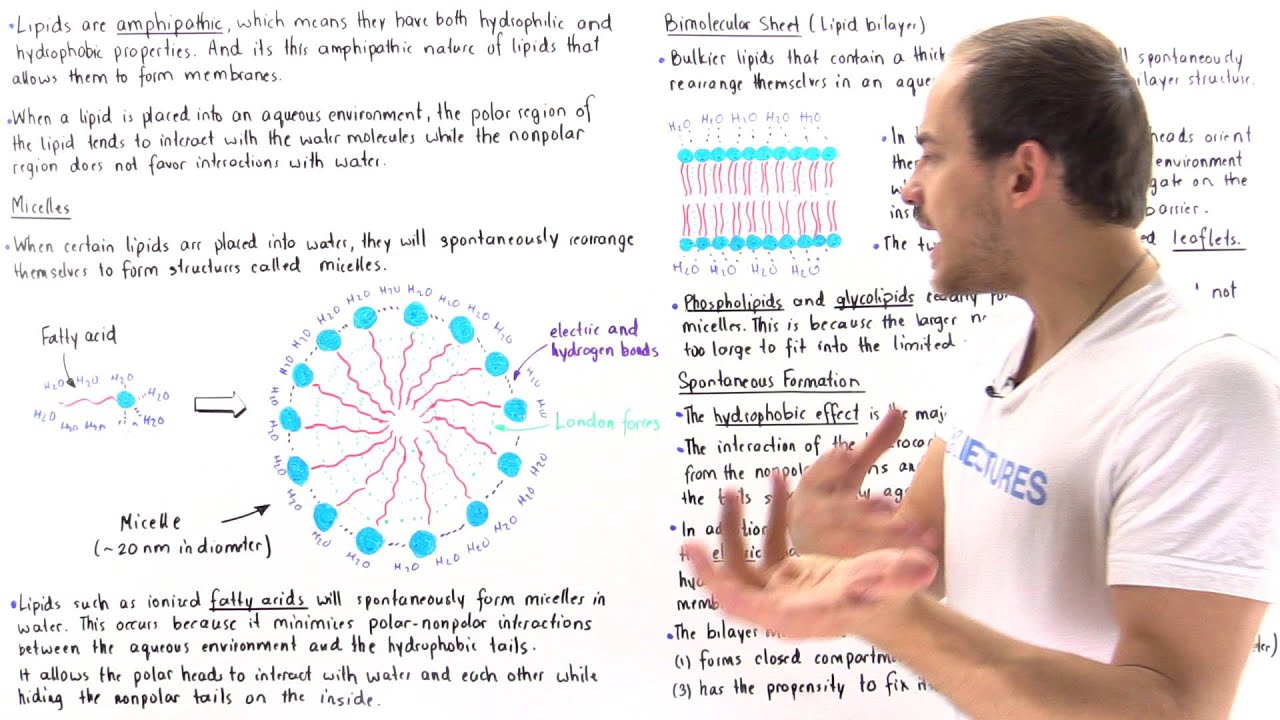
Micelles and Lipid Bilayer
Keywords
Summary
179 words
Critical Evaluation
Value of the Information & Strength of the Argument
The video provides a solid introduction to the molecular basis of lipid self-assembly. It clearly explains the hydrophobic effect and its role in driving the formation of micelles and bilayers. The argumentation is logical, starting with the amphipathic nature of lipids and progressing to the structural differences between micelles and bilayers. The use of diagrams enhances understanding. However, the video does not delve into quantitative aspects or experimental evidence, but for an introductory tutorial, it is effective.
Scientific Rigor, Source Quality, Title Accuracy
The scientific content is accurate and aligns with standard biochemistry textbooks. The video does not cite specific sources, but the information is well-established. The title accurately reflects the content. The description provides links to the lecturer’s website and donation page, but no direct references to scientific literature. The video is a tutorial, so the lack of citations is acceptable, but for a more rigorous treatment, references would be beneficial.
161 words
Title / Content Match
The title accurately reflects the content, which focuses on the structure and formation of micelles and lipid bilayers.
Quality & Reliability
8/10
The video provides a clear, accurate explanation of the hydrophobic effect and the formation of micelles and lipid bilayers, consistent with established biochemistry. The content is well-structured and pedagogically sound, though it lacks citations to primary literature.
Key Moments
Markers derived by PSI from the transcript: the creator did not define chapters.
- Introduction to amphipathic lipids and their role in cell membranes
- Explanation of micelle formation from ionized fatty acids
- Detailed diagram of micelle structure and hydrophobic effect
- Transition to lipid bilayer formation and comparison with micelles
- Cross-section of lipid bilayer showing leaflets and hydrophobic interior
- Types of lipids that form bilayers (phospholipids, glycolipids) vs micelles
- Hydrophobic effect as driving force for both structures
- Three key points: spontaneous formation, size difference, self-repair
Cited Sources
- AK Lectures - Micelles and Lipid Bilayer — Lecture page with additional resources
- AK Lectures — General website with educational content
Concurring Sources
- Lipid bilayer — Wikipedia article on lipid bilayers, consistent with video content
- Micelle — Wikipedia article on micelles, consistent with video content
External References
Contribution & Novelties
The video provides a clear and accessible explanation of the hydrophobic effect and its role in lipid self-assembly, which is a fundamental concept in biochemistry. It effectively contrasts micelles and lipid bilayers, highlighting structural differences and the importance of lipid geometry. The presentation is suitable for students new to the topic.
Pour aller plus loin :
- Hydrophobic effect — Overview of the thermodynamic driving force.
- Lipid bilayer — Detailed structure and properties.
- Micelle — Formation and applications.
77 words
Radar Profile
The radar profile shows high scores in quality and reliability, with moderate scores in quantity and technical level. This indicates a focused, accurate tutorial that provides essential information without excessive depth.