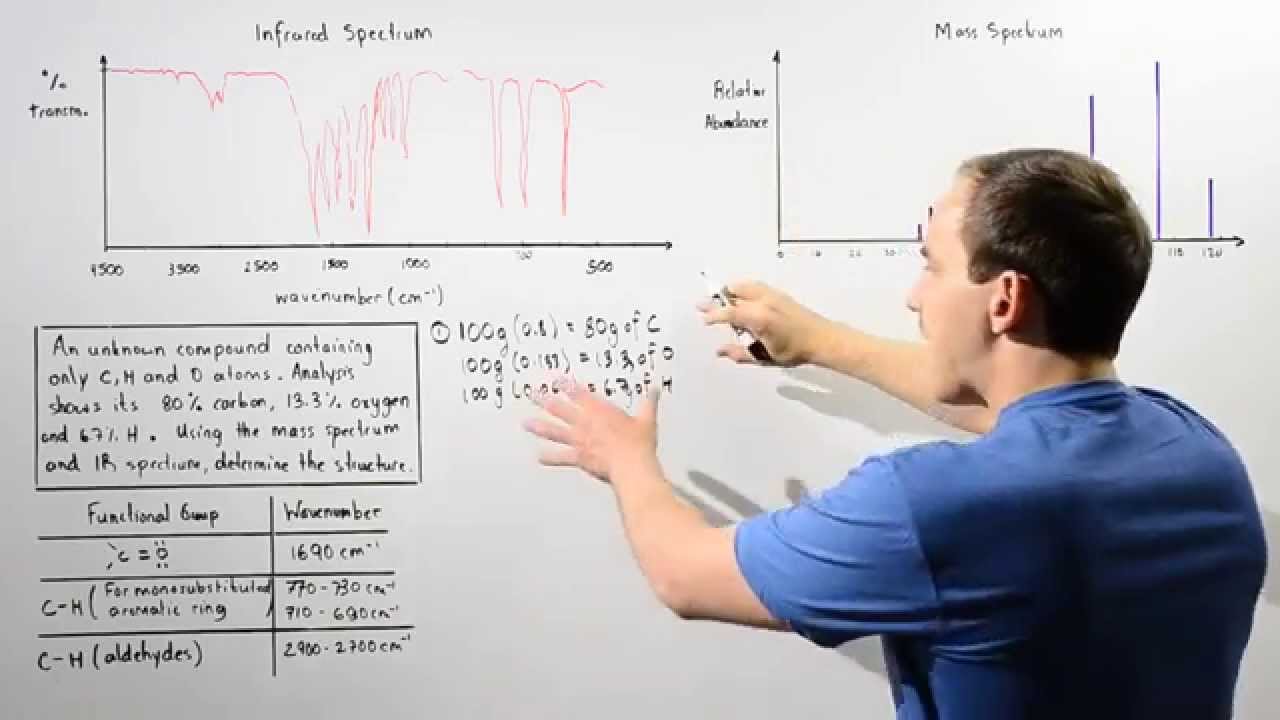
Mass and Infrared Spectrum Example
Keywords
Summary
178 words
Critical Evaluation
Value of the Information & Strength of the Argument
The video provides a clear, step-by-step approach to solving a typical analytical chemistry problem, combining elemental analysis, mass spectrometry, and infrared spectroscopy. The argumentation is logical and well-structured, with each step building on the previous one. The use of the degree of unsaturation formula is correctly applied, and the interpretation of the IR spectrum is systematic, using characteristic absorption bands to identify functional groups. The reasoning is sound, and the final structure is correctly deduced. However, the video could benefit from a more detailed explanation of the mass spectrum interpretation, as it only briefly mentions the molecular ion peak. Overall, the information is valuable for students learning spectroscopy, and the argumentation is solid.
Scientific Rigor, Source Quality, Title Accuracy
The video is a tutorial by Andrey K, a known educational content creator. The scientific content is accurate and follows standard textbook methods. However, no external sources or references are cited within the video or description, which limits the ability to verify the information independently. The title accurately reflects the content, which is a worked example combining mass and infrared spectra. The description provides links to the creator’s website and donation page, but no specific references to scientific literature. The video’s educational value is high, but the lack of citations reduces its scientific rigor.
222 words
Title / Content Match
The title accurately reflects the content, which is a worked example combining mass and infrared spectra.
Quality & Reliability
7/10
The video provides a clear, step-by-step tutorial on determining an unknown compound's structure using elemental analysis, mass spectrometry, and infrared spectroscopy. The methodology is standard and correctly applied, though the presentation is somewhat informal and lacks references to primary literature.
Key Moments
Markers derived by PSI from the transcript: the creator did not define chapters.
- Introduction to the problem: unknown compound with C, H, O, elemental analysis percentages.
- Step 1: Calculating empirical formula from mass percentages.
- Determining molecular formula using mass spectrum (molecular ion peak at 120).
- Step 2: Calculating degree of unsaturation (Omega = 5).
- Proposing possible structures with benzene ring and additional double bond.
- Analyzing IR spectrum: peaks at 710-690 and 770-730 cm⁻¹ indicate monosubstituted benzene.
- Eliminating aldehyde based on absence of C-H stretch around 2700-2900 cm⁻¹.
- Confirming ketone via carbonyl peak at 1690 cm⁻¹ and concluding structure is acetophenone.
Cited Sources
- AK Lectures - Mass and Infrared Spectrum Example — The video is hosted on this page, which may contain additional resources.
- AK Lectures Website — General website of the content creator, offering lectures on various topics.
Concurring Sources
- Mass Spectrometry (Wikipedia) — Provides background on mass spectrometry principles, supporting the video's use of molecular ion peak.
- Infrared Spectroscopy (Wikipedia) — Explains IR absorption frequencies for functional groups, consistent with the video's analysis.
External References
Contribution & Novelties
The video provides a clear, step-by-step example of combining mass spectrometry and infrared spectroscopy to determine an unknown compound’s structure, which is a common exercise in organic chemistry. It effectively demonstrates the logical process from elemental analysis to final structure elucidation. The novelty lies in its pedagogical approach, breaking down the problem into manageable steps.
Pour aller plus loin :
- Mass spectrometry — Overview of the technique and its applications.
- Infrared spectroscopy — Explanation of IR absorption and functional group identification.
- Degree of unsaturation — Formula and interpretation.
- Acetophenone — Properties and uses of the compound identified in the video.
100 words
Radar Profile
The radar profile shows balanced scores across all dimensions, with slightly lower technical level and information quantity, reflecting the introductory nature of the tutorial. The high reliability and quality scores indicate accurate content, while the moderate technical level suggests it is accessible to beginners.