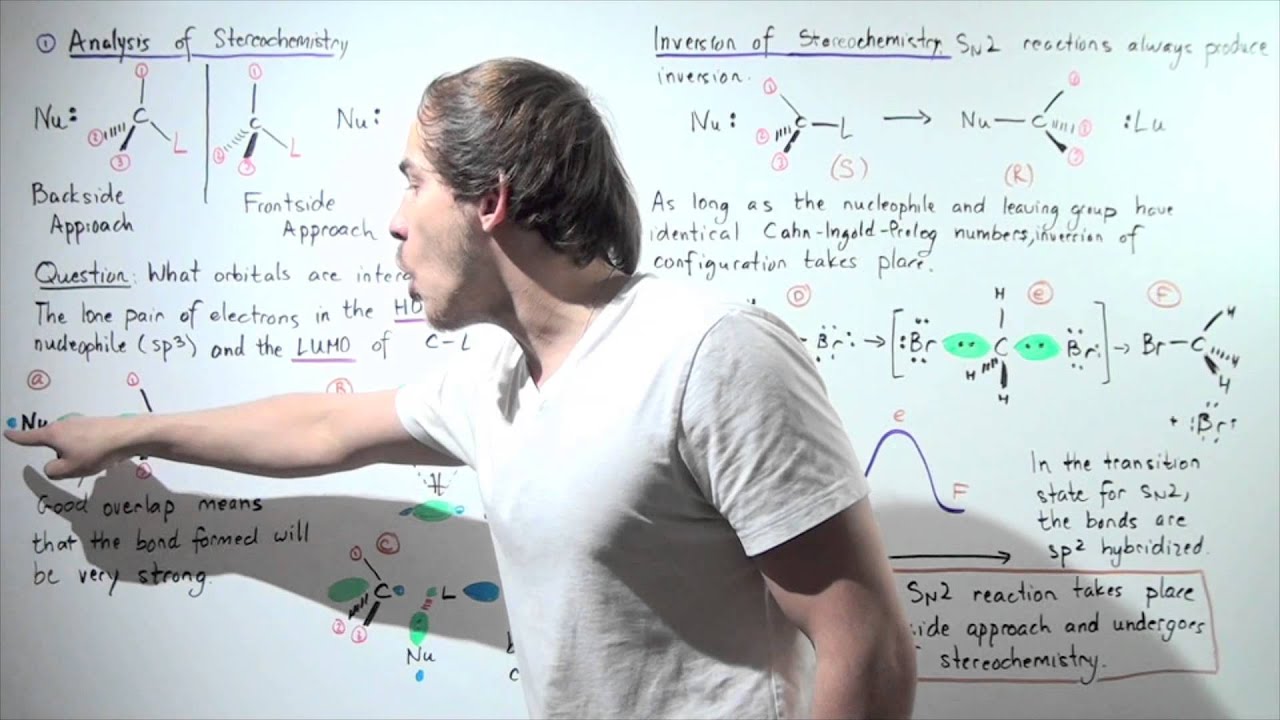
Mechanism of Sn2 Reaction
Keywords
Summary
157 words
Critical Evaluation
Value of the Information & Strength of the Argument
The video provides a clear and logical explanation of the SN2 mechanism, using molecular orbital theory to justify the backside attack. The argumentation is sound and builds step-by-step, from the identification of HOMO and LUMO to the comparison of backside and frontside approaches. The use of orbital overlap diagrams effectively illustrates why backside attack is favored. The explanation of stereochemical inversion is well-supported by the umbrella analogy and the transition state geometry. The video does not present any experimental data or references, but the theoretical framework is consistent with established organic chemistry knowledge.
Scientific Rigor, Source Quality, Title Accuracy
The video is scientifically accurate and aligns with standard textbook explanations of the SN2 mechanism. However, it does not cite any sources or references, which limits its scientific rigor. The title accurately reflects the content, and the video fulfills its promise of explaining the mechanism. The description provides links to the creator’s website and donation page, but no specific references to literature or further reading. The video is a tutorial, so the lack of citations is not unusual, but it could be improved by mentioning primary sources.
195 words
Title / Content Match
The title accurately reflects the content, which focuses on the mechanism of the SN2 reaction.
Quality & Reliability
7/10
The video provides a clear and accurate explanation of the SN2 reaction mechanism, focusing on orbital interactions and stereochemistry. The content is consistent with standard organic chemistry principles, but it lacks citations to primary literature and does not address potential exceptions or advanced nuances.
Key Moments
Markers derived by PSI from the transcript: the creator did not define chapters.
- Introduction to SN2 reaction and recap of previous lecture
- Question: backside vs frontside approach
- Identification of HOMO and LUMO in SN2 reaction
- Orbital overlap analysis for backside approach
- Frontside approach: poor overlap and cancellation
- Conclusion: SN2 always backside attack
- Inversion of stereochemistry and umbrella analogy
- Transition state geometry: planar and sp2 hybridized
- Energy diagram showing transition state at maximum
- Summary: backside attack and inversion
Cited Sources
- AK Lectures - Mechanism of SN2 Reaction — Video lecture page on the creator's website
- AK Lectures — General website of the creator
Concurring Sources
- SN2 reaction - Wikipedia — Confirms the backside attack and inversion of configuration in SN2 reactions.
External References
Contribution & Novelties
The video provides a clear and accessible explanation of the SN2 mechanism, particularly the orbital justification for backside attack and the resulting inversion of stereochemistry. It effectively uses molecular orbital theory to explain why frontside attack is unfavorable. The video is a tutorial, so it does not present new research, but it offers a pedagogical approach that may help students understand the concept.
Pour aller plus loin :
- SN2 reaction - Wikipedia — Provides a comprehensive overview of the SN2 mechanism, including kinetics and stereochemistry.
- Frontier molecular orbital theory - Wikipedia — Explains the HOMO-LUMO interactions that underpin the orbital analysis in the video.
- Nucleophilic substitution - Wikipedia — Contextualizes SN2 within broader substitution reactions.
115 words
Radar Profile
The radar profile shows a balanced performance across all dimensions, with slightly higher scores in quality of information and reliability, reflecting the accurate but uncited content. The lower score in technical level indicates that the video is accessible to a broad audience, while the quantity of information is moderate for a 12-minute tutorial.