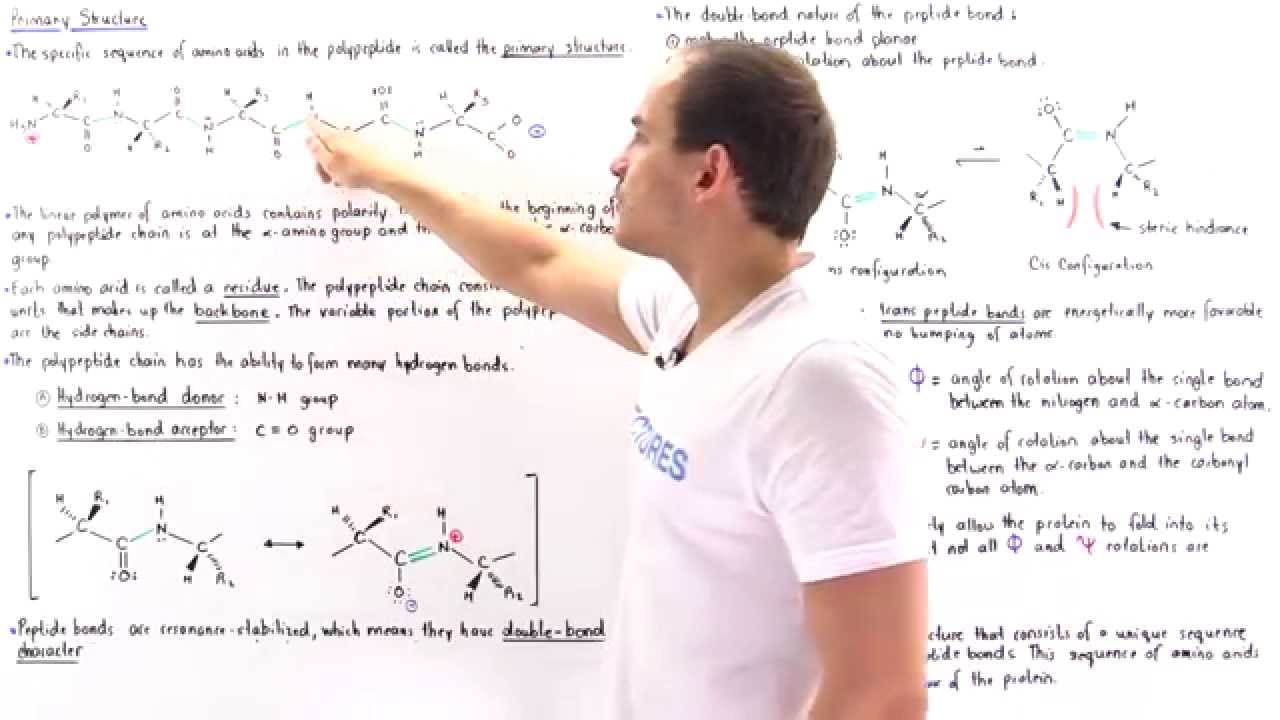
Primary Structure of Proteins
Keywords
Summary
218 words
Critical Evaluation
Value of the Information & Strength of the Argument
The video provides substantial educational value by breaking down complex concepts into understandable segments. The argumentation is solid, using clear diagrams and logical reasoning to explain the structural and chemical properties of peptide bonds. The explanation of resonance stabilization and its consequences on bond rotation is particularly well-argued, linking fundamental chemistry to protein structure. The presentation is methodical, building from basic definitions to more advanced concepts, which enhances comprehension.
Scientific Rigor, Source Quality, Title Accuracy
The scientific rigor is high; the content aligns with standard biochemistry textbooks. The video does not cite external sources but relies on established knowledge. The title accurately reflects the content, which is focused solely on the primary structure. The description provides links to the lecturer’s website for further resources, but no specific references are given. The comments indicate that viewers find the explanations helpful and clear, with no significant criticisms or corrections.
156 words
Title / Content Match
The title accurately reflects the content, which focuses exclusively on the primary structure of proteins.
Quality & Reliability
8/10
The content is scientifically accurate and well-structured, covering fundamental concepts of protein primary structure. The explanations are clear and consistent with established biochemistry knowledge. The video is a tutorial, not a primary research source, but the information is reliable for educational purposes.
Key Moments
Markers derived by PSI from the transcript: the creator did not define chapters.
- Introduction to protein structure levels and definition of primary structure
- Explanation of amino acid sequence and peptide bonds, including n-1 rule
- Discussion of polypeptide polarity and N-to-C convention
- Description of backbone and side chains, hydrogen bonding potential
- Explanation of peptide bond resonance stabilization and double-bond character
- Planarity of peptide bond and prevention of rotation
- Trans vs cis configuration and steric hindrance
- Introduction to torsion angles phi and psi, and their role in folding
Cited Sources
- AK Lectures Website — General resource for lecture videos and notes
- Primary Structure of Proteins Lecture — Direct link to the lecture page for this video
Concurring Sources
- Biochemistry Textbook (e.g., Lehninger) — Standard biochemistry textbooks confirm the concepts presented, such as peptide bond resonance and torsion angles.
External References
Contribution & Novelties
The video offers a clear and systematic explanation of protein primary structure, emphasizing the chemical basis of peptide bond properties. It effectively connects concepts like resonance stabilization to the planarity and rigidity of the peptide bond, and introduces torsion angles as key to protein folding. This provides a solid foundation for understanding higher levels of protein structure.
Pour aller plus loin :
- Protein primary structure - Wikipedia — Overview of primary structure and its significance.
- Peptide bond - Wikipedia — Detailed information on peptide bond properties, including resonance and planarity.
- Ramachandran plot - Wikipedia — Visual representation of allowed torsion angles (phi and psi) in protein backbones.
107 words
Radar Profile
The radar profile shows high scores in information quality and reliability, with slightly lower but still good scores in quantity and technical level. This indicates a well-balanced educational video that is both accurate and accessible.
💬 Très positif. Sur les 30 commentaires analysés, les spectateurs expriment une admiration unanime pour la clarté des explications et la qualité de l'enseignement, le qualifiant de 'meilleur professeur de biochimie' et soulignant l'impact positif sur leur compréhension et leur réussite aux examens.