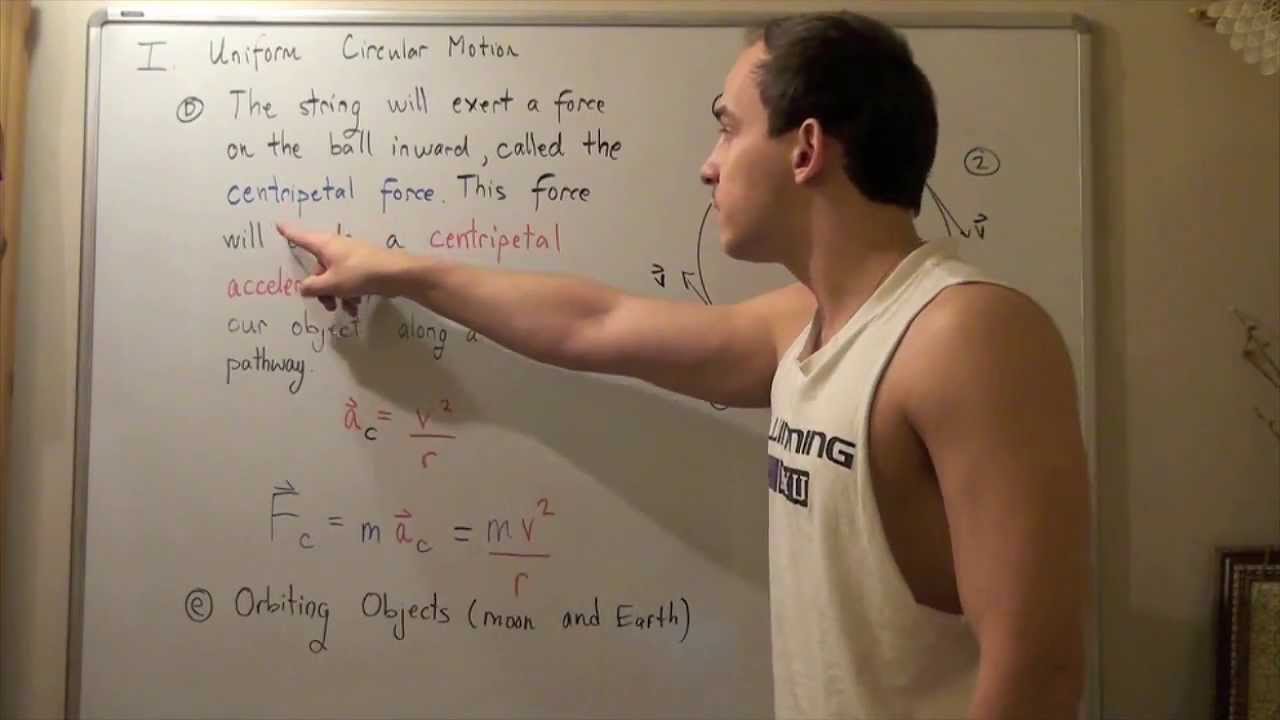
Uniform Circular Motion, Centripetal Acceleration and Centripetal Force
Keywords
Summary
118 words
Critical Evaluation
Value of the Information & Strength of the Argument
The video provides a solid conceptual foundation for uniform circular motion, emphasizing the role of perpendicular forces in changing direction without altering speed. The argumentation is logical, building from Newton’s laws to the definition of centripetal acceleration and force. However, the explanation is largely qualitative, with limited mathematical depth, and the derivation of the centripetal acceleration formula is only mentioned as coming from calculus without demonstration. The examples of a ball on a string and orbiting objects effectively illustrate the principles, but the video does not address potential misconceptions, such as the difference between centripetal and centrifugal force, or the conditions for uniform circular motion.
Scientific Rigor, Source Quality, Title Accuracy
The video is scientifically accurate, but it does not cite any external sources or references. The content aligns with standard physics textbooks, but the lack of citations reduces its scholarly rigor. The title accurately describes the content, which is a tutorial on uniform circular motion, centripetal acceleration, and centripetal force. The video is part of a lecture series, and the description provides links to the creator’s website and donation page, but no specific references to scientific literature. The presentation is clear and well-structured, but it does not engage with the broader scientific literature or address potential controversies.
217 words
Title / Content Match
The title accurately reflects the content, which covers the three specified topics.
Quality & Reliability
7/10
The video provides a clear and accurate explanation of uniform circular motion, centripetal acceleration, and centripetal force, consistent with Newton's laws. However, it lacks citations to external sources and does not address potential misconceptions or edge cases.
Key Moments
Markers derived by PSI from the transcript: the creator did not define chapters.
- Introduction to Newton's laws and setup of the problem
- Explanation of force perpendicular to velocity changing direction
- Introduction of centripetal acceleration and its direction
- Example of a ball on a string demonstrating centripetal force
- Formulas for centripetal acceleration and force presented
- Application to orbiting objects like the Moon and satellites
Cited Sources
- AK Lectures Website — The creator's website hosting the video and related lectures.
- Lecture Page — Direct link to the lecture page for this video.
Concurring Sources
- Centripetal force - Wikipedia — Confirms the definition and formula for centripetal force.
- Uniform circular motion - Wikipedia — Provides the derivation of centripetal acceleration and its direction.
External References
Contribution & Novelties
The video offers a clear and accessible introduction to uniform circular motion, centripetal acceleration, and centripetal force, using intuitive examples. It effectively connects Newton’s laws to circular motion, but does not provide new insights beyond standard textbook material. The explanation of how gravity provides centripetal force for orbiting objects is a useful application.
Pour aller plus loin :
- Centripetal force - Wikipedia — Provides a comprehensive overview of centripetal force, including derivations and applications.
- Uniform circular motion - Wikipedia — Explains the kinematics and dynamics of circular motion, including the derivation of centripetal acceleration.
- Newton’s law of universal gravitation - Wikipedia — Relevant to the discussion of gravitational force as the centripetal force for orbiting objects.
116 words
Radar Profile
The radar profile shows balanced scores across all dimensions, with slightly lower scores in quantity of information and technical depth, reflecting the video's concise and qualitative nature. The high quality and reliability scores indicate that the content is accurate and well-presented, but the lack of external sources and mathematical rigor prevents it from achieving a higher overall rating.
💬 Sur les 0 commentaires analysés, aucune tendance n'a pu être dégagée.