The Motor Unit
Keywords
Summary
167 words
Critical Evaluation
Value of the Information & Strength of the Argument
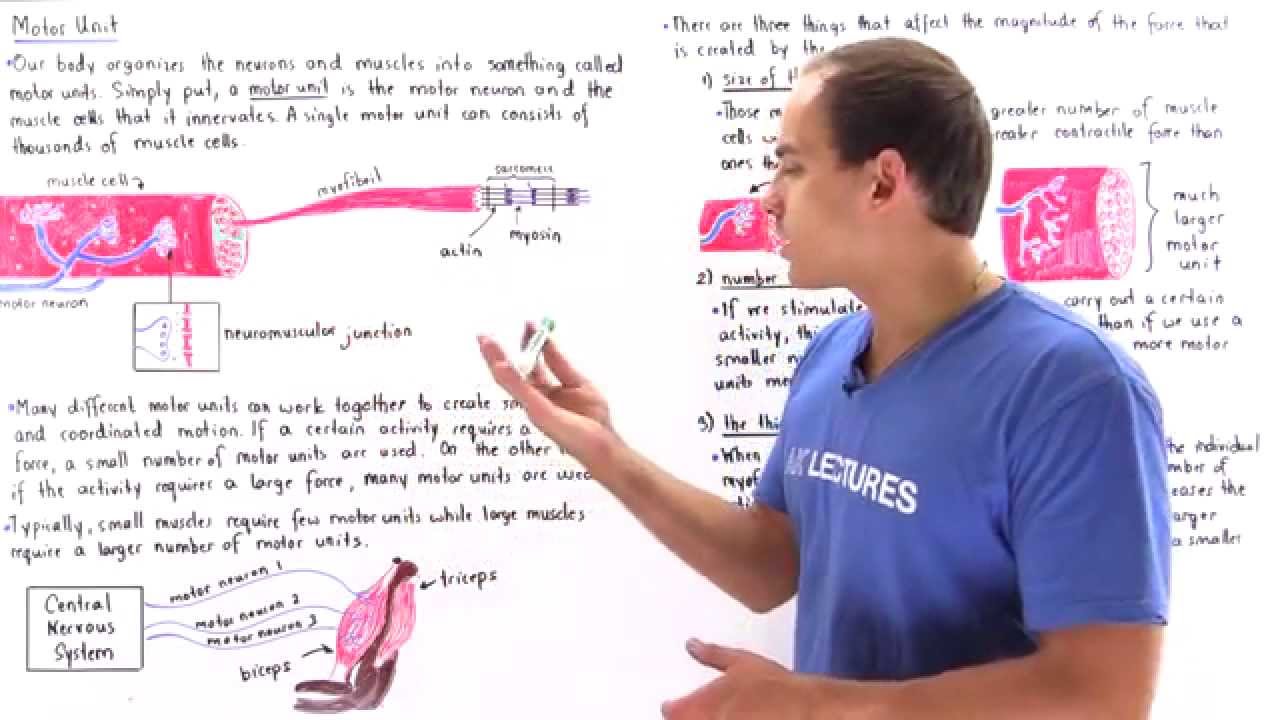
The video provides a solid introduction to the motor unit, accurately explaining its composition and the factors affecting muscle force. The argumentation is logical and well-structured, moving from definition to structure to functional implications. It effectively uses diagrams to clarify concepts. However, it lacks depth in discussing the physiological mechanisms of force generation, such as the sliding filament theory or the role of calcium, and does not address the different types of motor units (slow, fast fatigable, etc.). The explanation is clear and accessible, but for an expert audience, it may be too basic.
Scientific Rigor, Source Quality, Title Accuracy
The video does not cite specific scientific sources, but the content is consistent with standard physiology textbooks. The title accurately reflects the content. The video is a tutorial, and its scientific rigor is adequate for an introductory level, though it lacks references to primary literature. The description provides links to the creator’s website and donation page, but no direct citations to research papers.
172 words
Title / Content Match
The title accurately reflects the content, which focuses on the definition, structure, and function of motor units.
Quality & Reliability
7/10
The video provides a clear and accurate explanation of the motor unit concept, consistent with established physiology. It is a basic educational tutorial without in-depth citations, but the content is correct and well-structured.
Key Moments
Markers derived by PSI from the transcript: the creator did not define chapters.
- Introduction to the motor unit concept.
- Definition of a motor unit: motor neuron and muscle fibers.
- Diagram of a single motor unit with one muscle fiber.
- Explanation of motor unit size and its effect on force.
- Discussion on the number of motor units involved and force.
- Example of lifting a marker vs. a heavy weight.
- Explanation of muscle fiber thickness and exercise.
- Summary of the three factors affecting force.
Cited Sources
- AK Lectures - The Motor Unit — The video is hosted on AK Lectures, and this link provides additional resources.
- AK Lectures — The creator's website with more lectures.
- Donate to AK Lectures — Donation page mentioned in the video description.
Concurring Sources
- Motor unit - Wikipedia — Confirms the definition and structure of motor units.
- Muscle contraction - Wikipedia — Provides background on how muscle force is generated.
Contribution & Novelties
The video offers a clear and concise explanation of the motor unit, suitable for beginners. It effectively uses diagrams to illustrate the concept. However, it does not introduce novel information beyond standard textbook content. For a deeper understanding, one can explore the following:
Pour aller plus loin :
- Motor unit — Wikipedia article providing a comprehensive overview.
- Sliding filament theory — Explains the molecular mechanism of muscle contraction.
- Henneman’s size principle — Describes the orderly recruitment of motor units.
79 words
Radar Profile
The radar profile shows moderate scores across all dimensions, with slightly higher quality and reliability compared to quantity and technical depth. This indicates a well-explained but basic tutorial that is accurate but lacks advanced detail.