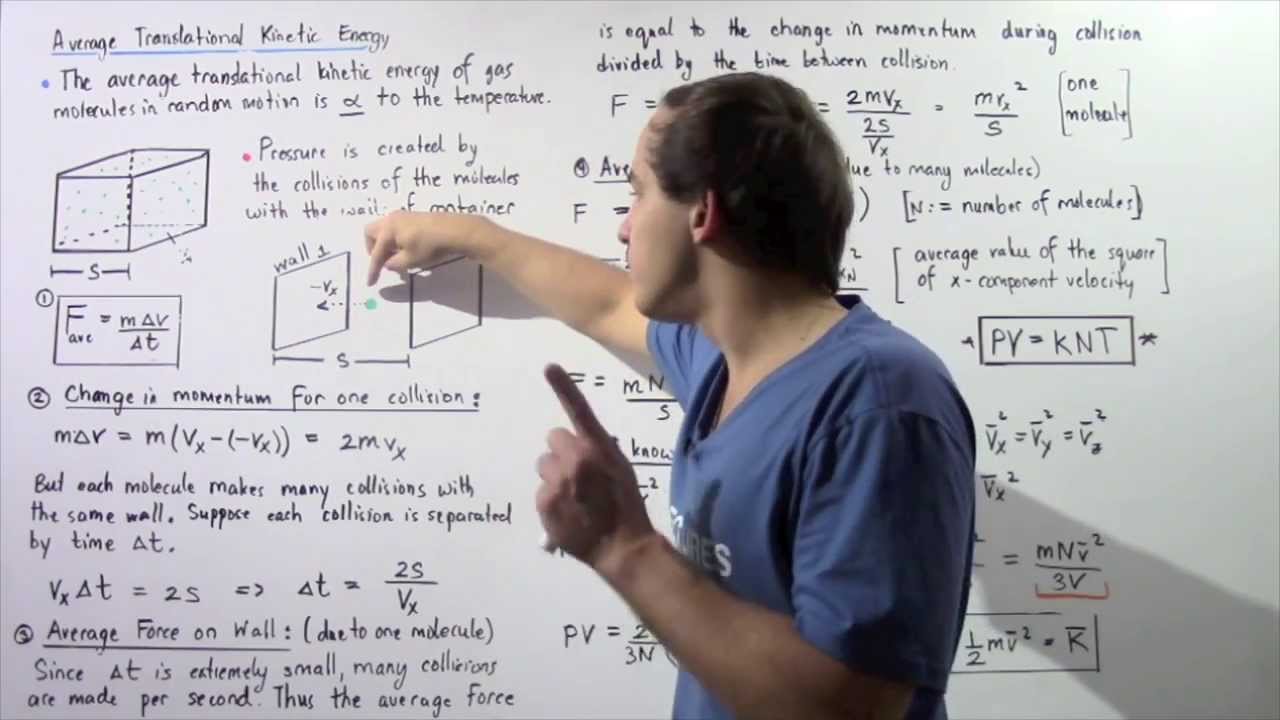
Average Translational Kinetic Energy with Derivation
Keywords
Summary
167 words
Critical Evaluation
Value of the Information & Strength of the Argument
The video provides a clear and logical derivation of the average translational kinetic energy formula, which is a fundamental result in kinetic theory. The argumentation is solid: each step is justified with physical principles (Newton’s laws, ideal gas law) and mathematical manipulations. The presenter carefully explains the assumptions, such as elastic collisions and random motion, and shows how they lead to the final result. The value lies in its pedagogical clarity, making a complex derivation accessible. However, it does not discuss real gas deviations or the limitations of the ideal gas model, which could be a drawback for advanced learners.
Scientific Rigor, Source Quality, Title Accuracy
The video is scientifically rigorous in its derivation, following standard textbook methods. However, it does not cite any external sources or references, relying solely on the presenter’s explanation. The title accurately reflects the content, which is a derivation of the average translational kinetic energy. The description provides links to the presenter’s website and donation page, but no specific references to scientific literature. Overall, the content is reliable for educational purposes, but the lack of citations reduces its scholarly depth.
194 words
Title / Content Match
The title accurately describes the content: a derivation of the average translational kinetic energy formula.
Quality & Reliability
8/10
The derivation is mathematically sound and follows standard kinetic theory steps. The presentation is clear and logical, with no apparent errors. However, the video lacks citations to external sources and does not discuss limitations or alternative approaches.
Key Moments
Markers derived by PSI from the transcript: the creator did not define chapters.
- Introduction to kinetic molecular theory and objective of deriving average translational kinetic energy.
- Setup of container with gas molecules and definition of variables (area, length).
- Consideration of a single molecule moving along x-axis and calculation of change in momentum.
- Derivation of force exerted by a single molecule on the wall using Newton's second law.
- Extension to all molecules by summing forces and introducing average squared velocity.
- Use of Pythagorean theorem to relate velocity components and assumption of random motion.
- Derivation of pressure in terms of molecular parameters and volume.
- Equating PV from kinetic theory with ideal gas law and solving for average kinetic energy.
- Conclusion: average translational kinetic energy equals (3/2)kT and is proportional to temperature.
Cited Sources
- AK Lectures Website — General educational resource by the presenter.
- Lecture Page for Average Translational Kinetic Energy — Direct link to the lecture on the presenter's website.
- Donation Page — Support page for the channel.
Concurring Sources
- Kinetic theory of gases - Wikipedia — Standard reference for kinetic theory, confirms the derivation and result.
Contribution & Novelties
The video provides a clear and systematic derivation of the average translational kinetic energy formula, which is a cornerstone of kinetic theory. It is particularly useful for students who want to understand the mathematical steps behind the result. The presentation is self-contained, starting from basic principles and building up to the final equation. While the content is not novel, its pedagogical approach is effective.
Pour aller plus loin :
- Kinetic theory of gases — Provides broader context and additional derivations.
- Boltzmann constant — Defines the constant used in the final formula.
- Ideal gas law — Relates pressure, volume, and temperature for ideal gases.
103 words
Radar Profile
The radar profile shows high scores in quality and reliability, with moderate scores in quantity and technical level. This indicates a focused, accurate tutorial that may not cover extensive breadth but is solid in its core content.