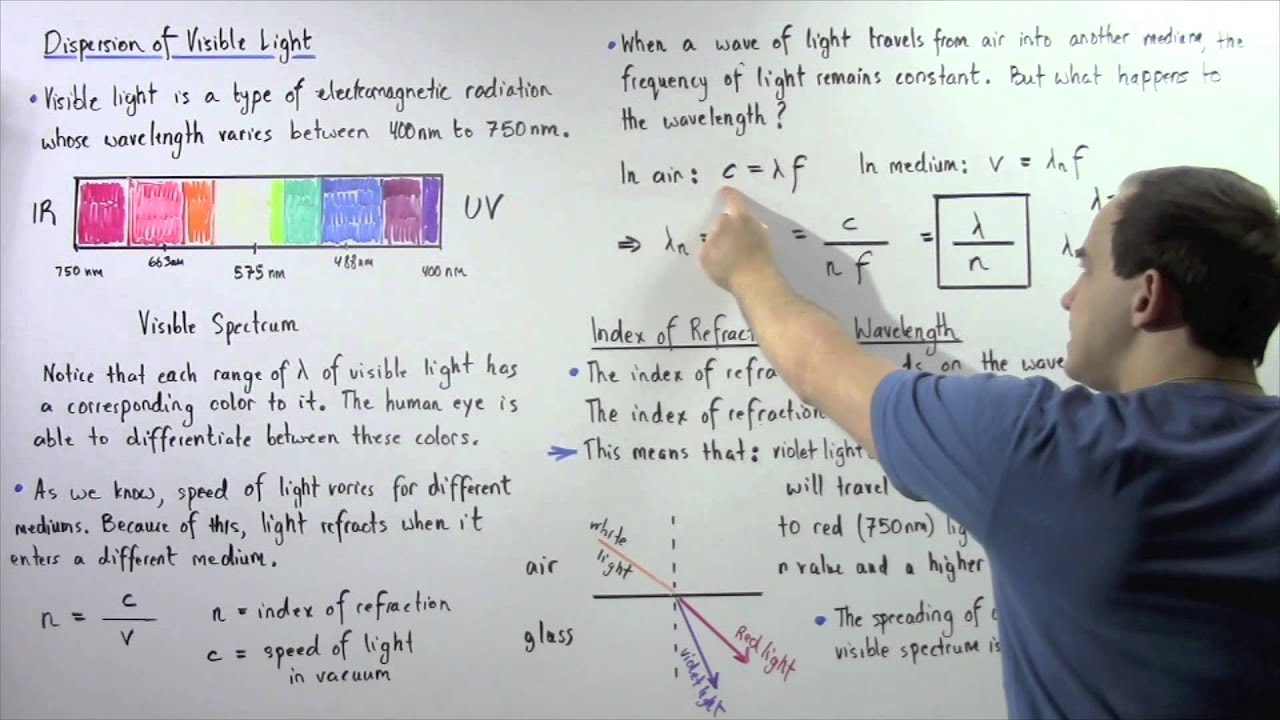
Dispersion of Visible Light
Keywords
Summary
157 words
Critical Evaluation
Value of the Information & Strength of the Argument
The video provides a solid explanation of dispersion, building on fundamental concepts such as the index of refraction and Snell’s law. The argumentation is logical and coherent, moving from definitions to derivations and finally to the application. The value lies in its pedagogical clarity, making complex ideas accessible. However, it does not delve into advanced topics like chromatic aberration or the wave nature of light, which could enhance depth.
Scientific Rigor, Source Quality, Title Accuracy
The scientific rigor is adequate for an introductory lecture; the physics is correct and consistent with standard textbooks. However, no external sources are cited, and the video relies on the instructor’s authority. The title accurately describes the content, and the video stays on topic. No public comments were provided for analysis.
135 words
Title / Content Match
The title accurately reflects the content, which focuses on the dispersion of visible light and its underlying physics.
Quality & Reliability
7/10
The video provides a clear and accurate explanation of dispersion, based on established physics principles (Snell's law, index of refraction). The content is consistent with standard textbook treatments. However, it lacks citations to primary sources and does not address potential complexities or exceptions.
Key Moments
Markers derived by PSI from the transcript: the creator did not define chapters.
- Introduction to visible light spectrum and wavelengths
- Definition of index of refraction and its relation to speed of light
- Derivation of wavelength change in a medium
- Relationship between index of refraction and wavelength
- Explanation of dispersion using white light and prism
- Summary of dispersion and its cause
Cited Sources
- AK Lectures Website — General resource for the lecture series.
- Lecture Page on Dispersion of Visible Light — Direct link to the lecture content.
Concurring Sources
- HyperPhysics - Dispersion — Confirms the explanation of dispersion and its dependence on wavelength.
External References
Contribution & Novelties
The video offers a clear, step-by-step explanation of dispersion, emphasizing the relationship between wavelength and index of refraction. It is particularly useful for students new to optics. The presentation is methodical, but it does not introduce novel concepts beyond standard textbook material.
Pour aller plus loin :
- Dispersion (optics) — Overview of dispersion in optics, including chromatic dispersion.
- Snell’s law — Fundamental law governing refraction, used in the video.
- Index of refraction — Detailed explanation of refractive index and its dependence on wavelength.
83 words
Radar Profile
The radar profile shows balanced scores, with quality of information and reliability being the highest, while quantity of information is slightly lower. This indicates a concise but accurate presentation.