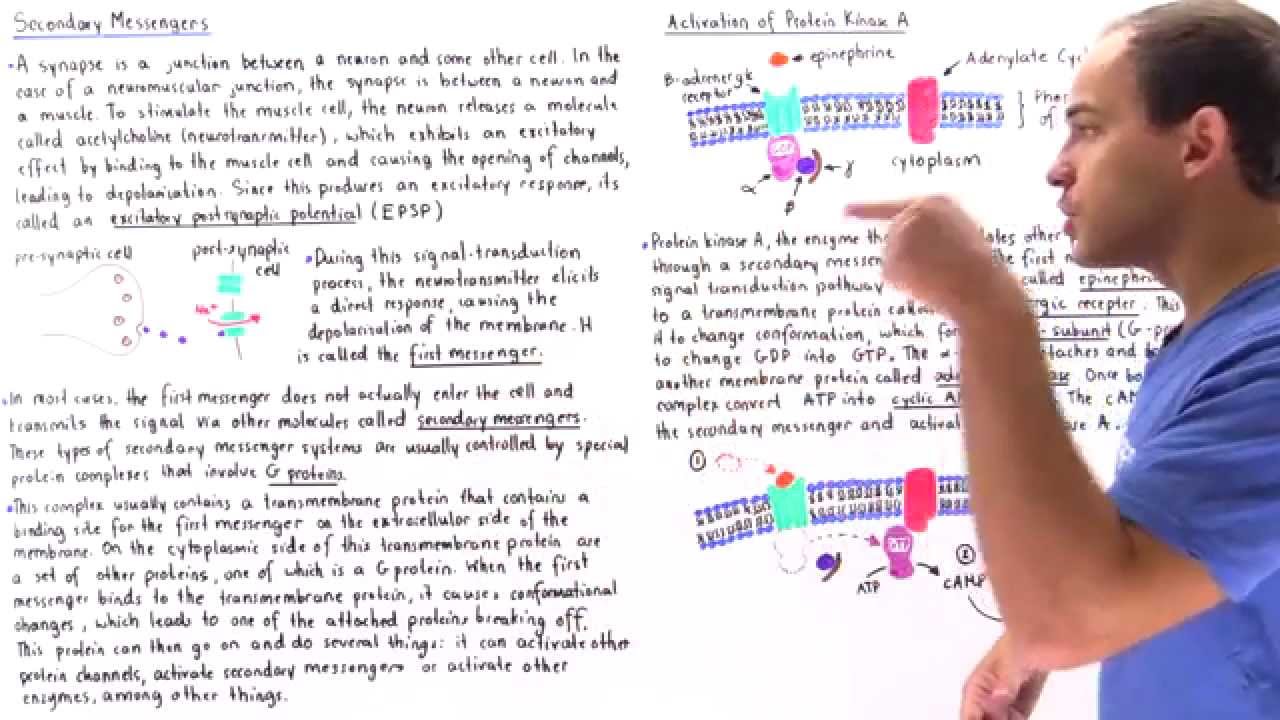
Secondary Messenger Systems
Keywords
Summary
156 words
Critical Evaluation
Value of the Information & Strength of the Argument
The video provides a clear and accurate explanation of the epinephrine-mediated secondary messenger pathway, which is a fundamental concept in cell biology. The argumentation is logical and step-by-step, building from the basic synapse to the specific molecular interactions. The value lies in its pedagogical clarity, making complex biochemical processes accessible. However, the video does not discuss alternative secondary messenger systems (e.g., IP3/DAG, calcium) or the broader context of G protein-coupled receptor signaling, which limits its comprehensiveness. The argumentation is solid but lacks critical evaluation of the evidence or mention of experimental validation.
Scientific Rigor, Source Quality, Title Accuracy
The video is scientifically rigorous in its presentation of the pathway, but it does not cite specific sources or references. The title accurately reflects the content, which is focused on secondary messenger systems. The video is a tutorial, and its educational value is high, but the lack of citations to primary literature or textbooks reduces its scientific rigor. The description provides links to the creator’s website, but these are not direct sources for the content. Overall, the video is reliable for introductory learning but not for advanced research.
195 words
Title / Content Match
The title accurately reflects the content, which focuses on secondary messenger systems and their role in signal transduction.
Quality & Reliability
7/10
The video provides a clear and accurate explanation of secondary messenger systems, focusing on the epinephrine-beta adrenergic receptor-cAMP-PKA pathway. The content is scientifically correct, but it lacks citations to primary literature and does not address alternative pathways or potential exceptions. The presentation is didactic and well-structured, but the depth is limited to a single example.
Key Moments
Markers derived by PSI from the transcript: the creator did not define chapters.
- Introduction to signal transduction at the neuromuscular junction.
- Explanation of first messenger and the need for secondary messengers.
- Overview of G protein-coupled receptor pathway.
- Detailed example: epinephrine binding to beta-adrenergic receptor.
- Activation of adenylate cyclase and production of cAMP.
- Activation of protein kinase A and downstream effects.
Cited Sources
- AK Lectures Website — General educational resource for biology lectures.
- Donation Page — Support page for the channel.
- Lecture Page on Secondary Messenger Systems — Direct link to the lecture content.
Concurring Sources
- Wikipedia: G protein-coupled receptor — General information on GPCRs, which are central to the pathway.
- Wikipedia: Cyclic adenosine monophosphate — Information on cAMP as a second messenger.
- Wikipedia: Protein kinase A — Details on PKA, the target of cAMP.
Contribution & Novelties
The video provides a clear and concise explanation of a classic secondary messenger pathway, which is a fundamental concept in cell signaling. Its originality lies in its pedagogical approach, breaking down the pathway into understandable steps. However, it does not introduce new scientific findings. For a deeper understanding, one can explore related concepts such as G protein-coupled receptors, cyclic AMP signaling, and protein kinase A. These are well-documented in textbooks and online resources.
Pour aller plus loin :
- G protein-coupled receptor — Overview of GPCRs, the receptor family involved.
- Cyclic adenosine monophosphate — Detailed information on cAMP as a second messenger.
- Protein kinase A — Function and regulation of PKA.
110 words
Radar Profile
The radar profile shows a balanced distribution with moderate scores across all dimensions, indicating a solid educational video that is accurate but not exhaustive. The highest score is in quality of information, reflecting the correctness of the content, while quantity and technical depth are slightly lower, suggesting a focused but not comprehensive treatment.