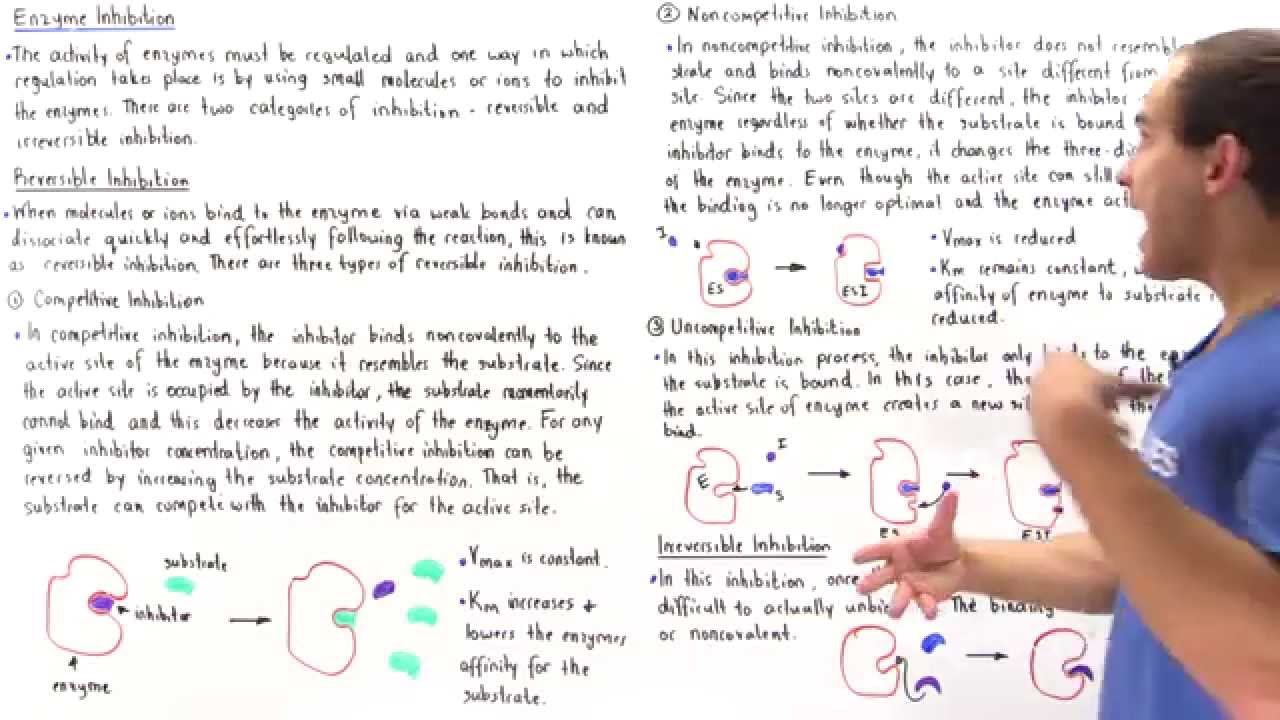
Reversible and Irreversible Enzyme Inhibition
Keywords
Summary
151 words
Critical Evaluation
Value of the Information & Strength of the Argument
The video provides a clear and systematic explanation of enzyme inhibition types, using diagrams to illustrate concepts. It effectively distinguishes between competitive, non-competitive, and uncompetitive inhibition, highlighting their effects on Vmax and Km. The argumentation is logical, building from basic definitions to more complex distinctions. However, it lacks quantitative examples or experimental data to support claims, and the explanation of molecular mechanisms is simplified. The value lies in its pedagogical clarity, making it a useful resource for students learning biochemistry.
Scientific Rigor, Source Quality, Title Accuracy
The video is scientifically accurate in its core content, but it does not cite specific scientific sources or references. The title accurately reflects the content, and the lecture is well-structured. The lack of citations to primary literature reduces its scientific rigor, but the information aligns with standard biochemistry textbooks. The video’s educational nature and clear presentation compensate somewhat for the absence of formal references.
159 words
Title / Content Match
The title accurately reflects the content, which covers both reversible and irreversible inhibition.
Quality & Reliability
7/10
Clear and accurate explanation of enzyme inhibition types, but lacks citations to primary literature and depth on molecular mechanisms.
Key Moments
Markers derived by PSI from the transcript: the creator did not define chapters.
- Introduction to enzyme inhibition and overview of reversible vs irreversible.
- Definition of reversible inhibition and its characteristics.
- Explanation of competitive inhibition with diagram.
- Effect of substrate concentration on competitive inhibition and Vmax/Km.
- Introduction to non-competitive inhibition and allosteric site.
- Effect of non-competitive inhibition on Vmax and Km.
- Explanation of uncompetitive inhibition and its unique binding requirement.
- Comparison of reversible and irreversible inhibition, including covalent bonding.
Cited Sources
- AK Lectures - Reversible and Irreversible Enzyme Inhibition — The video's official lecture page on the AK Lectures website.
- AK Lectures - Donate — Donation page for supporting the channel.
- AK Lectures - Home — Main website of the channel.
Concurring Sources
- Enzyme inhibition - Wikipedia — General reference on enzyme inhibition, consistent with the video's content.
Contribution & Novelties
The video provides a clear and concise educational overview of enzyme inhibition, effectively differentiating between reversible and irreversible types and their subtypes. It uses visual diagrams to illustrate concepts, which aids understanding. However, it does not introduce novel scientific insights; it is a tutorial for educational purposes.
Pour aller plus loin :
- Enzyme inhibitor - Wikipedia — Provides comprehensive information on enzyme inhibition, including types and mechanisms.
- Competitive inhibition - Wikipedia — Detailed explanation of competitive inhibition and its kinetics.
- Non-competitive inhibition - Wikipedia — Overview of non-competitive inhibition and its effects on enzyme kinetics.
- Uncompetitive inhibition - Wikipedia — Explanation of uncompetitive inhibition and its unique characteristics.
108 words
Radar Profile
The radar profile shows balanced scores across information quantity, quality, technical level, and reliability, indicating a solid educational resource. The video excels in clarity and structure but lacks depth in molecular details and citations.