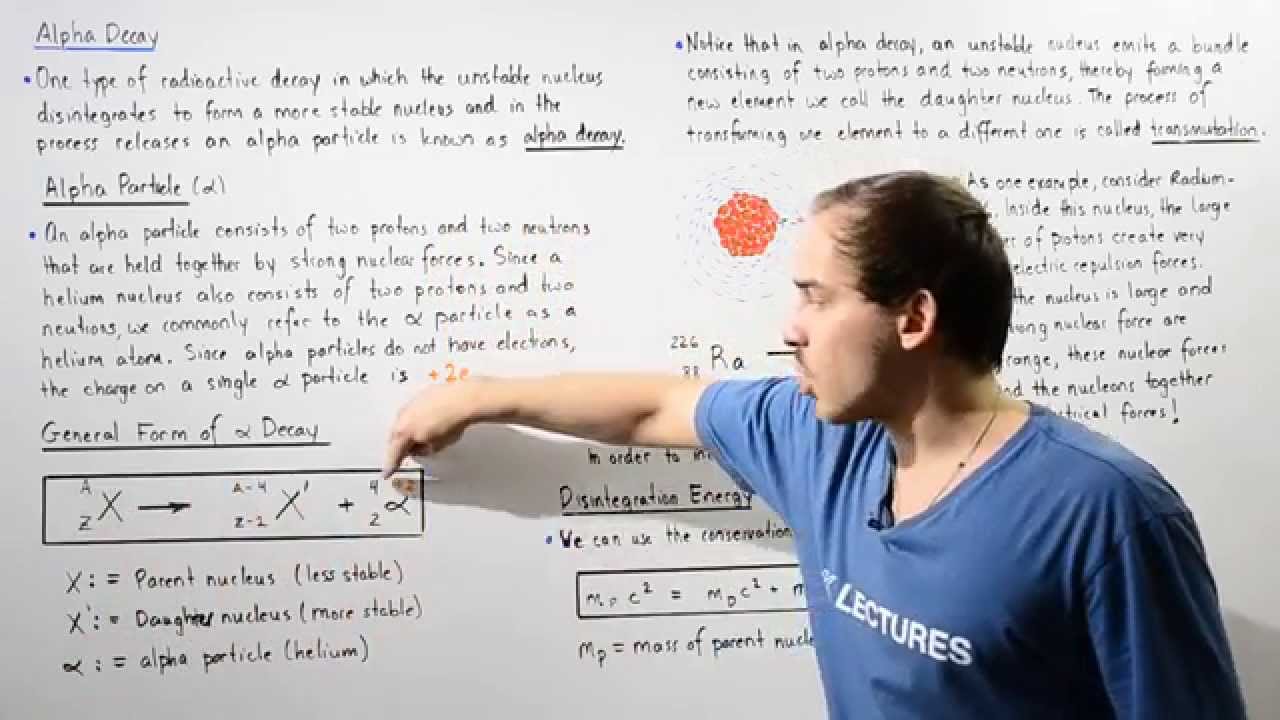
Alpha Decay
Keywords
Summary
179 words
Critical Evaluation
Value of the Information & Strength of the Argument
The video provides a solid introduction to alpha decay, clearly explaining the underlying physics and the reasoning behind why certain nuclei undergo this process. The argumentation is logical, starting with the definition of an alpha particle, then presenting the general equation, and finally illustrating with a concrete example. The use of conservation of energy to derive the Q-value adds depth, though the derivation is only sketched. The value lies in its pedagogical clarity, making complex concepts accessible to beginners. However, it does not delve into quantum tunneling or the probabilistic nature of decay, which are crucial for a complete understanding. The argumentation is sound but not exhaustive, leaving room for further exploration.
Scientific Rigor, Source Quality, Title Accuracy
The scientific rigor is adequate for an introductory tutorial: the physics is correct, and the example is well-chosen. However, the video does not cite any external sources, relying solely on the instructor’s explanation. The description provides links to the instructor’s website and donation page, but no references to textbooks or research papers. The title accurately reflects the content, which is focused solely on alpha decay. The video is part of a series on nuclear physics, and the instructor’s approach is systematic. While the lack of citations is a limitation, the content itself is reliable and aligns with standard textbook treatments. The adéquation between title and content is perfect.
235 words
Title / Content Match
The title 'Alpha Decay' accurately reflects the content, which focuses exclusively on the mechanism and equation of alpha decay.
Quality & Reliability
7/10
The video provides a clear and accurate explanation of alpha decay, including the definition of an alpha particle, the general equation, and an example with radium-226. The physics is correct and well-illustrated. However, it lacks citations to primary sources and does not discuss experimental evidence or historical context, which limits its depth.
Key Moments
Markers derived by PSI from the transcript: the creator did not define chapters.
- Introduction to alpha decay as a type of radioactive decay.
- Definition of an alpha particle: two protons and two neutrons, no electrons.
- General equation for alpha decay: parent nucleus -> daughter nucleus + alpha particle.
- Explanation of transmutation and the change in atomic number and mass number.
- Example with radium-226 decaying into radon-222 and an alpha particle.
- Discussion of why radium undergoes alpha decay: electrostatic repulsion vs. strong nuclear force.
- Introduction to disintegration energy (Q-value) and conservation of energy.
Cited Sources
- AK Lectures - Alpha Decay — The video is hosted on AK Lectures, and this link provides the lecture page with additional resources.
- AK Lectures — The instructor's website, which contains a series of physics lectures.
Concurring Sources
- Alpha decay - Wikipedia — The Wikipedia article confirms the definition of alpha decay and the general equation, as well as the example of radium-226.
- Nuclear Physics - HyperPhysics — HyperPhysics provides a detailed explanation of alpha decay, including the Q-value and examples.
External References
Contribution & Novelties
The video offers a clear and concise explanation of alpha decay, suitable for students new to nuclear physics. Its main contribution is the step-by-step derivation of the general equation and the introduction of the Q-value, which is often glossed over in introductory materials. The example with radium-226 helps solidify the concepts. However, it does not provide new insights beyond standard textbook content.
Pour aller plus loin :
- Alpha decay - Wikipedia — Provides a comprehensive overview, including quantum tunneling and decay energy calculations.
- Radioactive decay - Wikipedia — Covers all types of decay and the general principles of radioactivity.
- Nuclear transmutation - Wikipedia — Explains the concept of changing one element into another, which is central to alpha decay.
- Gamow factor — Explains the quantum mechanical probability of alpha emission, a key aspect not covered in the video.
138 words
Radar Profile
The radar profile shows a balanced performance with strengths in quality of information and technical level, but lower scores in quantity of information and reliability due to lack of citations and depth. This suggests the video is a good introductory resource but not comprehensive enough for advanced study.
💬 No comments were provided for analysis.