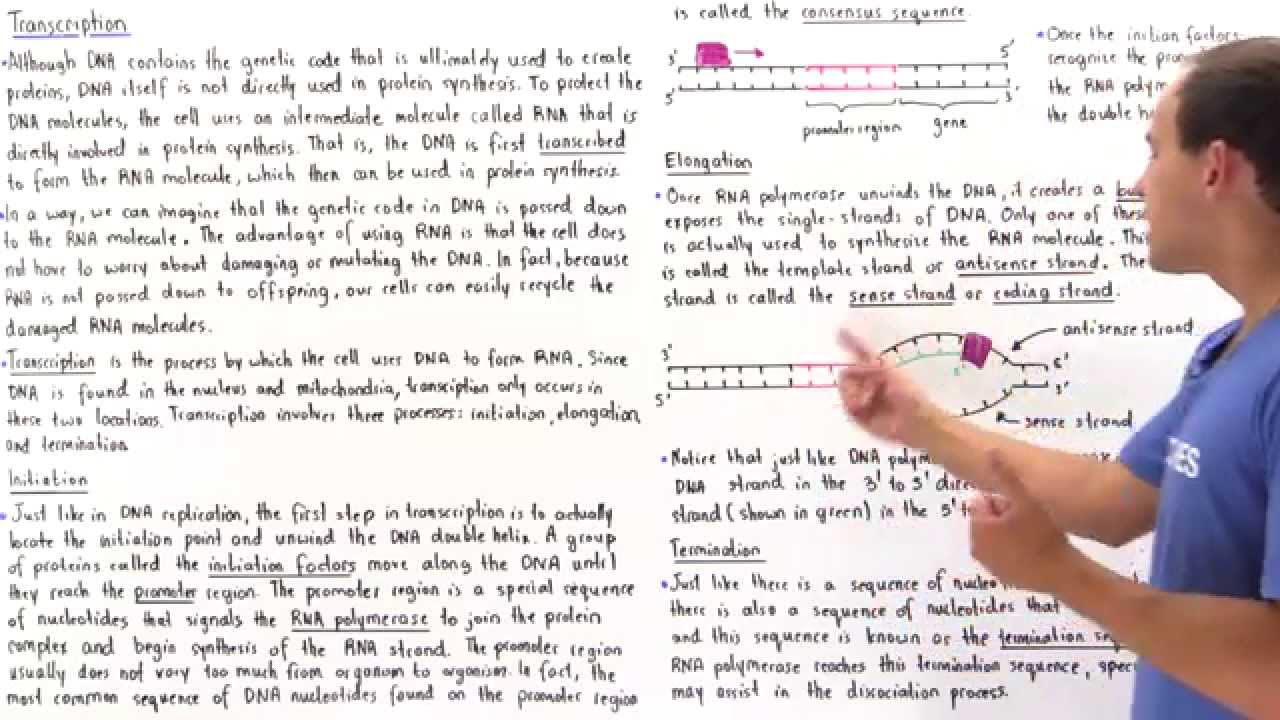
RNA Transcription
Keywords
Summary
177 words
Critical Evaluation
Value of the Information & Strength of the Argument
The video provides a solid introduction to transcription, clearly explaining the key steps and components. The argumentation is logical, building from the purpose of transcription to the detailed mechanisms. It effectively uses diagrams to illustrate the process, enhancing understanding. The explanations are accurate and align with standard molecular biology concepts, though some simplifications are made for clarity. The value lies in its accessibility for beginners, making complex concepts understandable.
Scientific Rigor, Source Quality, Title Accuracy
The scientific rigor is good for an introductory tutorial. The content is accurate and consistent with established knowledge. However, no specific scientific sources are cited within the video; the description only provides links to the creator’s website and donation page. The title accurately reflects the content, and the video stays on topic. The lack of citations is a minor weakness, but the information is reliable for educational purposes.
152 words
Title / Content Match
The title accurately reflects the content, which is a focused lecture on RNA transcription.
Quality & Reliability
8/10
The video provides a clear and accurate explanation of transcription, consistent with standard molecular biology. It correctly describes the roles of RNA polymerase, promoter regions, template and coding strands, and the lack of proofreading in RNA polymerase. Minor simplifications (e.g., not detailing eukaryotic transcription factors) are acceptable for an introductory tutorial.
Key Moments
Markers derived by PSI from the transcript: the creator did not define chapters.
Cited Sources
- AK Lectures — Main website of the lecturer, providing additional resources.
- Donate — Donation page for supporting the channel.
- RNA Transcription Lecture — Direct link to the lecture on the website.
Concurring Sources
- Transcription (biology) — General reference confirming the steps of transcription.
Contribution & Novelties
The video offers a clear and concise tutorial on RNA transcription, making it accessible to students. It effectively uses diagrams and step-by-step explanations to demystify the process. While it does not present new research, it serves as a valuable educational resource.
Pour aller plus loin :
- Transcription (biology) — Overview of transcription in biology.
- RNA polymerase — Detailed article on RNA polymerase structure and function.
- Promoter (genetics) — Explanation of promoter regions and their role.
75 words
Radar Profile
The radar profile shows high scores in quality and reliability, with moderate scores in quantity and technical level. This indicates a well-explained but concise tutorial that is accurate and trustworthy, suitable for beginners.
💬 Très positif. Sur les 30 commentaires analysés, la grande majorité exprime une gratitude et une admiration pour la clarté des explications, soulignant l'efficacité pédagogique de l'auteur.