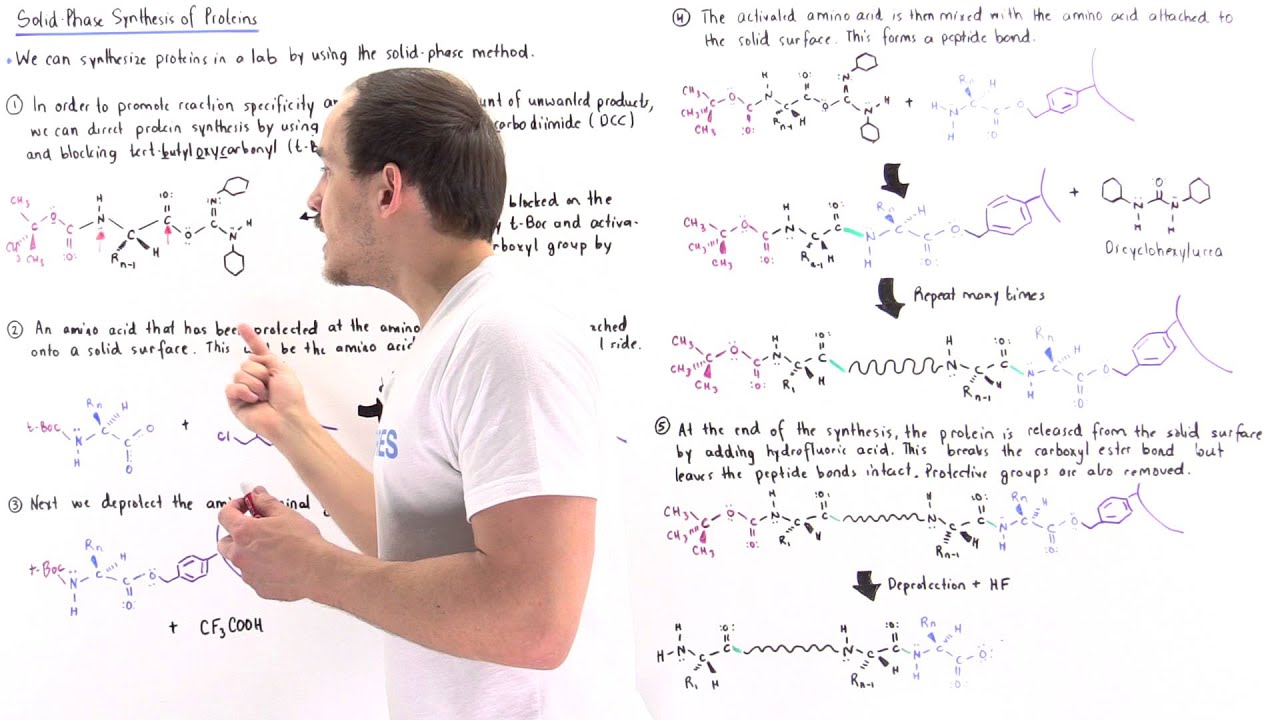
Solid-Phase Synthesis of Proteins
Keywords
Summary
122 words
Critical Evaluation
Value of the Information & Strength of the Argument
The video provides a valuable educational explanation of solid-phase peptide synthesis, a fundamental technique in biochemistry. The argumentation is logical and well-structured, walking through each step with clear diagrams. The explanation of why DCC and t-Boc are used is particularly useful, as it highlights the need to prevent side reactions. The video effectively conveys the importance of anchoring the growing chain and the role of protective groups. However, it does not discuss alternative methods or recent advancements, which limits its comprehensiveness.
Scientific Rigor, Source Quality, Title Accuracy
The scientific rigor is adequate for an introductory tutorial. The content is accurate and aligns with standard biochemistry textbooks. However, no external sources are cited, and the video relies on the presenter’s expertise. The title accurately reflects the content. The description provides links to the presenter’s website, which may contain additional resources, but no specific references are given. Overall, the video is reliable for educational purposes but lacks depth in terms of sourcing.
169 words
Title / Content Match
The title accurately reflects the content, which focuses on the solid-phase method for synthesizing proteins.
Quality & Reliability
8/10
The video provides a clear, step-by-step explanation of solid-phase peptide synthesis, covering key reagents (DCC, t-Boc) and mechanisms. The content is accurate and aligns with standard biochemistry knowledge, though it lacks citations to primary literature.
Key Moments
Markers derived by PSI from the transcript: the creator did not define chapters.
- Introduction to solid-phase synthesis and comparison with in vivo synthesis.
- Explanation of the two key points: anchoring to solid surface and use of activating/blocking agents.
- Step 1: Preparation of amino acids with DCC and t-Boc.
- Step 2: Attachment of first amino acid to solid support.
- Step 3: Deprotection of the amino group using trifluoroacetic acid.
- Step 4: Coupling of next amino acid and formation of peptide bond.
- Final step: Cleavage from solid support and removal of protective groups.
Cited Sources
- AK Lectures - Solid-Phase Synthesis of Proteins — Lecture page on the presenter's website, likely containing additional notes and diagrams.
- AK Lectures Website — General website of the presenter, offering educational content.
Concurring Sources
- Solid-phase synthesis - Wikipedia — General information on solid-phase synthesis, consistent with the video's content.
- Peptide synthesis - Wikipedia — Overview of peptide synthesis methods, including solid-phase, supporting the video's explanation.
External References
Contribution & Novelties
The video provides a clear and accessible explanation of solid-phase peptide synthesis, a core technique in biochemistry. It effectively breaks down the steps and explains the roles of DCC and t-Boc, making it useful for students. However, it does not introduce novel concepts beyond standard textbook material.
Pour aller plus loin :
- Solid-phase synthesis - Wikipedia — Overview of the technique and its applications.
- Peptide synthesis - Wikipedia — Detailed discussion of methods including solid-phase.
- Merrifield, R. B. (1963). Solid phase peptide synthesis. I. The synthesis of a tetrapeptide. J. Am. Chem. Soc., 85(14), 2149-2154. — Original paper introducing solid-phase synthesis.
101 words
Radar Profile
The radar profile shows high scores in quality and reliability, with moderate scores in quantity and technical level. This indicates a focused, accurate tutorial that may lack breadth but is solid in its core content.