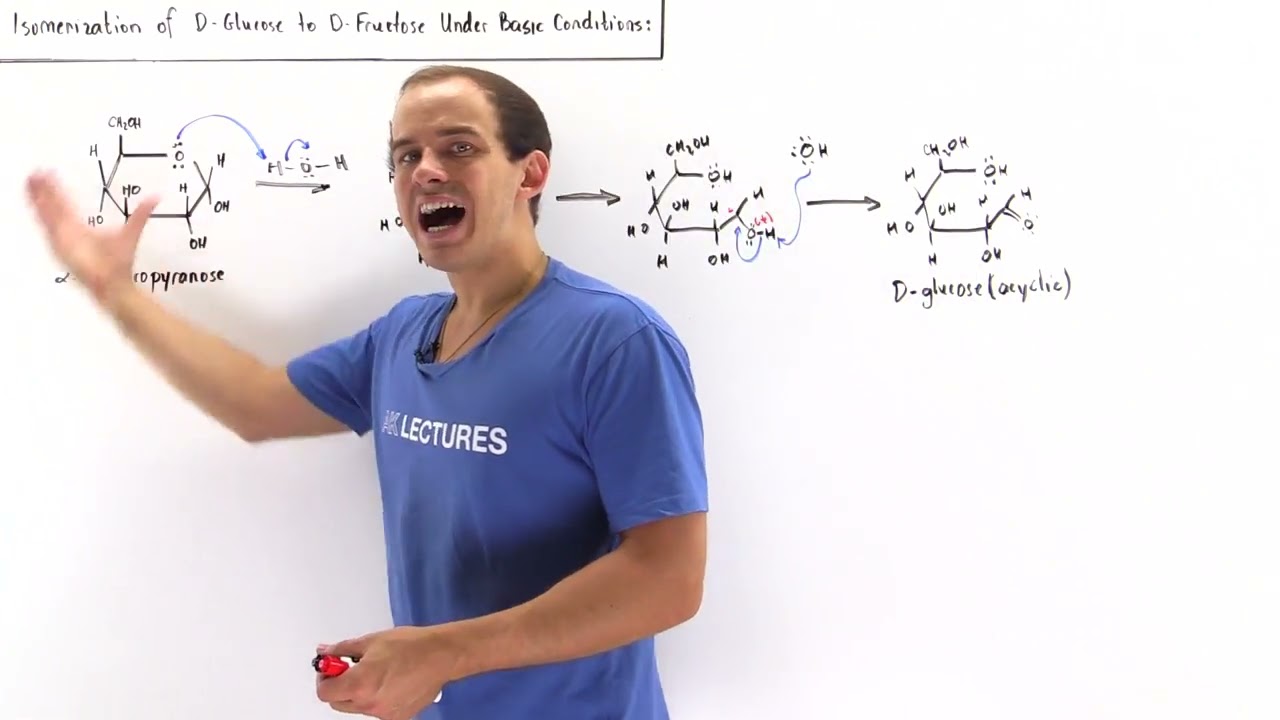
Isomerization of D-Glucose into D-Fructose
Keywords
Summary
111 words
Critical Evaluation
Value of the Information & Strength of the Argument
The video provides a thorough, step-by-step mechanism for the isomerization reaction, which is valuable for understanding carbohydrate chemistry. The argumentation is logical and follows the electron-pushing formalism, making it easy to follow. The presenter clearly explains each step, including the role of the base and the formation of intermediates. The explanation is consistent with standard organic chemistry textbooks and does not oversimplify the mechanism. However, the video does not discuss the biological significance or industrial applications of this reaction, which could add value.
Scientific Rigor, Source Quality, Title Accuracy
The video is scientifically rigorous in its presentation of the mechanism, and the content aligns with established organic chemistry principles. However, it does not cite any external sources or references, relying solely on the instructor’s explanation. The title accurately reflects the content, and the video stays focused on the topic. The description provides links to the instructor’s website and donation page, but no specific references to literature. Overall, the scientific quality is high, but the lack of citations reduces its utility for further research.
182 words
Title / Content Match
The title accurately reflects the content, which focuses exclusively on the isomerization of D-glucose to D-fructose.
Quality & Reliability
8/10
The video provides a detailed, step-by-step mechanism for the base-catalyzed isomerization of D-glucose to D-fructose, consistent with standard organic chemistry knowledge. The explanation is accurate and pedagogically sound, though it lacks citations to primary literature.
Key Moments
Markers derived by PSI from the transcript: the creator did not define chapters.
- Introduction to isomerization of D-glucose into D-fructose.
- Start with cyclic form of D-glucose.
- Protonation of ring oxygen and ring opening.
- Formation of open-chain D-glucose.
- Deprotonation of alpha carbon to form enolate.
- Formation of enediol intermediate.
- Tautomerization to form D-fructose.
- Comparison of glucose and fructose structures.
Cited Sources
- AK Lectures - Isomerization of D-Glucose into D-Fructose — Video lecture page on the instructor's website.
- AK Lectures - Homepage — General website of the instructor.
- AK Lectures - Donate — Donation page for the instructor.
Concurring Sources
- Lobry de Bruyn–van Ekenstein transformation — General reaction mechanism for base-catalyzed isomerization of sugars.
- Enediol — Intermediate in the isomerization mechanism.
Contribution & Novelties
The video provides a clear and detailed mechanism for the isomerization of D-glucose to D-fructose, which is a fundamental reaction in carbohydrate chemistry. It is particularly useful for students who need a step-by-step visual explanation of the electron-pushing mechanism. The video does not introduce new research but serves as an educational resource.
Pour aller plus loin :
- Lobry de Bruyn–van Ekenstein transformation — This is the general name for the base-catalyzed isomerization of aldoses to ketoses.
- Enediol intermediate — The key intermediate in the isomerization mechanism.
- Ketohexose — Fructose is a ketohexose; this page provides more information on this class of sugars.
102 words
Radar Profile
The radar profile shows high scores in quality of information, technical level, and reliability, indicating a solid educational resource. The quantity of information is moderate, reflecting the focused scope of the video. Overall, the video is a reliable and detailed tutorial for organic chemistry students.
💬 No comments were provided for analysis.