Types of Particle Accelerators
Keywords
Summary
165 words
Critical Evaluation
Value of the Information & Strength of the Argument
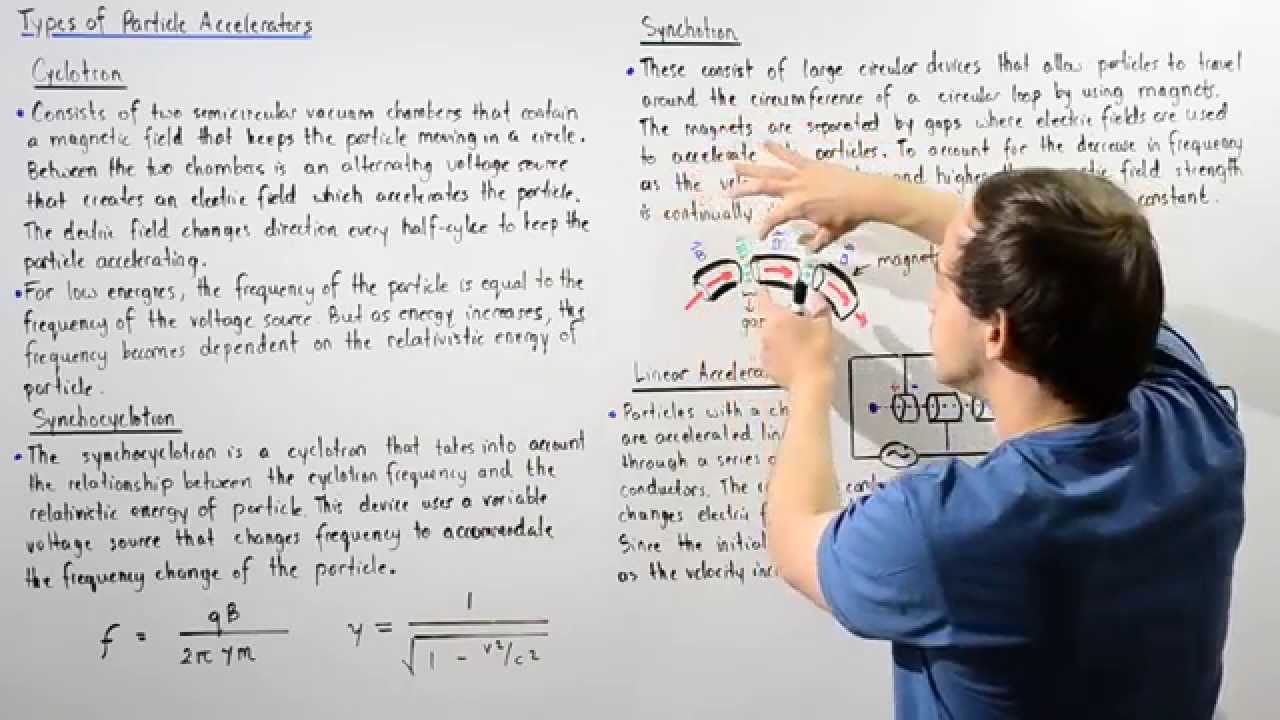
The video provides a solid introduction to the fundamental concepts of particle accelerators, explaining the physics clearly with equations and diagrams. The argumentation is logical, building from the simple cyclotron to more complex designs that address relativistic limitations. However, it does not delve into practical applications or recent technological advancements, limiting its depth. The explanation of the synchrotron’s magnetic field adjustment is particularly clear, but the video could benefit from more quantitative examples or comparisons.
Scientific Rigor, Source Quality, Title Accuracy
The video is scientifically accurate in its explanations and formulas, but it does not cite any external sources or references. The title accurately reflects the content, which covers multiple types of accelerators. The description provides links to the creator’s website and lecture page, but these are not primary scientific sources. The video is suitable for an introductory physics audience, but lacks the rigor of a peer-reviewed source.
157 words
Title / Content Match
The title accurately reflects the content, which systematically covers several types of particle accelerators.
Quality & Reliability
7/10
The video provides a clear and accurate explanation of the basic principles of particle accelerators, with correct physics formulas and concepts. However, it lacks citations to primary sources and does not discuss recent developments or applications in detail.
Key Moments
Markers derived by PSI from the transcript: the creator did not define chapters.
- Introduction to particle accelerators and the cyclotron
- Explanation of cyclotron frequency and limitations
- Introduction to the synchrocyclotron and relativistic effects
- Description of the synchrotron and magnetic field adjustment
- Explanation of the linear accelerator and its design
- Summary and conclusion
Cited Sources
- AK Lectures - Types of Particle Accelerators — Video lecture page with additional resources
- AK Lectures Website — General website of the creator
Concurring Sources
- Particle Accelerators - CERN — CERN's official page on particle accelerators, confirming the basic types and principles.
External References
Contribution & Novelties
The video offers a clear and concise explanation of the differences between cyclotrons, synchrocyclotrons, synchrotrons, and linear accelerators, focusing on how each addresses relativistic effects. It is particularly useful for students seeking a foundational understanding of accelerator physics. However, it does not introduce novel concepts or recent developments.
Pour aller plus loin :
- Cyclotron - Wikipedia — Provides a comprehensive overview of cyclotron history and operation.
- Synchrotron - Wikipedia — Details the principles and applications of synchrotrons.
- Particle accelerator - Wikipedia — General overview of accelerator types and uses.
89 words
Radar Profile
The radar profile shows balanced scores across all dimensions, with slightly higher scores in information quantity and quality, indicating a solid educational resource. The technical level is moderate, suitable for beginners, and the reliability is good, though not backed by external citations.
💬 Sur les 0 commentaires analysés, aucune tendance n'est disponible.