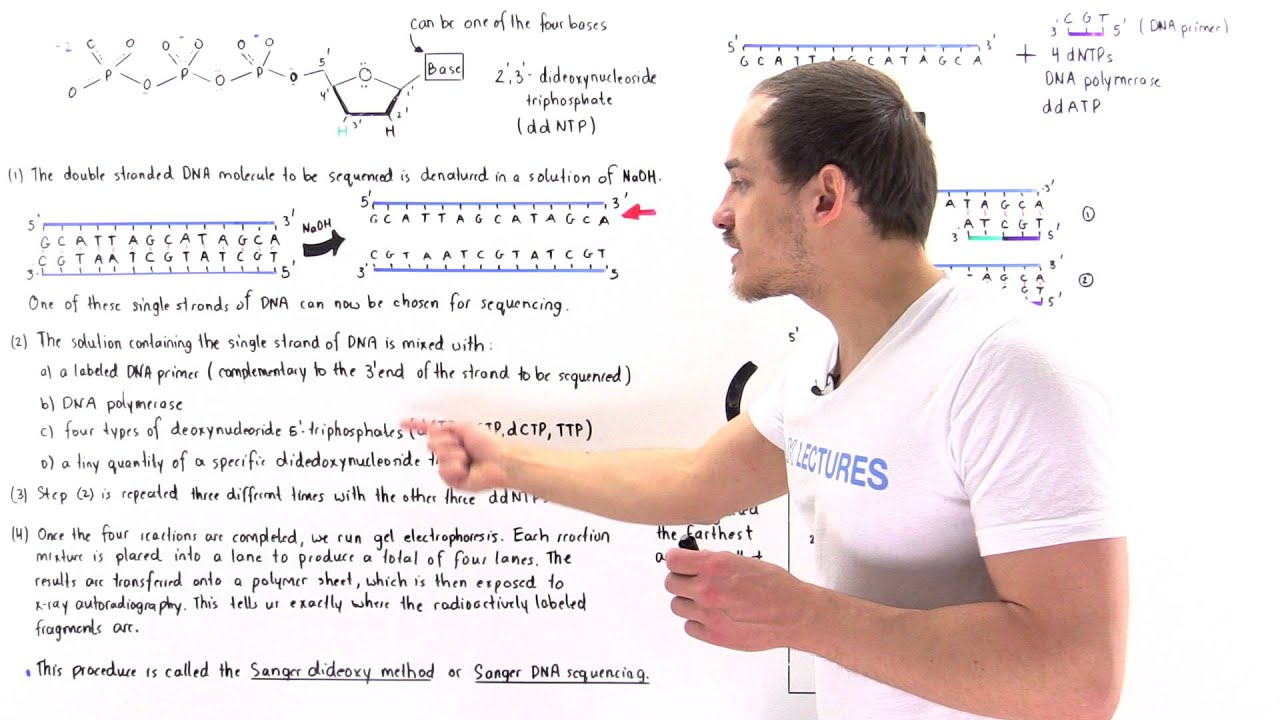
Sanger Sequencing of DNA
Keywords
Summary
136 words
Critical Evaluation
Value of the Information & Strength of the Argument
The video provides a high educational value by breaking down a complex technique into manageable steps. The argumentation is logical and builds progressively, ensuring that viewers understand the role of each component. The use of a concrete example with a specific DNA sequence helps solidify the concepts. The explanation of why ddNTPs terminate synthesis is clear and accurate. The video effectively demonstrates how gel electrophoresis results translate into a sequence, which is a common point of confusion for students. The argumentation is solid, with no logical gaps or unsupported claims.
Scientific Rigor, Source Quality, Title Accuracy
The scientific rigor is high; the content is accurate and aligns with standard biochemistry textbooks. However, the video does not cite specific sources or references, relying on general knowledge. The title accurately reflects the content, which is a tutorial on Sanger sequencing. The video does not discuss limitations or alternative methods, but this is acceptable for an introductory tutorial. The lack of citations is a minor weakness, but the content is well-established and correctly presented.
180 words
Title / Content Match
The title accurately reflects the content, which focuses exclusively on the Sanger sequencing method.
Quality & Reliability
8/10
The video provides a clear, step-by-step explanation of the Sanger sequencing method, based on established biochemical principles. The content is accurate and well-structured, though it lacks citations to primary literature and does not discuss limitations or modern variations.
Key Moments
Markers derived by PSI from the transcript: the creator did not define chapters.
- Introduction to Sanger sequencing and the dideoxy method.
- Explanation of ddNTP structure and its role in terminating DNA synthesis.
- Step 1: Denaturation of DNA with sodium hydroxide.
- Step 2: Setting up the reaction with primer, polymerase, and nucleotides.
- Illustration of fragment generation with ddATP.
- Step 3: Repeating the reaction with other ddNTPs.
- Step 4: Gel electrophoresis and autoradiography.
- Reading the sequence from the gel.
Cited Sources
- AK Lectures Website — The video is part of the AK Lectures series; the website provides additional resources and lectures.
- Donation Page — The creator requests donations to support the channel.
- Lecture Page for Sanger Sequencing — The specific lecture page for this video, providing supplementary materials.
Concurring Sources
- Sanger sequencing - Wikipedia — The video's explanation aligns with the standard description of Sanger sequencing.
Contribution & Novelties
The video offers a clear and detailed walkthrough of Sanger sequencing, which is a fundamental technique in molecular biology. Its novelty lies in the pedagogical approach, using a step-by-step example that makes the process intuitive. It does not present new scientific findings but serves as an educational resource.
Pour aller plus loin :
- Sanger sequencing - Wikipedia — Provides a comprehensive overview of the method, including history and applications.
- DNA sequencing - National Human Genome Research Institute — A glossary entry explaining DNA sequencing in general.
- Frederick Sanger - Nobel Prize — Information about the Nobel laureate who developed the method.
101 words
Radar Profile
The radar profile shows high scores in quantity and quality of information, with a moderate technical level. This indicates a well-balanced educational video that is detailed yet accessible. The fiabilité is high, reflecting the accuracy of the content.
💬 Très positif. Sur les 30 commentaires analysés, tous expriment une gratitude et une admiration extrêmes pour la clarté de l'explication, plusieurs mentionnant que c'est la meilleure vidéo sur le sujet qu'ils aient trouvée.