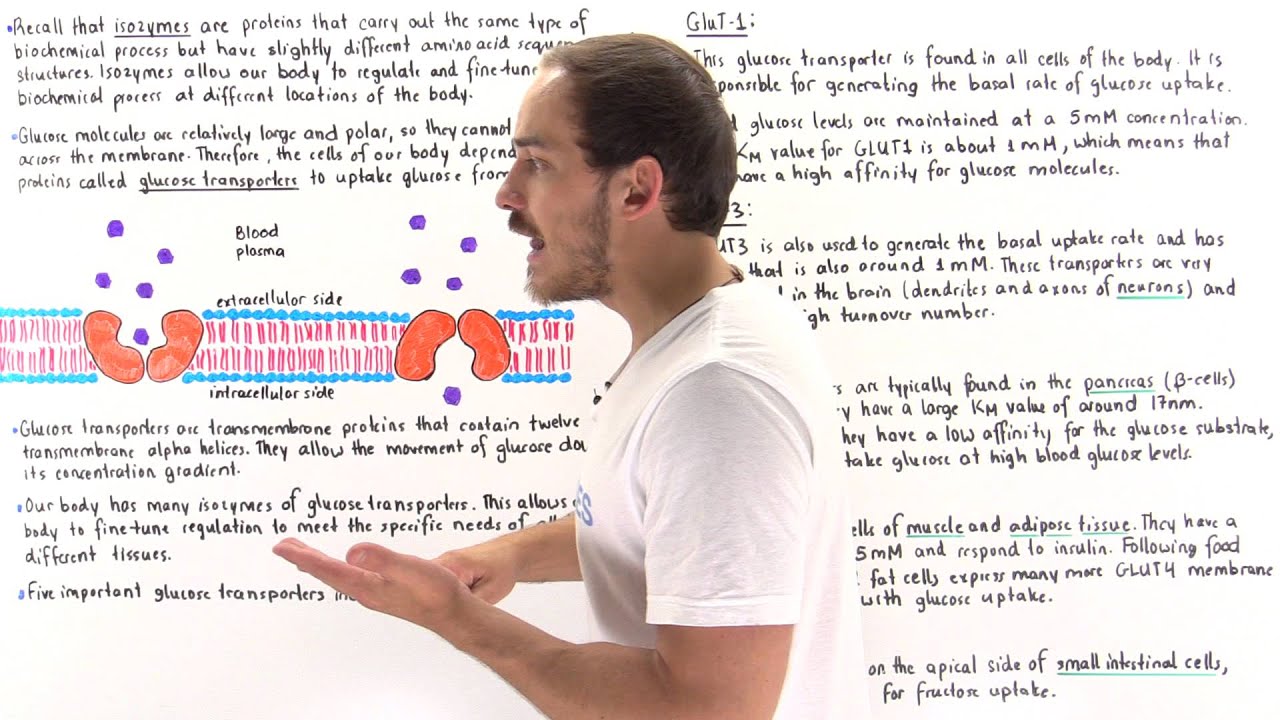
Glucose Transporters
Keywords
Summary
146 words
Critical Evaluation
Value of the Information & Strength of the Argument
The video provides a valuable educational overview of glucose transporters, clearly explaining the physiological significance of different Km values and tissue distribution. The argumentation is logical and builds from general principles (isozymes) to specific examples (GLUT1-5). It effectively uses the concept of Km to explain why certain transporters are suited for specific roles, such as GLUT2’s high Km for glucose sensing. The explanation of insulin’s role in GLUT4 translocation is accurate. However, the video lacks depth in discussing regulatory mechanisms beyond insulin, such as AMPK or other signaling pathways, and does not mention potential clinical implications (e.g., diabetes). The presentation is clear and accessible, but it is primarily descriptive rather than critical.
Scientific Rigor, Source Quality, Title Accuracy
The video demonstrates scientific rigor in its accurate presentation of established biochemical concepts. However, it does not cite specific sources or references, relying on general knowledge. The title accurately reflects the content, which is a focused summary of glucose transporters. The video is part of a series by Andrey K, a known educational channel, but the lack of citations reduces its scholarly value. The content aligns with standard biochemistry textbooks, but without explicit references, it is difficult to verify specific claims. The video’s structure is logical, and the information is presented in a coherent manner.
222 words
Title / Content Match
The title accurately reflects the content, which is a comprehensive summary of glucose transporters.
Quality & Reliability
7/10
The video provides a clear and accurate overview of glucose transporters, focusing on GLUT1-5, their tissue distribution, kinetic properties (Km), and regulation by insulin. The content is consistent with established biochemistry knowledge, but lacks citations to primary literature and does not discuss recent research or controversies.
Key Moments
Markers derived by PSI from the transcript: the creator did not define chapters.
- Introduction to isozymes and their role in fine-tuning biochemical processes.
- Explanation of glucose transporters as transmembrane proteins with 12 alpha helices.
- Discussion of GLUT1 and GLUT3, their low Km, and role in basal glucose uptake.
- Introduction of GLUT2, its high Km, and role in glucose sensing in pancreas and liver.
- Explanation of GLUT4, its insulin sensitivity, and role in muscle and adipose tissue.
- Discussion of GLUT5 and its role in fructose uptake in the small intestine.
- Summary of how different GLUT isoforms meet tissue-specific needs.
Cited Sources
- AK Lectures - Glucose Transporters — The video is hosted on AK Lectures, and this page likely contains additional notes and references.
- AK Lectures — General website of the educational platform.
- Donate to AK Lectures — Donation page, not a scientific source.
Concurring Sources
- Biochemistry Textbook (e.g., Stryer) — Standard biochemistry textbooks cover glucose transporters similarly.
Contribution & Novelties
The video provides a clear and concise summary of glucose transporters, emphasizing the concept of isozymes and their physiological significance. It effectively explains how different Km values allow tissue-specific regulation of glucose uptake. The video is educational and serves as a good introduction for students. However, it does not present novel research or insights beyond textbook knowledge.
Pour aller plus loin :
- GLUT4 and insulin signaling — Overview of GLUT4 and its regulation by insulin.
- Glucose transporter — General article on glucose transporters.
- Michaelis-Menten kinetics — Background on Km and enzyme kinetics.
92 words
Radar Profile
The radar profile shows high scores in quality of information and technical level, indicating a solid educational content. The quantity of information is moderate, and the reliability is good but not exceptional due to lack of citations. The overall balance suggests a reliable introductory resource.
💬 Sur les 0 commentaires analysés, aucune tendance n'est disponible.