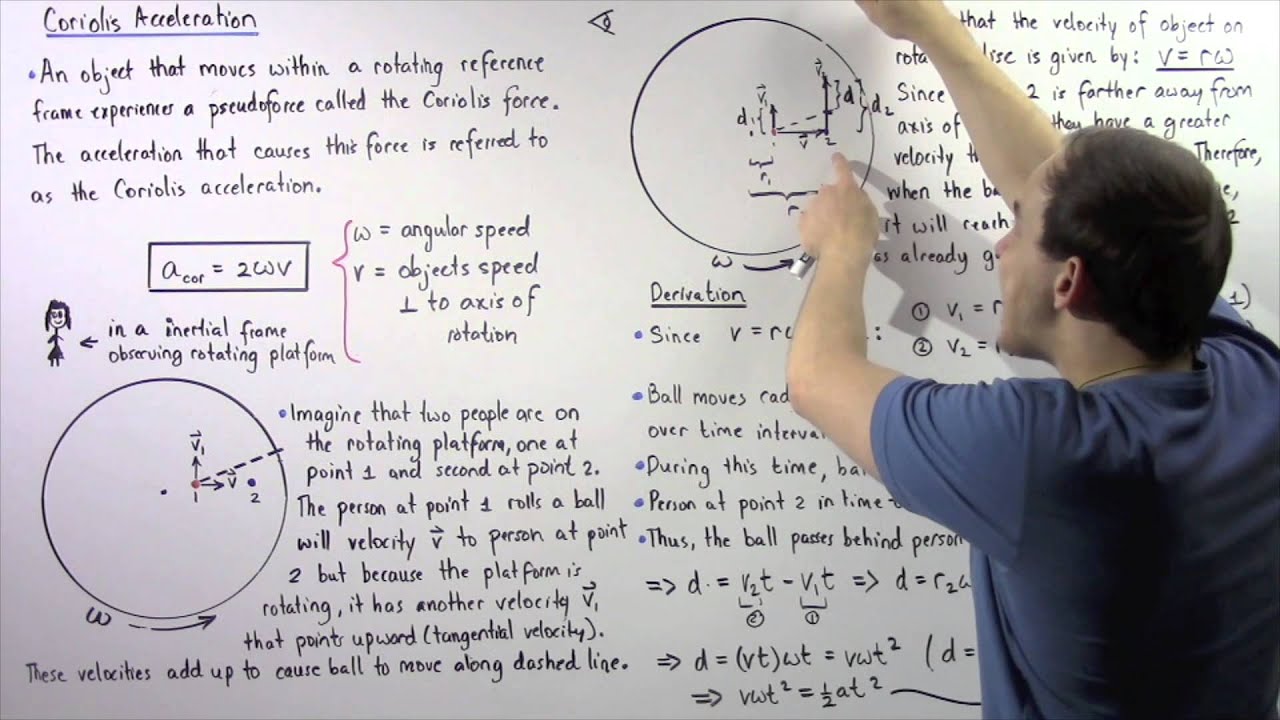
Derivation of Coriolis Acceleration
Keywords
Summary
109 words
Critical Evaluation
Value of the Information & Strength of the Argument
The video provides a valuable pedagogical derivation of the Coriolis acceleration, breaking down the problem into manageable steps. The argumentation is logical and coherent, using geometric and kinematic reasoning to arrive at the formula. The instructor carefully explains each variable and equation, making the derivation easy to follow. However, the video does not discuss the physical implications or applications of the Coriolis effect, which limits its depth. The argumentation is solid for a tutorial, but it lacks critical analysis or alternative perspectives.
Scientific Rigor, Source Quality, Title Accuracy
The video is scientifically rigorous in its derivation, with no apparent errors in the mathematics. However, it does not cite any external sources or references, relying solely on the instructor’s explanation. The title accurately describes the content, which is a focused derivation. The video’s pedagogical approach is clear, but the lack of citations reduces its scholarly value. The description provides links to the instructor’s website and donation page, but no additional references are given.
171 words
Title / Content Match
The title accurately reflects the content, which is a step-by-step derivation of the Coriolis acceleration formula.
Quality & Reliability
7/10
The derivation is mathematically sound and clearly explained, but the video lacks citations to external sources and does not discuss limitations or alternative derivations.
Key Moments
Markers derived by PSI from the transcript: the creator did not define chapters.
- Introduction to Coriolis force and acceleration, stating the formula to be derived.
- Setting up diagram 1: rotating platform with two people and a ball rolling radially outward.
- Explaining the inertial observer's view: ball has tangential velocity due to rotation.
- Setting up diagram 2: comparing tangential velocities of ball and person 2.
- Deriving equations for velocities V1 and V2 using V = Rω.
- Calculating displacement difference D and relating it to acceleration form.
- Final step: equating D to 1/2 a t^2 and solving for a = 2ωv.
Cited Sources
- AK Lectures - Derivation of Coriolis Acceleration — The video is hosted on this lecture page, which may contain additional notes or references.
- AK Lectures Website — General website of the instructor, providing access to other lectures.
Concurring Sources
- Coriolis force - Wikipedia — Confirms the formula and physical explanation.
External References
Contribution & Novelties
The video offers a clear, self-contained derivation of the Coriolis acceleration, making it accessible to students. It does not introduce new scientific concepts but serves as an educational tool. The step-by-step approach is its main strength.
Pour aller plus loin :
- Coriolis force - Wikipedia — Provides broader context and applications.
- Fictitious force - Wikipedia — Explains the concept of pseudo-forces in non-inertial frames.
- Rotating reference frame - Wikipedia — Discusses the physics of rotating frames.
76 words
Radar Profile
The radar profile shows high scores in quality of information and technical level, with moderate scores in quantity and reliability. This indicates a focused, accurate tutorial but with limited breadth and external validation.