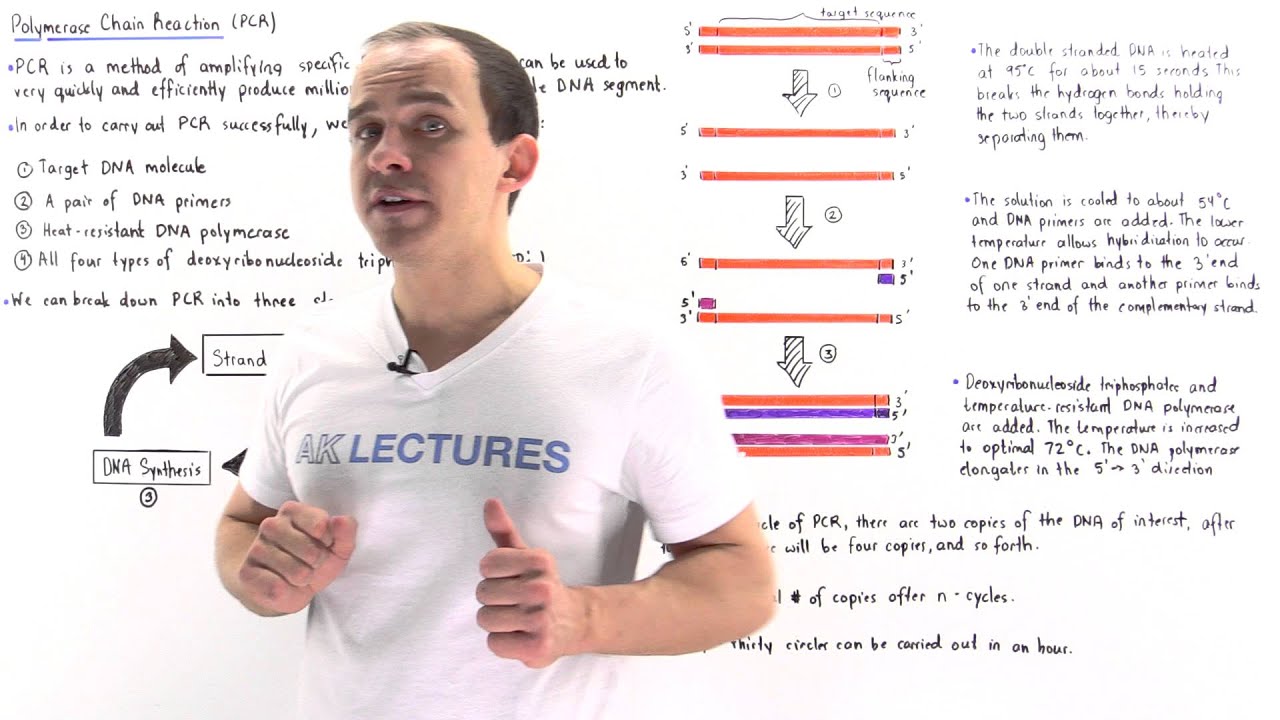
Polymerase Chain Reaction (PCR)
Keywords
Summary
146 words
Critical Evaluation
Value of the Information & Strength of the Argument
The video delivers high educational value by clearly explaining a fundamental molecular biology technique. The argumentation is solid, systematically building from the components to the step-by-step mechanism, and using diagrams to enhance understanding. The explanation of why heat-resistant polymerase is necessary and the directionality of DNA synthesis (5’ to 3’) adds depth. The comparison with bacterial amplification effectively justifies PCR’s advantages. The logical flow and repetition of key concepts reinforce learning.
Scientific Rigor, Source Quality, Title Accuracy
The scientific rigor is good; the content is accurate and aligns with standard textbook knowledge. However, the video does not cite specific scientific sources or references, relying on the instructor’s expertise. The title accurately reflects the content. The description provides links to the lecturer’s website and donation page, but no direct references to scientific literature. The video is a didactic explanation rather than a research presentation, so the lack of citations is acceptable for its purpose.
162 words
Title / Content Match
The title accurately reflects the content, which is a comprehensive introduction to PCR.
Quality & Reliability
8/10
The video provides a clear, accurate, and well-structured explanation of PCR, covering the principle, components, steps, and exponential amplification. The scientific content is correct and aligns with standard molecular biology knowledge. However, it lacks citations to primary sources and does not discuss limitations or variations of the technique, which slightly reduces the score.
Key Moments
Markers derived by PSI from the transcript: the creator did not define chapters.
- Introduction to PCR and comparison with bacterial amplification
- Explanation of the four ingredients needed for PCR
- Overview of the three steps in a PCR cycle
- Step 1: DNA strand separation at 95°C
- Step 2: Annealing of DNA primers at 54°C
- Step 3: DNA synthesis at 72°C
- Exponential amplification and formula 2^n
- Advantages of PCR and conclusion
Cited Sources
- AK Lectures - Polymerase Chain Reaction (PCR) — Video lecture page on the instructor's website
- AK Lectures — General website for the lecture series
- Donate to AK Lectures — Donation page for supporting the channel
Concurring Sources
- Polymerase chain reaction - Wikipedia — General reference for PCR, consistent with the video's explanation.
- PCR - Khan Academy — Educational resource that aligns with the video's content.
Contribution & Novelties
The video provides a clear and accessible explanation of PCR, making it valuable for students and learners. It effectively breaks down the process into digestible steps and highlights key concepts such as the role of primers and the exponential amplification. While it does not introduce new scientific findings, it serves as an excellent educational resource.
Pour aller plus loin :
- Polymerase chain reaction - Wikipedia — Comprehensive overview of PCR, including history, variations, and applications.
- PCR in Molecular Biology - NCBI — Detailed technical description of PCR from the National Center for Biotechnology Information.
- Taq polymerase - Wikipedia — Information on the heat-resistant DNA polymerase commonly used in PCR.
109 words
Radar Profile
The radar profile shows high scores in quantity and quality of information, with a moderate technical level. This indicates a well-balanced educational video that is informative and accurate, but not overly advanced. The fiabilite_globale score is also high, reflecting the reliability of the content.
💬 Très positif. Sur les 30 commentaires analysés, tous expriment une gratitude et une admiration extrêmes pour la clarté et l'efficacité de l'enseignement, avec de nombreux témoignages d'étudiants et de professionnels qui ont réussi grâce à ces vidéos.