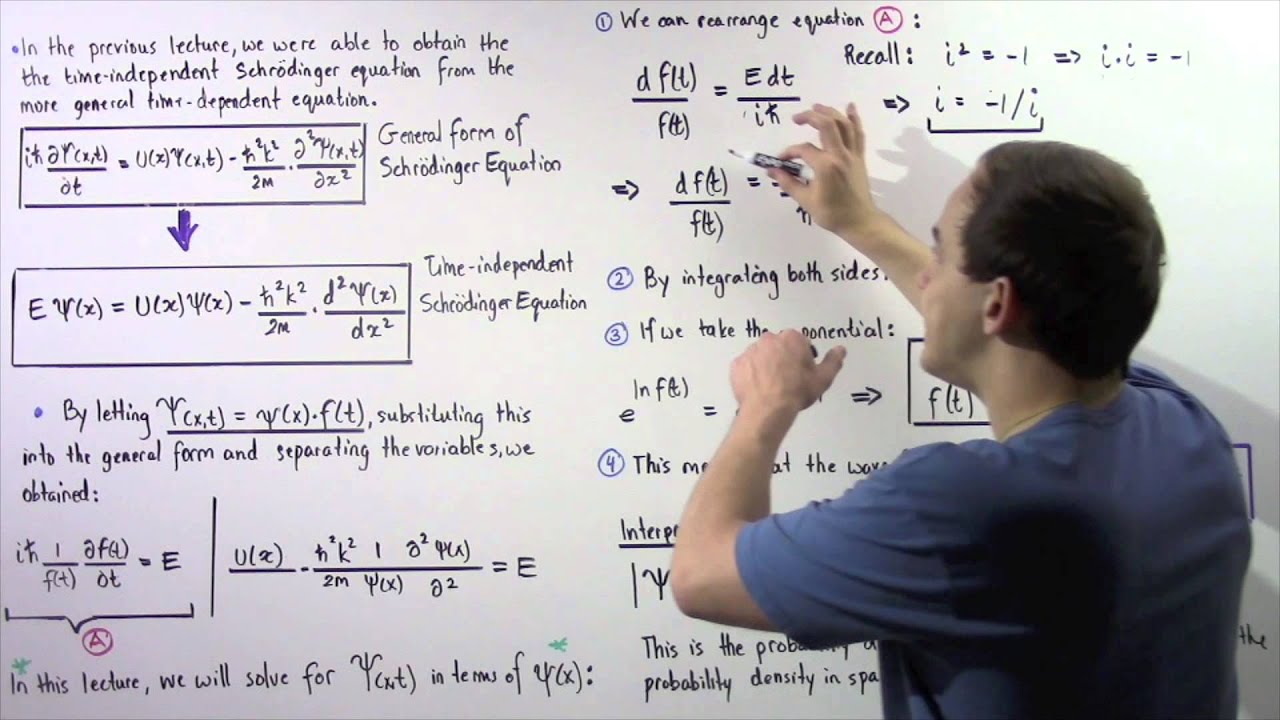
Probability Density in Quantum Mechanics
Keywords
Summary
149 words
Critical Evaluation
Value of the Information & Strength of the Argument
The video provides a solid, step-by-step derivation of the time-dependent wave function and its connection to probability density. The argumentation is logical and builds on previous material, making it accessible for learners. The explanation of why the wave function is not measurable and why the probability density is, is particularly clear. However, the video does not discuss the physical implications beyond the time-independence, nor does it address the normalization condition or the probabilistic interpretation in more depth. The value lies in its pedagogical clarity, but it lacks broader context or applications.
Scientific Rigor, Source Quality, Title Accuracy
The scientific rigor is adequate for an introductory tutorial: the mathematics are correct and the steps are justified. However, no external sources are cited, and the video relies solely on the instructor’s explanation. The title accurately reflects the content, and the description provides links to the instructor’s website for further resources. The video does not engage with primary literature or experimental evidence, which limits its depth but is acceptable for an educational video.
179 words
Title / Content Match
The title accurately reflects the content, which focuses on deriving and interpreting probability density in quantum mechanics.
Quality & Reliability
7/10
The video provides a clear, step-by-step derivation of the time-dependent wave function and its relation to probability density, based on the Schrödinger equation. The mathematical steps are correct and well-explained, but the presentation lacks citations to external sources and does not discuss experimental verification or alternative interpretations.
Key Moments
Markers derived by PSI from the transcript: the creator did not define chapters.
- Review of previous lecture: time-dependent vs time-independent Schrödinger equation
- Focus on equation (a) and goal to solve for total wave function
- Step 1: Rearranging equation (a) and integrating to find f(t)
- Step 3: Taking exponential to solve for f(t)
- Combining results to express total wave function
- Interpretation: wave function not measurable due to imaginary unit
- Probability density is time-independent; example with 20% probability
Cited Sources
- AK Lectures - Probability Density of Particles — Lecture page on the instructor's website
- AK Lectures — General website for video lectures
- Donate page — Support page for the channel
Concurring Sources
- Born rule — The probability interpretation of the wave function, consistent with the video's explanation.
- Schrödinger equation — The equation from which the probability density is derived.
Contribution & Novelties
The video provides a clear, step-by-step derivation of the time-dependent wave function and its relation to probability density, which is a fundamental concept in quantum mechanics. It emphasizes the physical interpretation of the wave function and why the probability density is time-independent for stationary states. The novelty lies in its pedagogical approach, making the derivation accessible to students.
Pour aller plus loin :
- Born rule — The probability interpretation of the wave function, directly related to the concept discussed.
- Schrödinger equation — The fundamental equation underlying the derivation.
- Stationary state — The concept that probability density is time-independent for stationary states.
101 words
Radar Profile
The radar profile shows balanced scores across all dimensions, with slightly higher quality of information and technical level, indicating a solid educational video that is reliable and informative, though not groundbreaking.