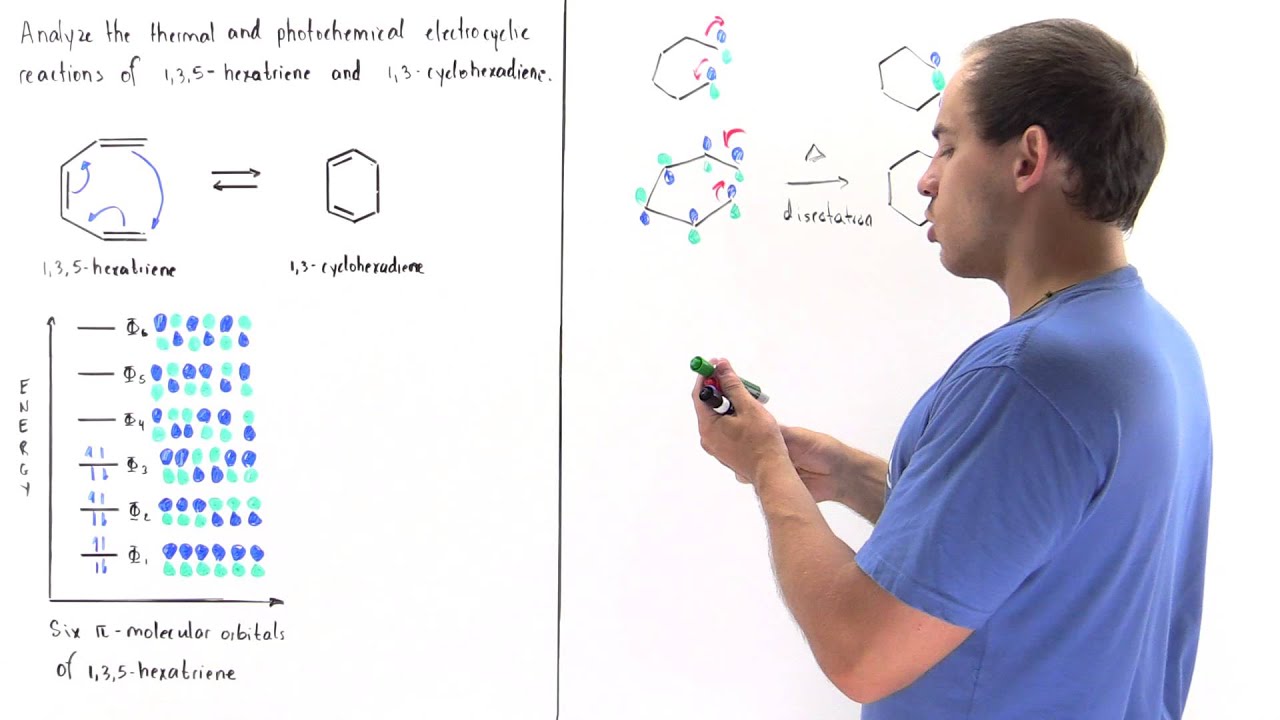
Electrocyclic Reaction of 1,3,5 Hexatriene
Keywords
Summary
175 words
Critical Evaluation
Value of the Information & Strength of the Argument
The video provides a clear and systematic explanation of electrocyclic reactions, using frontier molecular orbital theory to predict stereochemical outcomes. The argumentation is logical and well-structured, building from the molecular orbital diagram to the rotation modes and their consequences. The use of orbital phase diagrams effectively illustrates why certain rotations lead to bonding or antibonding interactions. The video correctly applies the Woodward-Hoffmann rules for a 4n+2 system (n=1 for hexatriene), showing that thermal reactions are disrotatory and photochemical reactions are conrotatory. The explanation is accessible and avoids unnecessary complexity, making it a valuable educational resource. However, it does not discuss alternative methods or exceptions, and the lack of citations to primary literature limits its depth for advanced learners.
Scientific Rigor, Source Quality, Title Accuracy
The video is scientifically rigorous in its application of molecular orbital theory and the Woodward-Hoffmann rules. The explanation is accurate and consistent with standard organic chemistry textbooks. However, the video does not cite any external sources or references, relying solely on the instructor’s presentation. The title accurately reflects the content, which is specifically about the electrocyclic reaction of 1,3,5-hexatriene. The video is a tutorial, so it does not present original research but rather explains established concepts. The lack of citations is a minor weakness, but the content itself is reliable. No comments were provided for analysis.
229 words
Title / Content Match
The title accurately reflects the content, which focuses specifically on the electrocyclic reaction of 1,3,5-hexatriene.
Quality & Reliability
7/10
The video provides a clear, step-by-step explanation of electrocyclic reactions, correctly applying frontier molecular orbital theory (HOMO/LUMO) to predict thermal and photochemical outcomes. The content is chemically accurate, though it lacks citations to primary literature and does not address exceptions or advanced nuances.
Key Moments
Markers derived by PSI from the transcript: the creator did not define chapters.
- Introduction to electrocyclic reactions and the example of 1,3,5-hexatriene to 1,3-cyclohexadiene.
- Construction of the π molecular orbitals of hexatriene and identification of the HOMO for the thermal reaction (π3).
- Analysis of the thermal electrocyclic reaction: disrotatory rotation leads to bonding, conrotation leads to antibonding.
- Demonstration of the conrotatory mode for the thermal reaction, showing antibonding interaction and no bond formation.
- Transition to the photochemical reaction: excitation promotes an electron to π4, making it the new HOMO.
- Analysis of the photochemical electrocyclic reaction: disrotation leads to antibonding, conrotation leads to bonding.
- Summary of the selection rules: thermal reactions are disrotatory, photochemical reactions are conrotatory for 4n+2 systems.
Cited Sources
- AK Lectures - Electrocyclic Reaction of 1,3,5-Hexatriene — The video's dedicated lecture page on the AK Lectures website.
- AK Lectures - Donate — Donation page for the AK Lectures platform.
- AK Lectures - Main Website — Main website of the AK Lectures channel.
Concurring Sources
- Woodward-Hoffmann rules — The rules that predict the stereochemistry of electrocyclic reactions based on the number of π electrons and thermal/photochemical conditions.
Contribution & Novelties
The video provides a clear pedagogical explanation of electrocyclic reactions, specifically for 1,3,5-hexatriene, using frontier molecular orbital theory. It effectively demonstrates how the symmetry of the HOMO dictates the stereochemical outcome under thermal and photochemical conditions. The visual representation of orbital rotations helps solidify the concepts. While not novel in content, it serves as a valuable educational resource for students learning pericyclic reactions.
Pour aller plus loin :
- Woodward-Hoffmann rules — The fundamental rules governing pericyclic reactions, including electrocyclic reactions.
- Pericyclic reaction — Overview of pericyclic reactions, including electrocyclic, cycloaddition, and sigmatropic reactions.
- Molecular orbital theory — The theoretical framework used to analyze orbital interactions in chemical reactions.
108 words
Radar Profile
The radar profile shows high scores in information quality and technical level, indicating a well-explained and accurate tutorial. The quantity of information is moderate, and the global reliability is solid, though the lack of citations slightly reduces the score. The overall profile suggests a reliable educational resource for organic chemistry students.