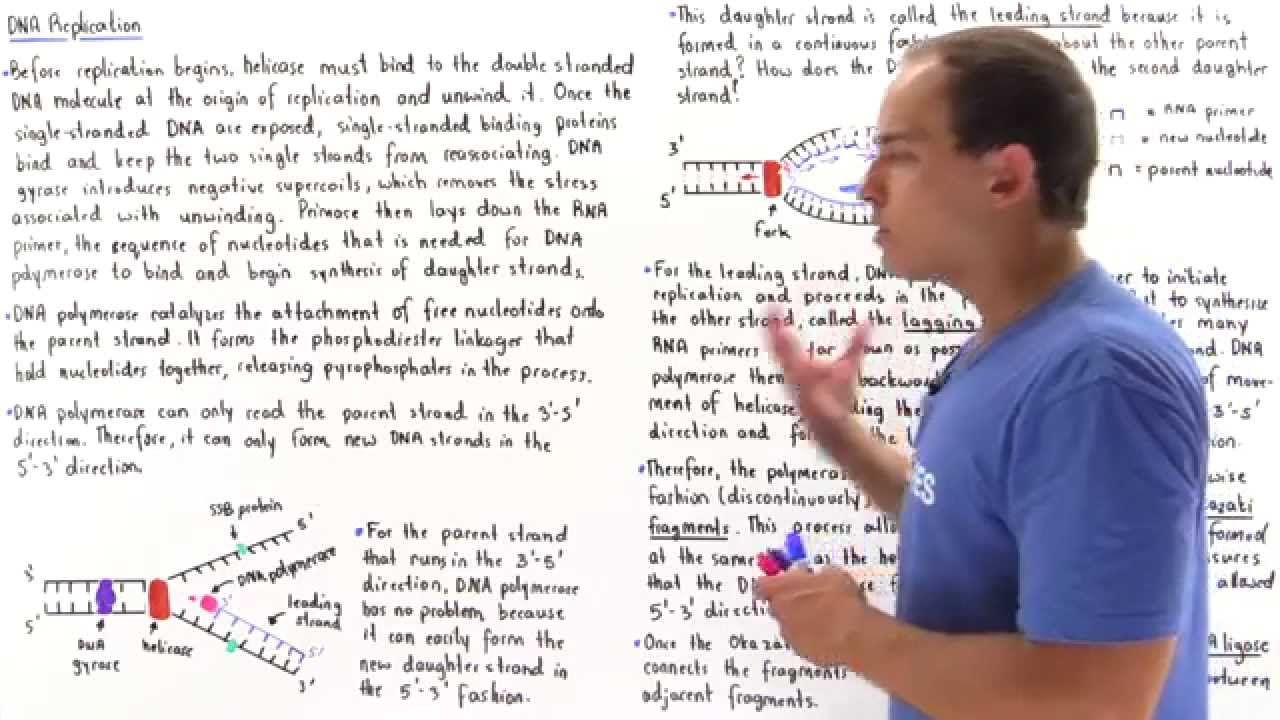
DNA Replication: Leading and Lagging Strand
Keywords
Summary
152 words
Critical Evaluation
Value of the Information & Strength of the Argument
The video provides a solid, accurate explanation of DNA replication, emphasizing the mechanistic details of leading and lagging strand synthesis. The argumentation is logical and well-structured, building from the initial unwinding to the final ligation. The use of diagrams enhances understanding, and the explanation of why the lagging strand is synthesized discontinuously is particularly clear. The video does not present new research but effectively synthesizes established knowledge, making it valuable for educational purposes.
Scientific Rigor, Source Quality, Title Accuracy
The video is scientifically accurate and aligns with standard molecular biology textbooks. However, it does not cite specific sources or references, relying on general knowledge. The title accurately reflects the content. The description provides links to the lecturer’s website, which may contain additional resources, but no direct citations to primary literature are given. The video is suitable for an introductory audience, but lacks depth for advanced learners.
155 words
Title / Content Match
The title accurately reflects the content, which focuses on the synthesis of leading and lagging strands during DNA replication.
Quality & Reliability
8/10
The video provides a clear, accurate explanation of DNA replication mechanisms, consistent with established molecular biology. The content is well-structured and pedagogically effective, though it lacks citations to primary literature and does not address recent advances or nuances.
Key Moments
Markers derived by PSI from the transcript: the creator did not define chapters.
- Introduction to DNA replication and overview of helicase unwinding
- Explanation of single-stranded binding proteins and DNA gyrase
- Role of primase and RNA primers
- DNA polymerase synthesizes in 5' to 3' direction
- Leading strand synthesis is continuous
- Lagging strand synthesis and Okazaki fragments
- DNA ligase connects Okazaki fragments
Cited Sources
- AK Lectures Website — General resource for lecture videos and supplementary materials.
- Donation Page — Support page for the channel.
- Lecture Page — Specific lecture page for this video.
Concurring Sources
- DNA replication (Wikipedia) — General reference confirming the mechanisms described.
- Molecular Biology of the Cell (NCBI Bookshelf) — Authoritative textbook chapter on DNA replication.
Contribution & Novelties
The video provides a clear and accessible explanation of DNA replication, particularly the distinction between leading and lagging strand synthesis. It effectively uses diagrams to illustrate the process, making it easier for students to grasp the concept. The explanation of why the lagging strand is synthesized discontinuously is particularly well done.
Pour aller plus loin :
- DNA replication — General overview of DNA replication.
- Okazaki fragments — Detailed information on Okazaki fragments.
- DNA polymerase — Overview of DNA polymerase enzymes.
80 words
Radar Profile
The radar profile shows high scores in information quantity, quality, and reliability, with a slightly lower technical level, indicating a well-balanced educational video that is both informative and accessible.
💬 Très positif. Sur les 30 commentaires analysés, tous expriment une gratitude et une appréciation pour la clarté des explications, certains mentionnant que la vidéo a remplacé efficacement leurs cours.