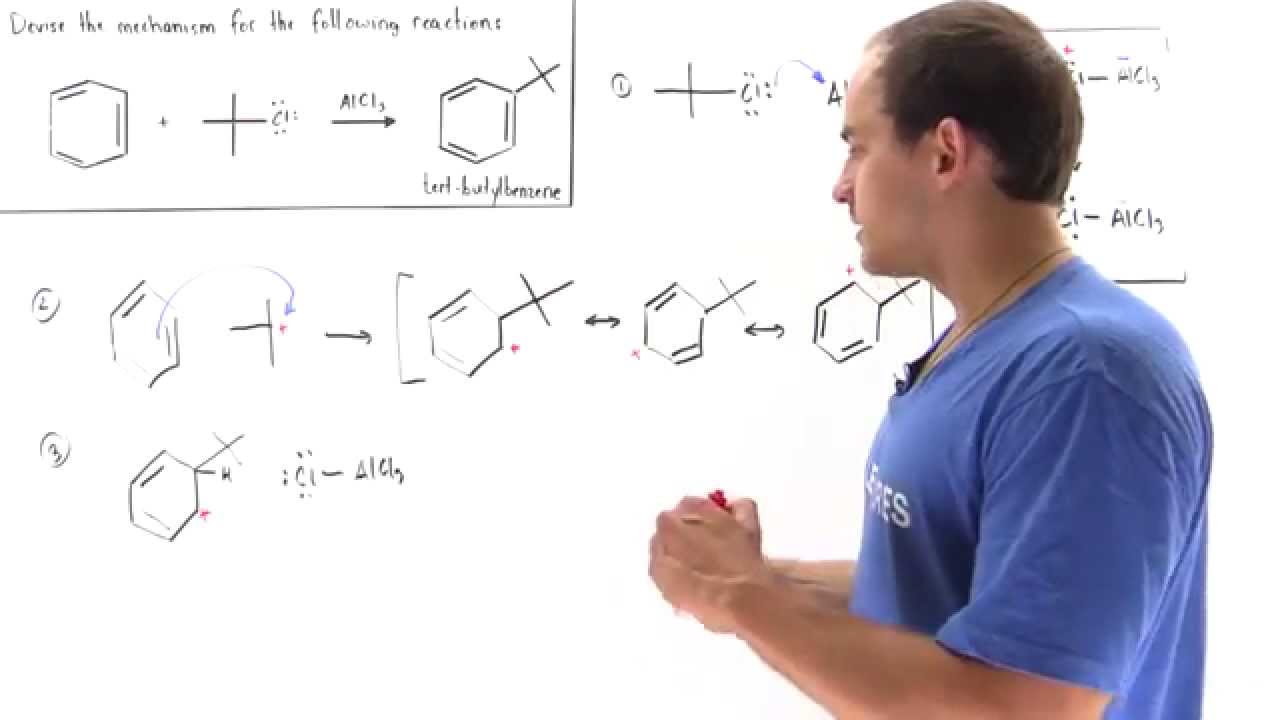
Friedel-Crafts Alkylation Example
Keywords
Summary
125 words
Critical Evaluation
Value of the Information & Strength of the Argument
The video provides a clear and logical explanation of the Friedel-Crafts alkylation mechanism, breaking it down into three distinct steps. The argumentation is solid, as it correctly identifies the formation of a resonance-stabilized carbocation and explains why the reaction proceeds through an SN1-like pathway due to steric hindrance. The reasoning is consistent with standard organic chemistry principles, and the step-by-step approach helps viewers understand the electron flow and the role of the catalyst. However, the video does not discuss potential side reactions or limitations of the Friedel-Crafts alkylation, such as polyalkylation or rearrangements, which would have enhanced its value.
Scientific Rigor, Source Quality, Title Accuracy
The video is scientifically accurate and aligns with established organic chemistry knowledge. However, it does not cite any external sources or references, which limits its scholarly rigor. The title accurately reflects the content, as it is indeed an example of the Friedel-Crafts alkylation. The video is a tutorial, and its pedagogical approach is effective, but the lack of citations and discussion of limitations prevents it from being a comprehensive resource.
184 words
Title / Content Match
The title accurately reflects the content, which is a worked example of the Friedel-Crafts alkylation mechanism.
Quality & Reliability
7/10
The video provides a clear, step-by-step mechanistic explanation of the Friedel-Crafts alkylation reaction, consistent with standard organic chemistry knowledge. The reasoning is sound, but it lacks citations to primary literature and does not address limitations or side reactions.
Key Moments
Markers derived by PSI from the transcript: the creator did not define chapters.
- Introduction to the example: benzene reacts with tert-butyl chloride in presence of AlCl3 to form tert-butylbenzene.
- Step 1: Formation of the electrophile via coordination of tert-butyl chloride with AlCl3, leading to a resonance-stabilized carbocation.
- Explanation of why the benzene attacks the open carbocation rather than the complexed intermediate due to steric hindrance.
- Step 2: Electrophilic attack of benzene on the carbocation, forming a resonance-stabilized arenium ion.
- Step 3: Deprotonation to restore aromaticity and regenerate the AlCl3 catalyst, yielding tert-butylbenzene and HCl.
- Summary of the three mechanistic steps and conclusion.
Cited Sources
- AK Lectures - Friedel-Crafts Alkylation Example — The video is hosted on AK Lectures, and this link provides the lecture page.
- AK Lectures - Main Website — The main website of the channel, providing additional educational content.
Concurring Sources
- Organic Chemistry by Clayden et al. — Standard textbook that covers Friedel-Crafts alkylation mechanism in detail, consistent with the video's explanation.
External References
Contribution & Novelties
The video offers a clear, step-by-step mechanistic explanation of the Friedel-Crafts alkylation, which is a standard topic in organic chemistry. Its originality lies in the detailed reasoning for why the reaction proceeds via the open carbocation rather than an SN2 pathway, which is often glossed over in textbooks. This pedagogical approach helps students understand the importance of steric effects and resonance stabilization.
Pour aller plus loin :
- Friedel-Crafts alkylation - Wikipedia — Provides an overview of the reaction, including its mechanism and limitations.
- Carbocation - Wikipedia — Explains the stability and structure of carbocations, relevant to the intermediate in this reaction.
- Electrophilic aromatic substitution - Wikipedia — Details the general mechanism of which Friedel-Crafts alkylation is a specific case.
119 words
Radar Profile
The radar profile shows a balanced performance across all dimensions, with high scores in quality and reliability, but slightly lower in quantity and technical depth. This indicates a focused tutorial that is accurate and well-explained, though it may not cover all aspects of the topic.